Pages

Showing posts with label Film. Show all posts

Thursday, 14 September 2023

The Scapegoat of Sin City REMEMBERING ROSCOE 'FATTY' ARBUCKLE


ROSCOE 'FATTY' ARBUCKLE 
24 March 1887 – 29 June 1933


Hollywood has always been a fertile breeding ground for scandal.  This was as true at the birth of the motion picture industry in the first decade of the twentieth century as it is today where scandal has become a cunningly exploited marketing tool thanks to social media and the public's envy-driven need to pass judgement on those it elevates to the status of celebrities.  Then as now, the scandals that received the most attention were those involving sex, either of the truly aberrant or only mildly sordid variety.  Add the word 'rape' to the mix and you had a story guaranteed to sell fifteen million newspapers.
 
That was certainly the case with what came to be known as 'the Arbuckle scandal.'  In September 1921 a rotund, baby-faced movie comedian named Roscoe 'Fatty' Arbuckle — one of Hollywood's most popular and highest paid performers at that time — was accused of raping and murdering a thirty year old actress named Virginia Rappe, someone he had known professionally for six years without ever having made anything that could be remotely described as a pass at her, in a San Francisco hotel room where they were attending a raucous weekend party.  
 
The fact that Arbuckle was completely exonerated of all the charges filed against him –– he was tried for his alleged crime three times, with the jury who served at his final trial taking all of six minutes to acquit him — made no difference to the public's media-driven perception of him as an obese, lust-crazed sex fiend.  In their minds he was morally if not technically guilty of violating Ms Rappe and ending her life no matter what verdict had been delivered by the jury.  Nor was he in any way supported by the industry he had been instrumental in helping to create as a member of Mack Sennett's knockabout Keystone Company.  The studio heads, including his then boss Adolph Zukor of Paramount Pictures, were only interested in appeasing the opinion-leading women's clubs and religious organizations that were seeking to ban the production of motion pictures in the United States in the same way the prohibition movement had recently fought a successful campaign to make it illegal to manufacture, sell or consume alcohol anywhere within the country.  Arbuckle — a lowly comedian rather than a 'respectable' dramatic actor — made the perfect scapegoat to sacrifice to the self-righteous defenders of 'traditional American values.' 
 
It's tempting to speculate what might have become of Arbuckle — a gifted physical comedian with a fine singing voice (he could have been the second best operatic tenor in the world according to Enrico Caruso had he been willing to abandon the silly business of picture making to devote himself exclusively to music) who excelled at impersonating women — had he accepted the invitation of his friend and colleague Buster Keaton to go fishing with him that Labor Day weekend instead of traveling to San Francisco's St Francis Hotel with fellow actors/directors Lowell Sherman and Fred Fishback to co-host a three day 'open house' party at which ample quantities of bootleg liquor would be consumed.  Arbuckle was that rarest of creatures in showbusiness — a major star who was, by all accounts, completely devoid of ego.  He was directly responsible for introducing Buster Keaton to the screen, having invited the talented young vaudeville performer to visit him on the set of a 1917 short titled The Butcher Boy he was then in the process of shooting.  Keaton made his cinematic debut in this film and went on to co-star with the man he affectionately referred to as his mentor in thirteen more shorts before inheriting Arbuckle's Comique company, following his friend's sudden fall from grace, along with its producer Joseph Schenck.  Keaton immediately signed over 35% of the company's profits to Arbuckle to ensure his friend had some sort of income on which to live and pay his legal costs.  He then went out and made the short film Cops, a nightmarish 'comedy' in which he's relentlessly pursued through the streets of Los Angeles by dozens of baton-wielding police officers.   


© 1919 Paramount Pictures


Keaton was not the only fellow performer Arbuckle helped during the course of his prematurely curtailed career.  He was already an established star, working with Keystone's leading lady Mabel Normand, when a British-born music hall comedian named Charlie Chaplin joined the company in early 1914, subsequently helping the newcomer find his feet in what was still a brand new industry.  Arbuckle also gave a boost to another young Englishman named Bob Hope, helping the dancing duo Hope was originally a member of to find steady work in a revue titled Hurley's Jolly Follies.  Roscoe Arbuckle was described by everyone who knew him — including his former co-star and soon-to-be ex-wife Minta Durfee who publicly stood by him throughout his ordeal — as an exceedingly nice man who wouldn't hurt a fly.  He also disliked the nickname 'Fatty' and would politely tell fans who approached him for his autograph that he had another name if they cared to use it.
 
None of this mattered when he was arrested on 17 September 1921 as the result of a statement made to the police by Virginia Rappe's friend and fellow party guest Bambina Maude Delmont.  Ms Delmont, a 'dress model' who it was eventually revealed had only known Ms Rappe for a matter of days prior to her death, accompanied her to the Labor Day gathering hosted by Arbuckle and his friends Mr Sherman and Mr Fishback along with Ms Rappe's agent Al Semnacher.
 
The details of exactly what happened on the afternoon of 5 September have been the subject of much lurid conjecture in the hundred years since the alleged crime occurred.  What is known is that Arbuckle went to his suite around 2pm to freshen up and change his clothes, only to find Ms Rappe either lying on its floor and physically blocking its door or vomiting into the toilet bowl inside its bathroom (sources disagree).  After giving the distressed woman the drink of water she had asked him for, Arbuckle then carried her to the nearest bed and went to seek help from his fellow revelers, returning with them — one of whom may (or may not) have been the prosecution's future star witness Bambina Maude Delmont — to find that Ms Rappe had fallen off the bed and was spread out on the floor with her dress partially torn off, experiencing violent convulsions that were causing her to moan and clutch frantically at her abdomen.  The concerned observers placed Ms Rappe in a bath of cool water and, when she appeared to be a little calmer, moved her to a different room where they hoped she would sleep off what were presumed, by them and the hotel physician who was called in to examine her, to be the after effects of having consumed too much poor quality bootleg liquor. 
 
The next morning Arbuckle returned to Hollywood in the company of Mr Sherman and Mr Fishback.  In the meantime, Ms Delmont had taken her own room at the St Francis Hotel with the intention of sobering up after hitting the bottle rather heavily herself.  The following day, Wednesday 7th September, she apparently went to check on Ms Rappe who was still in bed and, by this time, extremely unwell.  After possibly calling in an outside physician named Rumwell to examine her (his attendance has never been confirmed), Ms Delmont arranged to have her 'friend' taken to hospital where she was diagnosed as suffering from systemic alcohol poisoning.  Ms Rappe died on Friday 9 September, with an autopsy citing the cause of death as secondary peritonitis caused by what a second post-mortem examination of her body revealed to be a ruptured bladder.


VIRGINIA RAPPE
c 1920


Arbuckle, Sherman and Fishback returned to San Francisco on Saturday 10 September to provide statements to the police.  While they were doing this, Ms Delmont remained safely ensconced inside her hotel room, supposedly near to a state of collapse as she described to a police stenographer how Arbuckle had dragged Ms Rappe to his suite and sexually violated her while she had stood outside shouting in protest and trying in vain to kick down the room's internally locked door.  
 
Ms Delmont, who later embarked on a successful public speaking tour of the United States in which she lectured on the wickedness running rampant in sin-and-gin soaked Hollywood, neglected to mention that Ms Rappe had long been a sufferer of cystitis, a form of urinary tract infection aggravated by the consumption of alcohol.  (There was also a suggestion that Ms Rappe may have undergone or was seeking an abortion before attending the party, though this was never conclusively proven despite the fact that she'd undergone up to five abortions since the age of sixteen, had given birth to one child out of wedlock in 1917 and had a history of promiscuity and mental instability.)  Nor did Ms Delmont mention that no other guest attending the party at the time the alleged rape and murder took place — a group that included Ms Rappe's agent Al Semnacher who subsequently testified in court that Arbuckle had performed sexual acts on his deceased client with either a piece of ice or a Coca-Cola bottle — had been aware of what was happening to her or, even more shockingly, had made any effort to stop it.  
 
Ms Delmont's testimony, which varied each time it was repeated and was subsequently revealed to have been made for the purpose of extorting money from the accused before his case went to trial, became the cornerstone of the prosecution argument presented to the court by District Attorney Matthew Brady, supported by testimony provided by another female party guest identified as Zey Prevon (or Sarah Reiss, sources again disagree) that was supposedly even more shocking than that offered to the jury by Ms Rappe's so-called 'friend.'  Zey Prevon/Sarah Reiss would go on to publicly state during Arbuckle's second trial in January 1922 that she had been bullied into providing false evidence by Brady who had threatened to charge her with perjury if she refused to cooperate.  (Her true identity remains a mystery to this day.)  
 
Neither Brady nor the police bothered to inform the court that Bambina Maude Delmont had a criminal record following her own convictions for extortion, prostitution and blackmail or that she was scheduled to appear before a circuit court judge on 18 December 1921 to defend herself against a new charge of bigamy.  Instead, Arbuckle was arrested on 17 September and charged with Ms Rappe's murder, with Brady — a highly ambitious individual who had his sights set on becoming the next Governor of California — vowing to seek the death penalty while local coroner Harry Kelly began to be hounded by The Federation of Women's Clubs and religious groups like the Lord's Day Alliance to provide evidence that would guarantee the comedian's conviction before the homicide charge against him was reduced to the slightly less serious charge of manslaughter.
 
Already facing harsh criticism from these self-appointed moral watchdogs and eager to avoid any further damage to its increasingly tarnished reputation, the motion picture industry wasted no time banning Arbuckle's films from the nation's cinema screens.  The ban remained in force throughout his first two trials — the second of which revealed details of Ms Rappe's history of promiscuity and heavy drinking and saw the prosecution rely heavily on the testimony of a former studio guard named Jesse Norgard, an ex-convict who had recently been charged with the sexual assault of a minor — and was not rescinded after his third trial in March 1922 despite the jury's insistence that he was in no way responsible for Ms Rappe's death.  
 
'Acquittal is not enough for Roscoe Arbuckle,' the jurors' unanimously signed statement to the court began.  'We feel that a great injustice has been done him.  We feel also that it was only our plain duty to give him this exoneration, under the evidence, for there was not the slightest proof adduced to connect him in any way with the commission of a crime.  He was manly throughout the case and told a straightforward story on the witness stand, which we all believed.  The happening at the hotel was an unfortunate affair for which Arbuckle, so the evidence shows, was in no way responsible.  We wish him success and hope that the American people will take the judgment of fourteen men and woman [sic] who have sat listening for thirty-one days to evidence, that Roscoe Arbuckle is entirely innocent and free from all blame.' 
 
But the editors and the nation's self-appointed guardians of decency had done their work too well.  By the time of Arbuckle's acquittal his case had become a salacious daily headline story in virtually every US newspaper, with media mogul William Randolph Hearst reportedly boasting to an acquaintance that the scandal had sold more copies of his New York Evening Journal than the 1915 sinking of the unarmed passenger liner Lusitania by a prowling German u-boat.  Nor did Arbuckle get off scot-free after being cleared of the charges brought against him.  He was fined $500 because alcohol had been available at the party and consumed there by his guests, violating the federal Prohibition laws which had been in place since February 1919.  This sum was a drop in the ocean, however, compared with his unpaid legal bills.  By March 1922 Arbuckle owed his trial attorney Gavin McNab something in excess of $700,000 (equivalent to approximately $14 million today).  As this was more than half of the $1 million per year (equivalent to approximately $20 million today) salary he'd been earning under his recently terminated contract with Paramount Pictures he was obliged to sell his home and beloved automobiles in order to clear the debt.


© 1932 Vitaphone/Warner Bros Pictures


Worse was to follow.  On 18 April Arbuckle was banned by Will Hays, President of the newly formed Motion Pictures Producers and Distributors of America organization, from ever appearing in another film made in the United States.  Although Hays lifted the ban in December, the gesture came too late to save the comedian's screen career.  Exonerated or not, US distributors remained reluctant to book Arbuckle films for their theaters, with this and the ban imposed by what was now known as the Hays Office eventually forcing the comedian to seek work as a director under the pseudonym William Goodrich.  (Buster Keaton suggested that he use the name 'Will B Goode' to send an ironic message to those who had so casually sabotaged his career.) 
 
Although Arbuckle did direct a number of films under this pseudonym between 1924 and 1932, he did not appear again on screen until he was offered the starring role in a 1931 Vitaphone short titled The Back Page.  This was the first of six sound shorts he was contracted to make for Warner Bros, all of which proved successful enough with audiences (children were particularly fond of them) for the company to offer him the leading role in a feature scheduled to begin production in mid-1933.  Thrilled to be working again and recently married for the third time, Arbuckle went out with friends to celebrate his newfound success on the evening of 29 June 1933, only to die in his sleep of a cardiac arrest later that night at the age of forty-six.  What had been a massive misunderstanding or, as some have suggested, a publicity stunt engineered by Matthew Brady and his supporters to boost his pre-election profile by drawing attention to the unchecked immorality of the movie community, had cost him not only his career and home but quite probably his life.  (Brady was ultimately unsuccessful in his bid to become Governor but remained District Attorney until 1943.) 
 
The same was true of Virginia Rappe, a damaged and troubled young woman whose agonizing death might have been prevented had the men charged with examining and caring for her not been so quick to dismiss her condition as a simple case of intoxication.  She was as much the victim of Hollywood's form of self-serving hypocrisy as Roscoe Arbuckle proved to be.  Unlike the comedian, she's hardly remembered today despite having been named 'The Best Dressed Girl in Pictures' for 1918 and having appeared in at least half a dozen films.
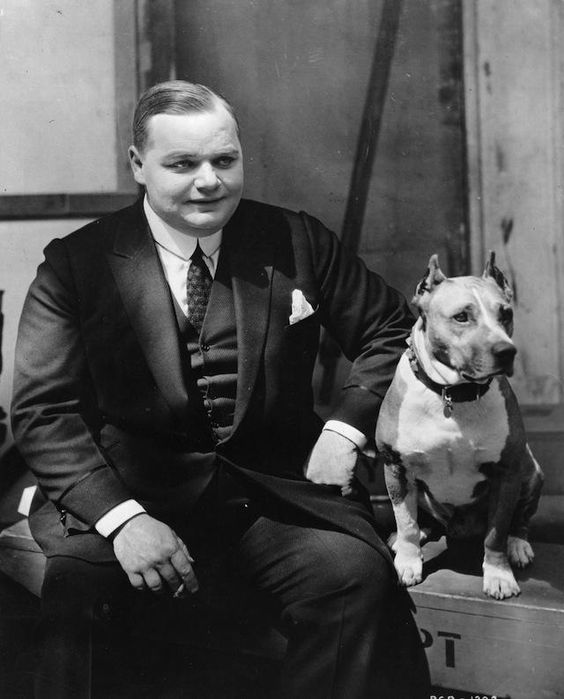


ROSCOE ARBUCKLE and his dog LUKE
(Co-star of many of the comedian's funniest films)
c 1920


Use the link below to view several films starring ROSCOE 'FATTY' ARBUCKLE, including a few featuring his friend and co-star BUSTER KEATON:


Special thanks to those who take the time to upload movies to YouTube.  Your efforts are appreciated by movie lovers everywhere.


You might also enjoy:


Thursday, 5 January 2023

'The Polish James Dean' REMEMBERING ZBIGNIEW CYBULSKI


ZBIGNIEW CYBULSKI
3 November 1927 – 8 January 1967


Actors are divided into those who transform their personalities and those who perpetuate them. I'm more interested in acting within certain individual characteristics. I realise that it is both difficult and dangerous…
Quoted in Film, No 2
 [1987]


The death of renowned Polish theater and cinema actor Zbigniew Cybulski on 8 January 1967 marked the end of what had been Poland's post-war cinematic renaissance, drawing a line between the generation which had come of age under the shadow of Nazism and the generation which had come of age under the equally oppressive shadow of Josef Stalin.  
 
 
Cybulski was the most charismatic and, as some critics have suggested, most emblematic representative of that earlier generation of actors, writers and directors, an artist who found international fame thanks to his era-defining role in Andrezj Wajda's 1958 masterpiece Popiól i diament [Ashes and Diamonds], only to perish after trying to leap aboard a moving train nine years later.  
 
 
Cybulski's appearance in Popiól i diament, as the troubled young Home Army/anti-Communist assassin Maciek, was nothing short of electrifying.  His performance earned him the (not altogether accurate) nickname 'The Polish James Dean' but it became a role that, as the years progressed, he found it increasingly difficult to disassociate himself from despite the fact that he appeared in more than twenty other feature films and many notable stage productions.  
 
 
But it's not difficult to understand why the character of Maciek so thoroughly captivated post-war audiences both in Poland and abroad.  Described by one Polish critic as a 'jazz existentialist,' Cybulski/Maciek seemed to personify the disaffection and unease of the Cold War 1950s, an idealist filled with doubt, searching for meaning and purpose in what had become a very restrictive society in which every aspect of life was dominated by Poland's Soviet-backed Communist Party.  Cybulski's identification with the Maciek character was total, extending even to the outfit — jeans, jacket, white shirt, sunglasses — he wore onscreen.  As the film's director Andrzej Wajda once explained in an interview:  'He wore his own clothes even though, historically, they were completely wrong… he rejected the costume we had prepared for him, he was in his own things with a small green haversack and that's how he came into the film…he wasn't able to think about the hero… as [being] anyone other than himself.


DVD cover, date unspecified


Zbigniew Hubert Cybulski was born on 3 November 1927 in Kniażu, a small Polish village in what is now western Ukraine where his grandfather was a property owner.  His family background was not in any way theatrical.  His father Aleksander Cybulski (1896–1965) was an official in the Ministry of Foreign Affairs while his mother Ewa Jaruzelska (1903–1987) was a homemaker of Polish-Armenian descent.  His younger brother Antoni (1931–2009) grew up to become a lawyer.  
 
 
Cybulski was educated in the southwestern Polish town of Dzierżoniów, subsequently moving to Krakow to pursue further study in the Consular Department of that city's Academy of Commerce and then in the Journalism Department of the School of Social Sciences before transferring again to the National Art Academy from which he graduated as an actor in 1953.  That year also saw him make his stage debut in the Polish port city of Gdańsk in Intrigue and Love, a 1784 play written by German poet and dramatist Friedrich Schiller.

 
In 1954 Cybulski obtained his first film role, appearing briefly but memorably in Andrzej Wajda's Pokoleniu [A Generation] alongside future controversial director Roman Polanski.  Another small part in the spy thriller Kariera [Career], directed by Jan Koechera, followed, although his name did not appear in the film's credits.  
 
 
1954 also saw him relocate semi-permanently to Gdańsk where he worked as a member of the Seashore Theater company and co-founded a student cabaret, called Bim-Bom, with his friend and future co-star Bogumił Kobiela.  (Kobiela would appear alongside him in Popiól i diament and also die young as the result of an accident, in his case involving an automobile.)  While not able to directly criticize the repressive state regime, Bim-Bom staged five productions between 1955 and 1960 that were notable for their tone of biting satire and their popularity with audiences both in Poland and in other European nations including France and Belgium.  'Bim-Bom was everything,' Cybulski would reminisce to a friend shortly before his death.  'Our mother, our brother, and our teacher.  It was our bread.  I don't know if it was theater, fun, a dream or a book…Through Bim-Bom I approached humanity.'
 
 
But it was in the world of cinema that Cybulski now began to distinguish himself as an actor, appearing as a cyclist in Trzy startsy [Three Starts] directed by Stanisław Lenartowicz and as a coalminer in Tajemnica dzikiego szybu [The Secret of the Wild Shaft] directed by Wadim Berestowski.  In 1957, the same year he and Kobiela founded their experimental Rozmow theater company,  he played the lead role in Koniec nocy [End of the Night], the tale of an unlikeable truckdriver who knocks down a pedestrian and eventually loses his job, only to sink into a life of alcoholism and petty thievery.  His stage work continued to be equally impressive, culminating in him starring as drug addict Johnny Pope in the North American play A Hatful Of Rain under the direction of Andrzej Wajda, a production that travelled to several Polish cities in 1959 following the success of Popiól i diament and was acclaimed by critics and audiences alike. 
 
 
The strength of Cybulski's performance in Koniec nocy earned him the lead role of Piotr Terlecki in Ósmy dzień tygodnia [The Eighth Day of the Week], directed by Alexsander Ford, the controversial story of frustrated young lovers trying to make a life for themselves in grey and grimy post-war Warsaw.  Unfortunately, the film met with disapproval from the state censors following its premiere in West Germany and remained unreleased in Poland until 1983.


ZBIGNIEW CYBULSKI and SONJA ZIEMANN
The Eighth Day of the Week
1958


Cybulski's next major film role in Popiól i diament was one he nearly failed to get.  Wajda's original choice for the part of the doomed Home Army soldier Maciek was Tadeusz Janczar, a choice he revised at the urging of his assistant director Janusz Morgenstern who would himself go on to direct Cybulski in Do widzenia, do jutra [Goodbye, See You Tomorrow] in 1960.  Like Ósmy dzień tygodnia, Wajda's film created a lot of controversy upon its release, attracting criticism from the state authorities and from his fellow director Alexsander Ford who questioned the 'counter-revolutionary nature' of its plot and called for it to be banned.  
 
 
Maciek is shown to be as much a victim of forces beyond his control as the Communist bureaucrat he's assigned (and initially fails) to assassinate, making him an immediately sympathetic figure and possibly explaining his popularity with Western audiences accustomed to seeing films featuring doomed anti-heroic leading characters.  (This explains why Maciek was compared with Jim Stark, the character portrayed by James Dean in the 1955 film Rebel Without A Cause directed by Nicholas Ray.  Cybulski allegedly attended a screening of Ray's film at Cannes and may have based aspects of his performance on that of the recently deceased Dean, although the two films have nothing in common politically and deal with very different subject matter.) 
 
 
The film's plot also deviates significantly from the plot of the popular 1948 novel (by Jerzy Andrzejewski) from which it was adapted, making Maciek its protagonist rather than a supporting character and introducing a romantic subplot which sees the young man fall in love with a barmaid named Krystyna who is at first reluctant to become involved with him but to whom he promises to return following the completion of his mission.  
 
 
Fortunately, Andrzejewski was respected enough as a cultural figure to be listened to when he insisted that the film was not anti-ideological and should be released without any cuts — a decision that saw it viewed by more than one million of his fellow Poles and go on to win an award at the Venice Film Festival after being banned and withdrawn from the Cannes competition.  In recent years Popiól i diament has again become the subject of controversy for its 're-working' of the true events of 1945, the year in which it is set.  It was in fact the Communists who hunted down and executed members of the Home Army rather than the other way round, a falsification of history that angered many Poles following the fall of Communism throughout Eastern Europe.


ZBIGNIEW CYBULSKI
c 1962


To a large extent the remainder of Cybulski's film career was defined by his portrayal of Maciek, with many of the projects he starred in — Wajda's Niewinni czarodzieje [Innocent Sorcerers, 1960] and the aforementioned Do widzenia, do jutra [1960] (which he also had a hand in writing) — seeing him play characters who experience similar forms of existential angst and which, in some respects, challenge the romantic idealism presented in the character of the doomed young assassin.  In Jak być kochaną [How To Be Loved], a 1962 production directed by Wojciech Has, Cybulski played Wiktor Rawicz, a wartime actor accused of killing a Nazi who is hidden by Felicja, a fellow actor who's in love with him, in her room.  When the war ends Rawicz flees her apartment to seek the fame he feels he's been wrongly denied by the war, only to see Felicja accused of collaboration because she took a job in a German-run theater to prevent him from being discovered and arrested by the Nazis.  Rawicz fails to find success and becomes a hopeless alcoholic who, after being found by Felicja in a grubby bar, is taken back to her apartment where, once more faced with the prospect of living there indefinitely, he kills himself by leaping from its window.  The bar scene is a direct parody of a similar scene in Popiól i diament between Maciek and his lover Krystyna, designed to contrast the former's idealism with Rawicz's unappealing venality.
 
 
Cybulski appeared in many more films as the 1960s progressed, including the 1964 Swedish drama Att Älska [To Love] and the bizarre 1965 historical satire Rękopis znaleziony w Saragossie [The Saragossa Manuscript], adapted from the 1815 novel by Jan Potocki in which he portrayed the Napoleonic army captain Alfons van Worden — one of the few roles for which he did not wear his trademark tinted eyeglasses.  Always in demand, Cybulski acted in nine more films and two television dramas over the next two years, combining this with work in radio and theater as he had done throughout most of his career.  
 
 
Ironically, the theater offered him a wider range of roles and also gave him the chance to direct, including a well received adaptation of Ernest Hemingway's 1938 play The Fifth Column in which he played the leading role of Philip Rawlings.  Nor was that his only venture into Western drama.  In addition to The Fifth Column and his earlier starring role in Michael Vincent Gazzo's A Hatful of Rain Cybulski also performed in Polish adaptations of works by William Gibson, William Faulkner, Terence Rattigan, Truman Capote and British screenwriters Ken Hughes and Philip Mackie.
 
 
The actor's hectic work schedule was partly responsible for his unexpected death.  Long known as 'a man in a hurry' to his friends, he frequently ran late for professional appointments and was often in the habit of arriving at railway stations at the last minute and leaping aboard moving trains as they were pulling out from the platform.  (He also did this in several films, beginning with his cinematic debut in Pokoleniu [A Generation] and ending with Salto [Jump] in 1965.)  This was what he did on 8 January 1967 at Wrocław Główny railway station in an effort to board the 'Odra' express to Warsaw so he could begin rehearsals at a television studio after completing principal photography on what was to be his final film Morderca zostawia ślad [The Murderer Leaves a Trace].  Unfortunately, Cybulski misjudged the distance between the carriage and the platform and tumbled into the gap.  His body was struck by the next oncoming carriage, causing major damage to his head, chest and liver.  Although he was rushed to hospital where he immediately underwent emergency surgery, the extent and severity of his injuries saw him die within an hour. 
 
 
The untimely passing of Zbigniew Cybulski was viewed as a national tragedy in Poland where he remains a revered and much loved artist to this day, with the government choosing to honour his life and artistic legacy by naming an acting prize in his honor.  He was survived by his wife Elżbieta Chwalibóg, a set designer he married on 30 August 1960, and their son Maciej (1961–2019) and buried in his family tomb in the southern city of Katowice after two separate funeral services — the Catholic ceremony preferred by his relatives and the secular ceremony preferred by the Communist PartyIn 2007 a stone with a cross and a bas-relief of his face were placed on the tomb to mark the fortieth anniversary of his death.  Ceremonies were also held in 2017 to mark the fiftieth anniversary of that tragic event.
 
 
Perhaps the most fascinating tribute to Cybulski was the film Wszystko na sprzedaż [Everything For Sale] made in 1968 by his old friend and collaborator Andrzej Wajda.  The film, one of the director's best, explores the efforts made by a group of actors to complete a project starring a deceased colleague, a man who died in circumstances that remain unclear and cause them to question their own careers, relationships and personal and professional motivations.  The film has a quasi-documentary feel to it and perfectly mirrors the situation Wajda found himself in at the time of Cybulski's passing.  It is well worth seeking out by anyone interested in the idea of celebrity and the mythical status some performers attain following their deaths. 


Film poster, 1968


Use the link below to view a series of interviews with ANDRJEZ WAJDA (with English subtitles) in which he discusses the life, work and legacy of Polish film, television, radio and theater actor ZBIGNIEW CYBULSKI:


You might also enjoy:


Thursday, 13 February 2014

Some Books About… TONY HANCOCK


TONY HANCOCK 
and friend, 1962


Anthony Aloysius St John Hancock was a comic fiction who lived in an imaginary place called East Cheam and had total reality for millions of people.  Anthony John Hancock (12 May 1924 – 24 June 1968), clown, was not content with this and searched for more reality, and more truth until he finally lost himself in a fantasy world.
DAVID NATHAN


Those unfamiliar with the work of Tony Hancock, the great English radio, television and variety comedian, may like to watch this 2 minute clip from season seven of his hit BBC TV series Hancock's Half Hour, which originally aired on 23 June 1961.  It's a comedic masterpiece titled The Blood Donor which captures everything that made him such a beloved figure in every part of the British Commonwealth prior to his death, while shooting a new television series in Australia, in June 1968. 


The Blood Donor
1961
2 minute clip


Arrow Books/Random House, 2000


When The Wind Changed: The Life and Death of Tony Hancock (2000) by CLIFF GOODWIN

Books about dead celebrities tend to fall into two categories –– warts and all exposés which focus exclusively on the more salacious aspects of their subjects' lives or highly respectful 'authorized biographies' written with the full cooperation (and sometimes under the strict supervision) of their subjects' relatives and legal executors.  The truth, as it does with most things, probably falls somewhere between these two extremes and, in the case of Cliff Goodwin's When The Wind Changed: The Life and Death of Tony Hancock, can make for illuminating if occasionally confronting reading.  

The author is obviously an admirer of Hancock's work but never allows that admiration to cloud his judgement when it comes to revealing what drove and tormented the comedian prior to his 1968 suicide in Australia, where he had gone in a last-ditch effort to salvage what was left of his alcohol and drug ravaged career.  It's a balanced biography, neither condemning nor condoning Hancock's erratic and often irrational behaviour, which traces his life year by year to reveal how his performing persona developed and the influence, largely negative, that success had on him both in and out of the spotlight.  The comedian's life was a charmed one in many ways but one which began to unravel and then spiral out of control as his alcoholism worsened and his habit of disassociating himself from those who had been instrumental to his success –– his writers Ray Galton and Alan Simpson, his comedic foil Sid James, his agent Phyllis Rounce – took its understandable toll on these friendships and, in time, on his ability to make effective use of his gifts as a performer.  

Goodwin's plain journalistic style of writing – which occasionally assumes a needlessly melodramatic tone in an effort to heighten the drama of events which were dramatic enough without requiring further embellishment –– enables the reader to get a real feel for the showbusiness world of 1950s and 1960s England, its variety theatres, radio and TV studios and locally staffed film sets (an unthinkable proposition in the very different, predominantly outsourced film industry of the twenty-first century).  Hancock knew and was friendly with most of the great names of the golden era of British radio, film and television comedy –– Peter Sellers, Harry Secombe, Spike Milligan, Eric Sykes, John Le Mesurier and Jimmy Edwards to name just a few –– and Goodwin's many references to them, and to his co-stars Sid James, Bill Kerr, Kenneth Williams and Hattie Jacques, helps to place Hancock's story firmly in the context of his times, shedding valuable light on how his idiosyncratic and largely inimitable style of comedy was born and laboriously perfected.  

If you only want to read one book about Hancock's short but troubled life, then this is probably the book to choose.  It's thoroughly researched, contains a full chronology, extensive notes and complete cast lists, and also includes a transcription of the comedian's 1960 Face to Face interview with BBC journalist John Freeman –– a probing analysis of his personality which exposes the banal, pre-rehearsed 'celebrity interviews' of today as the crass, self-indulgent time fillers they so often are.  It was Freeman's interview, many of Hancock's friends believed, that provoked the endless questioning of his talent which, as the years went by, warped, eroded and eventually destroyed it.   

The photograph chosen for the cover of this book, taken by French photographer Henri Cartier-Bresson, is also one of the best I've seen of Hancock, capturing in one unguarded moment much of the inner anguish and confusion he hid so well from the public during his time as Britain's best loved comedian.

When The Wind Changed: The Life and Death of Tony Hancock is no longer in print. 


Ariel Books/BBC, 1986


Hancock (1986) by FREDDIE HANCOCK and DAVID NATHAN

Freda 'Freddie' Hancock (née Ross) met a rising star named Tony Hancock while he was performing  in the English resort town of Bournemouth in 1954 and became first his press agent, then his mistress and finally, in December 1965, his second wife.  (His first wife, a former Lanvin model named Cicely Romanis whom he'd married in 1950, also became an alcoholic and followed him to an early grave in 1969 at the age of thirty-eight.)  The marriage officially lasted one year, his alcohol-fuelled self-destructiveness effectively crushing a relationship which had been, in some respects, the most stable and rewarding of his life.  But Freddie realised, as so many others associated with Hancock came to realise prior to his death, that hers was a choice between trying to keep him alive and sober or attempting to save her own threatened sanity.  'I loved Tony,' she told her co-author David Nathan while they were originally preparing this short but lovingly written biography, 'and I never ceased to love him.  But loving him and living with him were vastly different propositions.'

Hancock is as much the story of a relationship as it is the story of a doomed comic genius whose weekly half hour radio and television broadcasts literally brought the entire British nation to a standstill every Friday night for seven successful years.  Freddie's attempts to make her client and lover see what he was doing to himself –– which included leaving him on numerous occasions and once tipping an entire bottle of brandy over his head when he was supposed to be abstaining from alcohol and had thoughtlessly asked her to pour him a drink – fell on deaf ears, resulting in five failed suicide attempts on her part before she finally found the courage (and the sense) to walk out on him for good in July 1966.  Despite this, and the frequent beatings Hancock subjected her to after she attempted to wrench vodka bottles from his hand, she never ceased to hope that he would one day conquer his demons and begin to appreciate, as she and so many of his contemporaries in the British entertainment industry did, what a rare and exceptional talent he possessed.  Nor was she alone in finding this portly, round-shouldered man (the result of contracting rickets as a child) with 'funny feet' ('look like two kippers strapped to my ankles, they do' was how Hancock himself described them) and a remarkably expressive face irresistibly attractive.  Freddie was only one of many people, female and male, who fell in love with Hancock and drove themselves to the brink of madness in the quest to relieve his largely self-inflicted suffering.

It's a tribute to Freddie's generosity of spirit that she chose not to make her biography the muckraking tell-all exposé it could have so easily become in unkinder, less affectionate hands.  While it can by no means be described as an exhaustive biography, it remains a useful and enlightening one for any admirer of the comedian, revealing him as a deeply flawed man with chronic emotional problems and not, as some would have it, a humorless monster obsessed with becoming an international superstar in the style of his more successful friend and rival Peter Sellers (another inspired comedian who was no stranger to addiction, psychiatry and prolonged episodes of masochistic self-destruction).  Freddie admits that she was naïve, that she ignored the advice of her family and that of Hancock's friends who tried to make her see she had to leave him, but nowhere does she state that she ever regretted having him in her life.  'He was an exciting personality,' she recalls.  'He did not smile all that often, but when he did it was worthwhile.  His eyes smiled a lot.  He had a lasting effect on me from that moment.'  This book is a testament to the love she felt for him, tragically misguided and spurned though it ultimately was.

Hancock was last reprinted in 1996.  Lady Don't Fall Backwards, a similar 1988 memoir by JOAN LE MESURIER, his mistress and the wife of the comedian's friend and occasional Hancock's Half Hour guest star JOHN LE MESURIER, may also be available. 


Methuen Publishing Limited, 1999


Hancock's Last Stand: The Series That Never Was (1999) by EDWARD JOFFE

Edward Joffe was a South African-born, Scottish-based television director who was given the unenviable task of directing Hancock's last ever television series, provisionally titled Hancock Down Under, which had been commissioned by Australia's ATN7 network and featured brand new, tailormade scripts authored by Melbourne-based writer Hugh Stuckey.  The program, which was filmed entirely in the Seven network's Sydney studios and featured Hancock as a newly arrived immigrant trying to come to grips with his new home and the Australian way of life, was considered by the comedian's agent and virtually everyone who knew him to be his last chance to recapture and perhaps replicate the success of his BBC years, when Hancock's Half Hour, in both its radio and television formats, had regularly been enjoyed by audiences numbering in the millions.  Hancock himself apparently knew this was his last chance to salvage what was left of a career all but ruined by his addictions to alcohol and prescription medications and approached the project with a newfound sense of purpose and, at least initially, with the intention of remaining sober and drug-free throughout the long and, for him, tedious months of filming.  

He flew to Australia in March and, after spending some time in hotels, eventually moved into a house on Birriga Road in the upscale eastern Sydney suburb of Bellevue Hill with Joffe, his wife Myrtle and their three children.  The Joffes occupied the upper two floors of the house, while Hancock lived alone in a small, self-contained flat on the ground floor overlooking the garden.  It was an arrangement the producers of the show had encouraged, believing that having his director so close would in turn encourage Hancock to curb his drug and alcohol intake, both of which once again became prodigious within a few weeks of his arrival in Australia.  It was in this Birriga Road flat that Hancock was found, dead in his underwear with a cigarette clamped between his badly scorched fingers, by Joffe on the morning of 24 June 1968.

This was, of course, a dismal end to what had been a sad and wasted life and it's a tale that might have been more poignantly told by a writer other than Joffe, whose style has a tendency to become annoyingly glib at times.  The book's one saving grace is that it reveals Hancock trying to understand and confront his own self-destructiveness and its consequences, fighting to regain control of a career which had hit rock bottom following his separation from Freddie Ross and the failure of his one man show – which saw him turned down flat by his former writers Galton and Simpson after begging them to provide him with new material –– to wow audiences at London's Festival Hall and other 'safer' venues in Aden, the Isle of Man and Australia.  

These were dark days for Hancock and this is, at times, a very disturbing book.  Nor is what was actually filmed of Hancock Down Under – a program plagued by disaster from day one that was only screened in edited form following the comedian's death –– a fitting memorial to a performer who had previously been able to make audiences laugh simply by raising his eyebrow or impatiently muttering the phrase 'Stone me!' to himself.  While the program does offer a few brief glimpses of the old, mobile-faced, incredibly subtle clown of the Hancock's Half Hour days, there are too many moments when the old magic simply isn't there, when it becomes tragically obvious that you're watching a sick and scared man trying to regain public favour by sheer force of will.  The show, like Joffe's book, is not a must-own item for any but the most obsessive of Hancock fans, who will most likely be disconcerted or at the very least disappointed to read of the pitiable conclusion to what had been, before the comedian was destroyed by his own insecurities, a sparkling career.

Hancock's Last Stand has not been reprinted since it was originally published in 1999. 


Arrow Books/Random House UK, 2004


50 Years of Hancock's Half Hour (2004) by RICHARD WEBBER

'One thing,' author Richard Webber writes in his introduction to this fine and indispensable book, 'needs clarifying from the beginning: this is not another Tony Hancock biography.  The tragic life story of one of the nation's finest comedy actors has already been meticulously detailed by other authorsthis book is a biography of a radio and television series, a celebration of a show which, even now, fifty years later, provides pleasure to the millions who continue to listen to or watch Hancock's Half Hour. 

Mr Webber is clearly a man of his word.  His book is an affectionate, lovingly detailed celebration of a program which, amazingly, has remained popular with audiences for over half a century – an audience which includes people, like myself, who were not yet born when it originally aired and have only discovered Hancock thanks to the canniness of the BBC marketing department which wisely chose to repackage, re-release and re-promote what most of the world's other major entertainment conglomerates would have thrown away or left to ignominiously rot in their rarely opened vaults.  

The continuing popularity of Hancock's Half Hour is a testimony to its star's ability to simultaneously personify and lampoon what may be termed a quintessentially English personality and a quintessentially English view of life.  Hancock was appealing because he behaved no better and no worse than anybody in his audience behaved, was unafraid to portray himself as a deluded buffoon whose pretensions were as numerous as they were ludicrous, a clown whose antics nevertheless revealed, in the beautifully chosen words of novelist and playwright JB Priestley whose two part 1968 novel The Image Men features a character based on Hancock, '…a suggestion of depth somebody close to "mass man" of today, coming out of the faceless crowd, hopeful, near to glory for some minutes, before the lid comes on again, before he shrugs his way back into the dark.'  That shrug, it could be argued, was the key to what made 'the lad himself' so popular –– a willingness to get on with it and not linger over his latest defeat that became, in time, the endearing hallmark of the flawed, all too human 'Everyman' he so effectively portrayed.

This book doesn't dwell on the alcoholism, the drug abuse, the affairs or the two failed marriages, the long slow fall from grace that led to what had probably been the comedian's always inevitable decision to take his own life.  Instead, it turns the spotlight on what should always be the first and last consideration when we speak of Tony Hancock –– his ongoing ability to make people laugh.  That somebody so beloved, who had, in the words of his friend Spike Milligan '…no enemy but himself' should die such a lonely premature death only makes a book like this that much more valuable as a celebration of what, in anybody's terms, must rank as a unique and precious legacy.  Containing full episode guides to all his BBC radio and television programs, a complete unaired script penned by Galton and Simpson (who also provide a short and rather silly introduction), full rundowns of cast and crew details plus a complete bibliography and (nowadays all but irrelevant) list of LP, cassette and video releases, it's a book that deserves a place in the collection of any Tony Hancock fan.

50 Years of Hancock's Half Hour is still in print and may be obtainable from your local bookstore or preferred online retailer. 


Macdonald Queen Anne Press UK, 1987


The Illustrated Hancock (1987) by ROGER WILMUT

Like Richard Webber's book, Roger Wilmut's The Illustrated Hancock is a celebration of a body of work rather than a lament for a sadly squandered talent.  What makes the book worth owning, as should be obvious from its title, is the assortment of stunning black and white photographs it contains, covering all aspects of the phenomenon that was Tony Hancock from his early days as a variety performer through his radio and television years and his work as both a star in the films The Rebel (1960) and the unfairly scorned The Punch and Judy Man (1962) and as a supporting actor in big budget extravaganzas including Those Magnificent Men In Their Flying Machines (1965) and The Wrong Box (1966)Each section is preceded by a short introduction which provides a context for the images and includes quotes from many of those who knew, loved and worked with him.  The book is a brief but fitting tribute to a comedian who almost singlehandedly raised the bar of British comedy, paving the way for later and equally gifted generations of 'comedy of embarrassment' performers including John Cleese, Harry Enfield, Kathy Burke, Jennifer Saunders, Catherine Tate, Steve Coogan and Ricky Gervais.

The Illustrated Hancock has not been reprinted since it was originally published in 1987.  ROGER WILMUT was also the author of Tony Hancock: Artiste, a 1978 biography that was fully revised and expanded in 1983.


Special thanks to the person who posted this clip from The Blood Donor on YouTube.  Your efforts are appreciated by comedy fans everywhere.


You might also enjoy:

 
Some Books About... BUSTER KEATON

 
Some Books About... MODS!

 
Some Books About… BOOKS


Last updated 14 July 2023 §