Pages

Showing posts with label Joseph Conrad. Show all posts

Thursday, 30 April 2020

Some Books About… JOSEPH CONRAD


JOSEPH CONRAD  
3 December 1857 – 3 August 1924


Joseph Conrad, who was born Józef Teodor Konrad Nalecz Korzeniowski on 3 December 1857 in what had recently become the Ukrainian city of Berdyczów, is now considered to be one of the key figures of early literary Modernism, a novelist whose work became a profound influence on many of the writers –– André Gide (who was for a time his French translator), Virginia Woolf, William Faulkner and Ernest Hemingway to name just four –– who would themselves go on to become important novelists in the years preceding and immediately following World War One.  While Conrad is perhaps best remembered today as the author of the groundbreaking 1899 novella The Heart of Darkness, it was in his full scale novels Lord Jim (1900), Nostromo (1904), The Secret Agent (1907) and Under Western Eyes (1911) that he can be said to have genuinely pushed the boundaries of the form, creating ironic, multi-layered narratives which dragged the English novel out of its cosy Victorian rectitude into what would prove to be a bleak and frequently terrifying new century.  


That Conrad, a Pole by birth whose second language was French, achieved this by writing in his third language (or fourth as there is evidence to suggest that he was also fluent in German) was nothing short of miraculous, as was his apparently instinctual understanding of evil and heroism and the vital role that integrity and personal responsibility play in all human undertakings.  He is the subject of innumerable works of criticism and at least half a dozen major biographies, with the numbers of each growing by the year as critics, cultural as well as literary, continue to mine his work for clues to the various moral and political dilemmas the world still finds itself confronted by today.
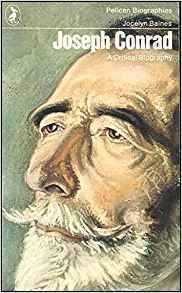


Pelican/Penguin Books UK, 1971


Joseph Conrad: A Critical Biography (1960) by JOCELYN BAINES


Unlike most literary biographers, Jocelyn Baines was not an academic as such.  He was born in London in the same year that his one and only biographical subject died and worked for most of his professional life as an antiquarian bookseller, leaving that honourable profession for a brief stint as an editor at the English publishing firm of Longmans, Green.  Although he read law at Oxford University and obtained an English degree, his study of Conrad's life –– the first major English biography of the novelist to appear in almost forty years –– is anything but donnish.   


The book is divided into fourteen chapters, each of which is further subdivided into sections to facilitate the reading experience and ensure the presentation of facts never becomes so relentless that they can't be easily assimilated.  While this may seem a trivial observation, it is not.  Many literary biographies, particularly those which focus on towering figures like Conrad, can quickly become a drain on the reader's endurance, turning what should be a pleasurable and informative experience into a dull unedifying chore.  Baines presents the facts of Conrad's life –– his birth in a section of Poland which had recently been annexed by Russia, the exile of his father for reasons of political expediency and the deaths of both his parents while he was still a young boy, his struggle to go to sea against the wishes of his autocratic uncle first in France and eventually in England, his gaining of his first (and only) maritime command and subsequent desertion of the sea for what became the even more uncertain career of professional writer –– in a clear straightforward manner, providing enough in the way of supplementary detail to convincingly recreate what, even by action-packed nineteenth and early twentieth century standards, was an extraordinarily rich and fascinating life.  


Baines does this, in part, by including a generous selection of quotations drawn from the hundreds if not thousands of letters Conrad wrote throughout his life, including those composed in French to people like Marguerite Poradowska, the Polish-born Belgian novelist who was his maternal cousin by marriage and the woman, nine years his senior, whom he may have unsuccessfully proposed to before marrying Jessie George, eldest daughter of his London landlady, in March 1896.  (Unfortunately, the letters written in French are untranslated, an oversight which should have been corrected in the reprinted edition of the book published in 1993.)  By allowing Conrad to tell key parts of his own story in his own words, Baines provides the reader with unusually lucid insights into his subject's character, state of mind and literary preoccupations.  He also has a gift for analysing Conrad's novels without becoming mired in esoteric academic language, of which his comments about Under Western Eyes should serve as a typically concise example:


There is a very successful attempt to present what Razumov [the novel's protagonist] thought … indeed, the characters in Under Western Eyes are more subtly and convincingly developed than those in any other of Conrad's novels.  Razumov himself is the most considerable character that Conrad created; his thoughts, words, and actions reveal depths of personality which show that Conrad succeeded in identifying himself imaginatively with him. 


While Joseph Conrad: A Critical Biography is not the most erudite book ever published about this great and still much studied novelist, it remains one of the more accessible in terms of style and length.  It's also something practically never encountered in today's cut-throat and rapidly shrinking book market –– a reliable, uncondescending biography written for the non-specialist by a fellow (passionate and well-read) non-specialist that I would unhesitatingly recommend to anybody seeking to broaden their knowledge of Conrad's life as a means of acquiring a deeper understanding of his fiction. 


Joseph Conrad: A Critical Biography is no longer in print.  


Ecco Press, 1989


Joseph Conrad: A Personal Remembrance (1924) by FORD MADOX FORD


'He was small rather than large in height,' Ford Madox Ford states in the opening paragraph of the monograph he published about his friend and collaborator shortly after Conrad's death on 3 August 1924, '…very broad in the shoulder and long in the arm; dark in complexion with black hair and a clipped black beard.  He had the gestures of a Frenchman who shrugs his shoulders frequently.  When you had really secured his attention he would insert a monocle into his right eye and scrutinise your face from very near as a watchmaker looks into the works of a watch.  He entered a room with his head held high, rather stiffly and with a haughty manner, moving his head once semicircularly.  In this one movement he had expressed to himself the room and its contents; his haughtiness was due to his determination to master that room, not to dominate its occupants, his chief passion being the realisation of aspects of himself.'  This is an astonishingly vivid description of Conrad the human being as opposed to Conrad the literary icon, entirely characteristic of Ford and what he set out to achieve in this short, affectionate, elegantly composed memoir. 


Ford was the perfect person to write such a book, having collaborated with Conrad on three novels –– The Inheritors (1901), Romance (1903) and The Nature of a Crime (written in 1906 but published, like this memoir, in 1924) –– after being introduced to him in 1898 by Conrad's friend and literary advisor Edward Garnett.  Theirs quickly became a mutually instructive friendship which naturally lent itself to collaboration and the perfecting of a literary technique that Conrad had dubbed 'progression d'effet' or, in English, progression of effect.  'In writing a novel,' Ford explains, 'we agreed that every word set on paper –– every word set on paper –– must carry the story forward and, that as the story progressed, the story must be carried forward faster and faster and with more and more intensity.'  This method of writing, which became a core principle of what would come to be known as literary impressionism (and the modern spy and detective novel), is now considered to be one of Conrad's most essential contributions to Western literature –– a contribution it may have been impossible for him to make had he not met and worked so closely with the man he originally knew as Ford Madox Hueffer.  (Ford changed his surname after World War One in an effort to re-invent himself following his military service in the trenches of France and the entirely understandable nervous breakdown he suffered as a result of that altogether horrific experience.)


Although their friendship was no longer as close by 1909 –– it became strained after they quarrelled about Conrad's contributions to The English Review, a new periodical Ford was at that time editing, and was further compromised by the affair the still-married Ford had recently begun with journalist Violet Hunt –– Ford's genuine affection for Conrad and his memories of the many hours they spent discussing the art and practise of writing at Pent Farm in rural Kent shines through on every page.  It closes with a moving addendum, composed in (again untranslated) French, of Ford's thoughts written immediately after learning of Conrad's death that originally appeared in the Journal Littéraire on 26 August 1924.


As generous and laudatory as it is, Ford's memoir was vehemently disliked by the widow of his friend and former collaborator.  Jessie Conrad –– who would go on to write several newspaper articles and two interesting if unreliable memoirs of her own about the husband whose genius she claimed not to have understood –– never warmed to Ford, whom she considered too bohemian in his outlook in addition to being a shameless exploiter of Conrad's overly generous nature.  She publicly criticized Ford after his memoir appeared, going so far as to describe his reminiscences as 'detestable' to one Fleet Street journalist.  


Personally, I think Mrs Conrad got it wrong.  For all his faults, of which he possessed as many as the next person, Ford could not count insincerity or the failure to pay his friends due homage among them.  A Personal Remembrance stands as an eloquent heartfelt tribute to a man he genuinely respected and admired and what they accomplished as novelists both individually and collectively. 


Joseph Conrad: A Personal Remembrance may still be obtainable from your local library, bookstore or preferred online provider.  


Joseph Conrad As I Knew Him (1927) and Joseph Conrad and His Circle (1935), both written by JESSIE CONRAD, are long out of print, as is Joseph Conrad: Times Remembered the better memoir by the writer's youngest son JOHN CONRAD published by the Cambridge University Press in 1981. 


Farrar Straus Giroux first US edition, 1979


Joseph Conrad: The Three Lives (1979) by FREDERICK R KARL


It is hard to believe that this was only the third Conrad biography published since the writer's death, following the previously mentioned work by Jocelyn Baines and Gérard Jean-Aubry's Joseph Conrad: Life and Letters (1927) and Vie de Conrad (1947, translated ten years later as The Sea-Dreamer: A Definitive Biography of Joseph Conrad).  What Baines lacked in detail and Jean-Aubry lacked in verisimilitude –– although he knew Conrad and translated much of his work into French, the Frenchman had a worrying tendency to extrapolate Conrad's fiction into his life and vice versa, making many of his claims and assumptions unreliable –– Frederick R Karl more than made up for in this massive tome, a book which remains one of the truly great literary biographies and a landmark of modern literary scholarship.


A critic of no small repute and a published novelist in his own right, Karl combines extensive research with a keen appreciation of Conrad's literary achievements and scrupulous analysis of his subject's novels, short stories, memoirs and even the three plays he wrote in his always urgent quest to obtain a steady source of income for his family.  He depicts Conrad's life as a voyage of discovery divided into three distinct but overlapping phases –– the young self-exiled Pole struggling to find a purpose and make his way in the world, the apprentice seaman who taught himself to speak and read English and rose through the ranks of the British merchant service to become master of the Otago in 1885 only to be denied the captaincy he undoubtedly deserved, and finally the writer who faced a different kind of struggle to earn enough by his pen to support his ailing wife and sons. 


Building upon what was unearthed by Conrad's previous biographers, Karl refutes many of their unsubstantiated claims (particularly those of Jean-Aubry) while confirming and elaborating on others, doing it all in a style that never patronizes the reader or becomes so academic as to become off-putting or tedious to read.  He is refreshingly honest about the uneven quality of much of Conrad's later output, unafraid to state which, in his view, are his important works and which, like his last published novel The Rover (1923), would probably not have seen the light of day had their author not been so chronically strapped for cash throughout so much of his career. 


The Three Lives was recognised as the masterpiece it is by many leading reviewers of the day, including Anthony Burgess who described it as '…a model of American scholarship in which not even the most recherché reference has gone unresearched.  It tells the story of a very sad man, a hopeless warrior, and of the heroinism of a wife who… suffered not only in herself but for him.'  There have, of course, been many other Conrad biographies published since 1979 but none, I dare to venture, that compare with Professor Karl's work in terms of erudition and sheer attention to detail.  


Joseph Conrad: The Three Lives is no longer in print. 


FREDERICK R KARL was the co-editor, with his colleague LAURENCE DAVIES, of The Collected Letters of Joseph Conrad which were published in nine volumes by the Cambridge University Press between 1983 and 2007.


Oxford University Press, 2000


Oxford Reader's Companion to Conrad (2000) by OWEN KNOWLES and GENE MOORE [editors]


This slim but densely packed book, first published in hardback by the Oxford University Press in 2000, is aptly named.  Edited by two of the world's leading Conrad scholars, with contributions from four of their colleagues including Zdzislaw Najder who was Conrad's first Polish biographer, it delivers exactly what its title promises –– an easy to use, cross-referenced guide to its subject's life and career which provides effective short analyses of all his published works (no story, tale, novel, play or significant piece of journalism or non-fiction is omitted), including summaries of their plots, overviews of past and current critical responses along with many helpful suggestions for further reading.  


This is the book I find myself automatically reaching for when I need further information regarding a particular point of Conrad's life or work.  (This post would have been difficult to write without it.)  It is informative, concise and helpfully separated into categories like 'Private Life and Attitudes,' 'Reputation' and 'Critical Approaches' which make it an indispensable research tool for the scholar and non-specialist alike.  It also contains a well-structured chronology, a family tree and four maps of, respectively, Conrad's divided Poland, Conrad's Malay Archipelago (the setting for Lord Jim and much of his finest short fiction), the River Congo (the setting for The Heart of Darkness and a river he personally navigated in 1890 as first mate of the paddle steamer Roi des Belges) and his various Homes in southeast England.  What more could any Conrad enthusiast reasonably expect from a reference book?  This truly is a work designed for the so-called 'ordinary reader' (if there is such a thing), dating from a time before the internet became the preferred source of information not just about literature but about everything else on our factoid obsessed planet. 


The Oxford Reader's Companion to Joseph Conrad may still be obtainable from your local library, bookstore or preferred online provider.


THE JOSEPH CONRAD SOCIETY is a UK-based organisation (with an allied branch in North America) devoted to 'the study of all aspects of the writings and life of Joseph Conrad' that also aims to 'provide a forum and resource for Conrad scholars throughout the world and those with a strong interest in things Conradian.'


You might also enjoy:


The Secret Agent: A Simple Tale (1907) by JOSEPH CONRAD


The Write Advice 118: JOSEPH CONRAD


A Call: The Tale of Two Passions (1910) by FORD MADOX FORD


Last updated 30 September 2021

Thursday, 2 May 2019

The Write Advice 118: JOSEPH CONRAD


Fiction –– if it at all aspires to be art –– appeals to temperament.  And in truth it must be, like painting, like music, like all art, the appeal of one temperament to all other innumerable temperaments whose subtle and resistless power endows passing events with their true meaning, and creates the moral, the emotional atmosphere of the place and time.  Such an appeal to be effective must be an impression conveyed through the senses; and, in fact, it cannot be made in any other way, because temperament, whether individual or collective, is not amenable to persuasion.  All art, therefore, appeals primarily to the senses, and the artistic aim when expressing itself in written words must also make its appeal through the senses, if its high desire is to reach the secret spring of responsive emotions.  It must strenuously aspire to the plasticity of sculpture, to the colour of painting, and to the magic suggestiveness of music –– which is the art of arts.  And it is only through complete, unswerving devotion to the perfect blending of form and substance; it is only through an unremitting never-discouraged care for the shape and ring of sentences that an approach can be made to plasticity, to colour, and that light of magic suggestiveness may be brought to play for an evanescent instant over the commonplace surfaces of words: of the old, old words, worn thin, defaced by ages of careless usage.

 
      The sincere endeavour to accomplish that creative task, to go as far on that road as his strength will carry him, to go undeterred by faltering, weariness or reproach, is the only valid justification for the worker in prose.  And if his conscience is clear, his answer to those who in the fulness of a wisdom which looks for immediate profit, demand specifically to be edified, consoled, amused; who demand to be promptly improved, or encouraged, or frightened, or shocked, or charmed, must run thus: –– My task which I am trying to achieve is, by the power of the written word to make you hear, to make you feel –– it is, before all, to make you see.  That –– and no more, and it is everything.  If I succeed, you shall find there according to your deserts:  encouragement, consolation, fear, charm –– all you demand –– and, perhaps, also that glimpse of truth for which you have forgotten to ask.


Preface to The Nigger of the 'Narcissus' (1897)


Use the link below to visit the THE JOSEPH CONRAD SOCIETY, a British-based organisation (which also has a North American branch) devoted to '…the study of all aspects of the writings and life of Joseph Conrad' which aims to 'provide a forum and resource for Conrad scholars throughout the world and those with a strong interest in things Conradian.'


http://josephconradsociety.org/


You might also enjoy:


The Secret Agent: A Simple Tale (1907) by JOSEPH CONRAD


A Call: The Tale of Two Passions (1910) by FORD MADOX FORD


The Write Advice 100: FORD MADOX FORD


Thursday, 7 November 2013

The Secret Agent: A Simple Tale (1907) by JOSEPH CONRAD


Penguin Modern Classics UK, 1970s


The evening visitors –– the men with collars turned up and soft hats rammed down –– nodded familiarly to Mrs Verloc, and with a muttered greeting, lifted up the flap at the end of the counter in order to pass into the back parlour, which gave access to a passage and to a steep flight of stairs.  The door of the shop was the only means of entrance to the house in which Mr Verloc carried on his business of a seller of shady wares, exercised his vocation of a protector of society, and cultivated his domestic virtues.  These last were pronounced.  He was thoroughly domesticated.  Neither his spiritual, nor his mental, nor his physical needs were of the kind to take him much abroad.  He found at home the ease of his body and the peace of his conscience, together with Mrs Verloc's wifely attentions and Mrs Verloc's mother's deferential regard.


The Novel:  Terrorists, of one type or another, have always been with us.  Jesus Christ was deemed to have been one by his tyrannical Roman overlords, hence their decision to teach him and his fellow agitators a lesson they would never forget by publicly and very brutally crucifying him.  The assassination of public figures –– Presidents, Cabinet Ministers, Czars, Arch Dukes and the like –– was a common and highly popular form of political protest throughout the nineteenth and twentieth centuries and unfortunately remains so in this century, as does the idea of killing and maiming as many people as possible with the aid of ultra-destructive, cunningly concealed explosive devices.  Terrorists can strike anywhere, at any time, even during a marathon or while you're hard at work in a seemingly impregnable office tower located in the world's busiest city.  Yet the constant state of fear we live in nowadays –– call it a state of perpetual unease if you prefer –– can hardly be identified as being a new or even particularly unusual phenomenon.  The world's major cities have always been magnets for the dissatisfied, the disaffected and the criminally insane.  Why go to the bother of decimating a haystack or a barn in some lightly populated rural area when you can really get your point across by destroying the Twin Towers, a passenger train in Madrid or, say, London's Greenwich Observatory?  Terrorists are, first and foremost, attention seekers.  They crave the notice of the world and choose their targets accordingly.

 
Adolf Verloc, the protagonist of The Secret Agent, is a notable exception to this rule.  While he could be described as a terrorist –– an Anarchist, to be precise, employed and paid a monthly stipend by an allegedly 'friendly' foreign government to serve as an agent provocateur in peaceful, liberty loving England –– he's not what anyone would call a violent or even a mildly threatening figure.  He is soft, flabby, indolent and married, very un-Anarchistically, to a plain, practical-minded Londoner named Winnie, with whom he shares a house, along with her crippled mother and mentally handicapped brother Stevie, behind his stationery shop in a particularly insalubrious, fog-shrouded part of Soho.  The shop –– in which he ekes out a living, or at least pretends to, as a peddler of illustrated papers and under the counter pornography –– serves as the perfect cover for his work as a spy, allowing him to act as a police informant and entertain certain suspicious acquaintances who appear from time to time to exchange various items of semi-useful information with him.  He is, in short, a  pretender, a slightly risible figure who became a political activist because it represented the quickest route to the easy life he always fancied for himself and now so contentedly enjoys.


Verloc's domestic contentment is threatened, however, when he's summoned to the embassy by his 'controller,' the urbane but extremely impatient First Secretary Mr Vladimir.  Vladimir is fed up with him.  "…You are a lazy fellow; you don't use your opportunities," he chides his shamefaced employee, whom he has already criticized for being too fat and for allowing himself to be caught and sent to prison after stealing some useless English gun designs several years earlier.  "In the time of Baron Stott-Wartenheim we had a lot of soft-headed people running this Embassy.  They caused fellows of your sort to form a false conception of the nature of a secret service fund.  It is my business to correct this misapprehension by telling you what the secret service is not.  It is not a philanthropic institution."  The First Secretary tells Verloc he must start earning his pay, and living up to his title of agent provocateur, by blowing up the Greenwich Observatory.  "What we want," he explains to his horrified visitor, "is to administer a tonic to the Conference in Milan… Its deliberations upon international action for the suppression of political crime don't seem to get anywhere.  England lags.  This country is absurd with its regard for individual liberty."   Destroying a building like the Observatory, striking a blow against Science in the popular and innocuous form of Astronomy, will alert the lagging English, Vladimir and his superiors believe, to the need to implement internationally binding laws which will allow governments like theirs to identify and lock away convicted terrorists and even suspected terrorists for life.  (Is any of this beginning to sound familiar?  Hello, President Bush.  How are things in Guantanamo Bay?)  Verloc, faced with the prospect of being denounced and thrown into prison again should he refuse to cooperate, can do nothing but agree to obey the Secretary's order.


But Verloc is, before anything else, a coward.  How can he carry out the attack himself, he wonders, when there's every chance that doing so may result in his own destruction?  He needs to find an intermediary –– somebody loyal and ideally not too bright, who will do what he says without needing or wanting to analyze or question his instructions too closely –– to plant the bomb and detonate it for him.  A few nights later, while entertaining his fellow Anarchists Mr Ossipon, Mr Michaelis and the grubby Mr Yundt in his back parlour, his anxious eye falls upon his slow-witted brother-in-law –– the most suitable candidate, in his view, to carry out what amounts to an almost certain suicide mission.  His wife's brother is docile, he respects and admires him, and he once got into trouble for setting off fireworks when he was briefly and rather disastrously employed as an errand-boy — a useful little anecdote to pass on to the police, Verloc reminds himself, should the lad be picked up and questioned in relation to the attack.  Winnie and her mother will naturally be upset if the boy perishes but they will, he assures himself, get over it in time.  Stevie is, after all, not quite right in the head, unfortunately prone to emitting loud but wordless howls of protest whenever he spots a horse being mistreated in the street.


The scene now shifts to a restaurant, where Ossipon and a sinister figure known only as 'the Professor' are intrigued to learn of a failed attempt to destroy the Greenwich Observatory which occurred that same morning.  The bomber himself did not survive the attack, which seems, to Ossipon at least, to spell the end of his comrade Mr Verloc –– not entirely a tragedy, given how young and domestically inclined the man's shy but still attractive widow is.  Ossipon questions the Professor, well-known in Anarchist circles as a manufacturer and provider of explosives, to learn if it was he who provided the bomb in question to Verloc.  The Professor admits that he did supply Verloc with a specimen of his 'stuff,' adding that Verloc must have been very careless with it to have caused it to explode prematurely.  Ossipon, however, is more concerned about the effect the unsanctioned bombing will have on the Central Red Committee and the London police.  The police might leap to the wrong conclusion and blame some innocent member of his organization for perpetrating this unsuccessful outrage.  He doesn't want to go to prison and feels certain that Michaelis, currently enjoying the hospitality of his elderly Lady Patroness on her lavish country estate, has no desire to be sent back there now he has established a new career for himself, with a book deal to prove it, as the unjustly martyred victim of government incompetence and public paranoia.  The Professor's parting advice to Ossipon is both simple and practical.  "Fasten yourself upon the woman," he tells him, meaning the widow Verloc, "for all she's worth."


Doubleday Anchor US edition, date unknown


The truth of what really happened in Greenwich slowly emerges during the course of the next few days, confirming that it was not Verloc but rather the innocent and hapless Stevie who prematurely set off the bomb he had been instructed to plant in the grounds of the Observatory by accidentally stumbling over a tree root, blowing himself to smithereens in the process.  Naturally, the police become involved in the case in the form of Chief Inspector Heat, the diligent if rather fatuous head of the Special Crimes Department, and his immediate superior, the unnamed Assistant Commissioner of Police.  Heat, who has already paid one fruitless visit to the Professor, suspects Michaelis of the crime and is eager to arrest him, unaware that he was in the country when the bomb exploded, being fawned over by his Lady Patroness and her aristocratic friends.  This woman, wealthy and well-connected, is a close personal friend of the Assistant Commissioner's own socially active wife who will make life hell for him, he knows, if he places her new pet Anarchist under arrest.  Anxious to do the right thing, he seeks the advice of the Home Secretary, the imposing Sir Ethelred.  "Very well", Sir Ethelred impatiently tells him when he's eventually shown into his office.  "Go on.  Only no details, pray.  Spare me the details."  Between them, they conclude that their safest course of action will be to remove Heat from the case and have the Assistant Commissioner pay a personal visit to the Verloc home to see what, if anything, he can uncover in regard to the attacker's true identity and possible political affiliations.


What he finds when he arrives in Soho is the remorseful, guilt-wracked Verloc himself, eager to confess his whole sordid tale to him within the temporary sanctuary provided by the public bar of a nearby drinking establishment.  Verloc tells the Assistant Commissioner everything about his life as a paid foreign agent, his conversations with Mr Vladimir, his ill considered decision to use the hapless Stevie to plant the bomb.  While he's busy unburdening himself, Chief Inspector Heat pays a visit of his own to the Verloc residence where he shows Winnie, who is upset because her mother has finally acted on her longstanding threat to have herself removed to a nursing home and neither her brother nor husband have arrived home yet, a piece of cloth removed from the scene of the crime.  Winnie recognizes the cloth as part of the address label she stitched into the lining of Stevie's coat, the same coat he was wearing when her husband –– whom she has always deemed to be 'a good man' despite his many failings –– took her brother out with him that morning.


While the Assistant Commissioner returns to Sir Ethelred to report his findings –– findings which later lead to an interesting and illuminating discussion with Vladimir at a soirée held in the London home of Michaelis' Lady Patroness –– Verloc arrives home to find Heat, whose informant he has secretly been serving as for years, still conversing with his wife.  Heat questions Verloc while Winnie eavesdrops on their conversation, learning during the course of it that her brother was, in fact, the assailant destroyed in the explosion in Greenwich that morning.  Heat departs and the couple are finally left alone together, with Verloc, who is unaware that Winnie knows the truth about him, doing his best to calm and soothe her, promising her they will go away and live 'a quiet life' somewhere on the savings he had the foresight to withdraw from the bank earlier that day.  But her stubborn refusal to talk, an 'old trick' of hers, quickly exasperates him.  "You have a devilish way of holding your tongue sometimes," he chides.  "It's lucky for you that I am not so easily put out as some of them would be by your deaf-and-dumb sulks.  I am fond of you.  But don't you go too far."  Exhausted and uncertain, he collapses on the sofa, forbidding Winnie to go and visit her mother and pleading with her to come to him so they can have sex –– his preferred method of stress-relief during times of crisis.  Winnie pretends to obey, bringing a carving knife which has been lying on the table with her that she uses to stab her unsuspecting husband to death before he can lay a finger on her.  


Her revenge taken, Winnie finds the money Verloc withdrew from the bank that day and flees the house, more frightened at the prospect of being hung for her crime than remorseful about having taken the life of a man, her mother's former lodger, whom she never really loved and only married to give herself, Stevie and that same invalid mother the stable home her cruel drunkard father was incapable of providing for them.  


The first person the traumatized Winnie meets is Ossipon, coming to have a word with her now deceased husband.  Noting how agitated Winnie is, the wily Ossipon offers to help her, still unaware that she's murdered Verloc, whom she bitterly criticizes to him as a coward and a brute.  Ossipon, excited at the prospect of having the distraught and emotionally vulnerable woman right where he wants her, is all for the idea of helping her leave her husband until he returns to the shop and stumbles upon the grisly evidence of her crime.  Realizing that he could be implicated in Verloc's murder unless he disassociates himself from Winnie, he takes her to the station on the pretext that the two of them will catch that evening's boat train and flee to Paris together.  Grateful for his help, Winnie swears her undying allegiance to him, only to find herself trapped alone in the carriage as the train pulls out while Ossipon, his dead comrade's money tucked safely in his pocket, leaps back onto the platform right at the last moment, permanently ridding himself of the serious threat which Verloc's murder briefly represented to both his dubious legal status and his personal freedom.


Ten days later, the Professor visits Ossipon to discuss the Verloc business.  They go for a drink together and Ossipon shows the Professor a newspaper clipping, describing the death of an unknown woman who committed suicide by leaping into the sea from the deck of the cross channel ferry.  He wants to relieve his conscience, but the Professor has no interest in becoming his confessor.  He soon gets up to leave, prompting Ossipon to comment, resentfully, that he knows nothing of madness or despair.  "There are no such things," the Professor chillingly replies.  "All passion is lost now.  The world is mediocre, limp, without force.  And madness and despair are a force.  And force is a crime in the eyes of the fools, the weak and the silly who rule the roost."  Ossipon offers him Verloc's money, no longer wanting it because it feels tainted by Winnie's death, but the Professor merely smiles and promises to send him the bill for certain chemicals he needs in order to continue with his work.  He leaves Ossipon sitting at the table and steps out into the street –– 'frail, insignificant, shabby, miserable… unsuspected and deadly, like a pest in the street full of men.'


Vintage Classics/Random House UK, 2008


It is impossible to overestimate what Conrad achieved in this, his sixth published novel and twelfth published book.  The combination of espionage, black satire and the genuine sense of terror personified in the ruthless and unrepentant figure of the Professor –– a man who stalks the damp and grimy streets of London carrying a bomb he can detonate in twenty seconds merely by squeezing a rubber ball concealed in his pocket –– was unsurpassed in his time and remains as suspenseful, funny (some parts of the book are very funny, reading like a kind of Edwardian precursor to Joseph Heller's Catch-22 in their merciless lampooning of bumbling spies, priggish policemen and clueless, self-serving bureaucrats) and horrifying in a world where the threat of terrorism has now become an undeniable, ever-present reality.  The Secret Agent is a novel so crammed with irony, a work of art as scornful of the politically active minority as it is of the politically passive majority who are content to stand aside and do nothing to stop terrorism as long as they remain personally unaffected by the atrocities it inspires, that it seems more like a warning to the future than a 'simple tale' set in what was, at the time it was published, the fairly recent past.  (Although published in 1907, the novel is actually set twenty years earlier and was inspired by a genuine 1894 attempt to destroy the Greenwich Observatory planned by a French Anarchist named Martial Bourdin who, like the unfortunate Stevie, managed only to blow himself to pieces without doing any major structural damage to his intended target.)  


The novel reveals a dark and essentially damning vision of humanity and of a seedy, post industrial London where nothing and no one is really who or what they appear to be, a city where the innocent are punished for their innocence and governments are content to allow any kind of social outrage to occur as long as it does not presume to threaten the prevailing status quo.  This London –– inspired in part by the London Dickens so vividly created in Bleak House (1853), which was reportedly Conrad's favourite novel –– is a strange, fog bound city, populated largely by foreigners, in which the English seem to be the guests and the foreigners themselves seem to be running the show, with neither party being redeemed from what are, for the most part, stultifying and quite alarming degrees of cynicism, corruption and unrestrained idiocy.  


Yet it is ultimately the image of the friendless and desperate Winnie, throwing herself into the sea from the deck of the cross channel ferry –– an event Conrad never directly describes –– following Ossipon's callous and calculated desertion of her which lingers most hauntingly in the mind, reminding us, as does the death of her unsuspecting brother, that the victims of terrorism come in many forms and are not exclusively limited to those who perish as the result of its depredations.  The true victims, Conrad implies, are those naïve enough to place their faith in a system that's fundamentally incapable of protecting them –– a system, moreover, which frequently does everything in its power to initiate if not guarantee their destruction.


JOSEPH CONRAD, c 1907


The Writer:  In his introduction to the 1992 Everyman's Library edition of The Secret Agent, novelist and travel writer Paul Theroux draws the following, highly interesting parallels between the lives of its author and its central character:   


'When he sat down furtively to begin [writing the book], Conrad was forty-eight years old.  Long ago he had been in the French merchant marine.  He now lived in England and spoke English and had been married for nine years in a sort of mismatch to Jessie, a dull and bovine Englishwoman (whom he had met while lodging in her mother's boarding house).  A novelist, and former ship's captain, he was an unlikely candidate for domesticity.  He was a remote and somewhat unwilling father of a sickly boy.  


Verloc, 'a man well over forty,' was furtive and foreign.  Long ago, he had been in the French artillery.  He now lived in England and spoke English and had been married for seven years in a sort of mismatch to Winnie, an incurious and silent Englishwoman (whom he had met while lodging in her mother's boarding house).  An agent provocateur, and former prison convict, he was an unlikely candidate for domesticity.  He was a remote and somewhat unwilling foster father to his wife's younger brother, an hypersensitive boy.'


The literary career of Joseph Conrad –– who had been born Jósef Teodor Konrad Nalcez Korzeniowski on 3 December 1857 in Berdyczów, a region of Poland which had been annexed to Russia in 1793 –– was not looking especially promising in February 1906 when he took his ailing wife Jessie and their infant son Borys to the French town of Montpellier for a short holiday and began to write what he believed, at the time, would be a money-spinning short story of some 18,000 words he planned to title Verloc.  While his previous novel Nostromo (1904) had been praised as a work of tremendous scope and even genius by some critics, it had been derided and dismissed by others as an embarrassing failure, with the reviewer of The Times Literary Supplement going so far as to state that 'we think that the publication of the book as it stands is an artistic mistake.'  Readers on both sides of the Atlantic were similarly unimpressed, preferring the Conrad who had enchanted them with tales of the south seas and shipboard life in early 'exotic' novels like An Outcast of the Islands (1896) and The Nigger of the 'Narcissus' (1897) to the Conrad who wrote so gloomily and abstrusely of an imaginary South American oligarchy, dominated by foreign mining interests, teetering on the brink of violent revolution.


The author needed a quick popular success, yet became increasingly aware as work on the serial version of Verloc, now retitled The Secret Agent, continued that he was writing a novel and a very grim and complex novel at that.  The only buyer his agent could find for the rapidly completed serial version was the North American magazine Ridgway's: A Militant Weekly for God and Country which published it, in weekly installments, between advertisements for revolvers, cigars and the unexpurgated works of Honoré de Balzac, from 15 October until 6 December 1906.  Conrad did not begin revising this serial version of his story for re-publication as a novel –– still a common practice in the Edwardian era as it had been in Victorian times –– until May 1907, by which time he and his family, which had now expanded to include a second son John, were receiving treatment for their respective ailments in the Swiss spa town of Champel-les-Bains.  The finished book, which Conrad described to his friend RB Cunninghame Graham as 'a new departure in genre' and 'a sustained effort in ironical treatment of a melodramatic subject' was published by the English firm Methuen on 12 September 1907 and by the North American firm of Harper two days later.  


As had been the case with Nostromo, reviews for the novel were mixed, with critics and readers alike finding themselves baffled by its multi-layered irony and unusual and, for some, jarringly archaic style.  Although it sold 5000 copies in England, the book did not sell nearly so well in North America and did not make its sick and financially desperate author rich, forcing him to do what he had done so many times in the past and beg loans from friends including fellow novelists John Galsworthy and Ford Madox Ford in order to pay his always burdensome household expenses.


Conrad's next full-scale novel, a scathing criticism of revolutionary Russia titled Under Western Eyes (1911), fared little better than its predecessors.  Popular with critics and now considered, like The Secret Agent and Nostromo, to be an early Modernist masterpiece, it failed to sell and did nothing to improve its author's precarious financial situation.  In fact, its composition triggered a severe nervous breakdown which saw Conrad confined to his bed for three months, where he communicated only in a mixture of Polish and the Eastern languages he had picked up during his seafaring days.  Not until 1913, with the publication of Chance and its healthy sales in North America, would he begin to enjoy a small measure of the financial security which had eluded him throughout most of his career.


Conrad was an unlikely candidate for literary immortality.  The son of a poet, playwright and failed revolutionary who was exiled from his homeland in 1862 for expressing what the ruling Russian autocracy deemed to be unlawful political opinions, he grew up in the Russian towns of Vologda (near Moscow) and Chernikhov (near Kiev), a sickly boy who loved to read and dreamed of going to sea when he eventually came of age to do so.  His mother Ewa died in 1865, his father Apollo –– who managed to earn small amounts of money during his exile by translating selected works of Shakespeare, Dickens and Victor Hugo into Polish –– following her to the grave just four years later, leaving the boy in the care of his politically and socially conservative maternal uncle Tadeusz Bobrowski.  


It was Bobrowski who gave young Josef his first sight of the sea at Odessa and permitted him to travel to the southern French port of Marseilles in September 1874 where, after a short 'test' voyage to the island of Martinique, he joined the French merchant marine as a ship's boy or 'novice.'  It was also Bobrowski who came to his aid following a series of misadventures in and around Marseilles which allegedly saw the young sailor become involved in a scheme to supply guns to Spanish revolutionaries, run up heavy gambling debts at the casinos in Monte Carlo and make what may, or may not, have been a serious attempt at suicide by shooting himself in the chest.  After settling his debts, Bobrowski decided that his nephew would be better off leaving France and signed him up for the British Merchant Service, which he officially joined as an ordinary seaman on 15 October 1878.


JOSEPH CONRAD, c 1888


The new recruit, quickly nicknamed 'Polish Joe' by his crewmates, spent the next fifteen years at sea, rising through the ranks of the merchant service from second mate to first mate to master, gaining his first command –– of the sail-powered vessel the Otago –– in 1888.  Still an avid reader as he had been since childhood, he used his time at sea to teach himself English –– his third language after French and his native Polish –– and to begin writing, in 1889, what would become his first novel Almayer's Folly in this newly learned tongue.  The book's acceptance by the London firm of T Fischer Unwin and subsequent publication in April 1895 effectively brought his sea career to a halt, although his experiences –– battling typhoons in the unpredictable waters off the south China coast, abandoning a burning vessel off the coast of Sumatra, a brief but horrifying stint as a riverboat captain in the Belgian Congo in 1890 –– would serve as the basis for much of his fiction, culminating in what are now considered to be his earliest masterpieces, the 'long tale' or novella The Heart of Darkness (1899) and the novel Lord Jim (1900).  The combination of exotic locations, witnessed first-hand, and the penetrating psychological insight of his great early and middle period work was sufficient to earn him the admiration and friendship of many of his already famous British and North American contemporaries including HG Wells, Henry James, Stephen Crane and Jack London.


Perhaps his most important friendship, however, was with the younger English writer Ford Madox Ford, who in addition to providing him with moral, artistic and financial support throughout their eleven year friendship also collaborated with him on three 'minor' novels –– The Inheritors (1901), Romance (1903) and The Nature of a Crime (written in 1906 but not published until 1924).  Ford also provided the inspiration and much of the source material for The Secret Agent via the reminiscences of his cousin, the former Anarchist newspaper editor Helen Rossetti.  (Ford also wrote parts of Nostromo, it's widely believed, to meet its serial publication deadlines when the prostrate Conrad was too ill to do so himself.)  Conrad repaid his friend's kindness by becoming his mentor, teaching him how to make his writing more dramatic and precise and sharing with him his theory of 'progression d'effet.'  'In writing a novel,' Ford recalled in his 1924 memoir Joseph Conrad: A Personal Remembrance, 'we agreed that every word set on paper –– every word set on paper –– must carry the story forward and, that as the story progressed, the story must be carried forward faster and faster and with more and more intensity.'


JOSEPH CONRAD, c 1920


Despite his impressive literary connections, and the growing recognition of his status as one of the world's greatest novelists, Conrad lived a tension-fraught, hand-to-mouth existence for most of his writing career, borrowing heavily from friends and from his agent James Pinker to help pay his bills and support his perpetually unwell family, which by 1918 included an almost entirely lame wife and a shell-shocked eldest son.  The relative popularity of Chance and its successor Victory (1914), combined with the encouraging reception of memoirs and reminiscences like A Personal Record (1912) and Notes on Life and Letters (1921), made him an institution in British literary life –– a position he was no doubt glad to retain until his death, of heart failure, on 3 August 1924.


Use the link below to visit the official website of THE JOSEPH CONRAD SOCIETY (UK):


JOSEPH CONRAD spent three years adapting The Secret Agent for the stage, eventually transforming it into a four act play which ran for just ten performances at London's Ambassadors Theatre in November 1922.   His original stage version has only been revived once since its 1922 debut, by the Italian theatre company Teatro Stabile di Genova, in January 2008.  


The novel was first adapted for the screen by ALFRED HITCHCOCK, under the title Sabotage, in 1936.  This film, which starred OSKAR HOMOLKA as Verloc and SYLVIA SIDNEY as Winnie, bears little resemblance to the original novel and reduces its complex, irony-laden plot to a simplistic, sentimental and utterly predictable love story.  The latest film version –– directed by CHRISTOPHER HAMPTON and starring BOB HOSKINS as Verloc, GERARD DEPARDIEU as Ossipon, PATRICIA ARQUETTE as Winnie, JIM BROADBENT as Chief Inspector Heat, CHRISTIAN BALE as Stevie and ROBIN WILLIAMS as The Professor –– was released in 1996 and remains widely available on DVD. 


Twentieth Century Fox/Capitol Films, 1996


In addition to serving as the basis for a 1975 BBC telemovie, a three part 1992 BBC drama series (starring DAVID SUCHET as Verloc and CHERYL CAMPBELL as Winnie), a new 2008 play by North American playwright ALEXANDER GELMAN and three –– yes, three! –– contemporary operas, the novel was also adapted as a futuristic comic book by artist JOHN K SNYDER III in 1991 and reprinted by Papercutz as Classics Illustrated #17 in July 2013.


Papercutz, July 2013


The Secret Agent is also credited as being the favourite novel of THEODORE KACZYNSKI, better known to the world as 'the Unabomber.'  KACZYNSKI, a brilliant but disgruntled mathematician who earned his PhD at Harvard and briefly taught at Berkeley, conducted a one man terror campaign in the United States between 1978 and 1995 which saw three people killed and twenty-three injured as the result of homemade explosive devices he sent through the mail and, on one occasion, successfully planted aboard a commercial airliner.  He apparently viewed himself as an updated version of The Professor –– a proto-Anarchist whose search for 'the perfect detonator' was intended to 'wake up' a society which he felt had allowed human freedom to become dangerously eroded by 'modern technologies requiring large-scale organization.'  He claims to have read The Secret Agent a dozen times and supposedly urged his family to read it as well so they would better understand him, his philosophy and what he had set out to 'achieve.'  


KACZYNSKI –– who freely admitted using the aliases 'Conrad, 'Konrad' and 'Korzeniowski' in letters he sent to several North American newspapers –– was arrested by the FBI in February 1996 and, after refusing to enter a plea of insanity at his trial, was convicted of ten counts of illegally transporting, mailing, and using bombs and three counts of murder and sentenced to life imprisonment without possibility of parole.  He remained behind bars, first in a Supermax facility in Colorado and then in the Federal Medical Center in North Carolina following a diagnosis of cancer in 2021, until his death on 10 June 2023.


You might also enjoy:


Some Books About… JOSEPH CONRAD


The Write Advice 118: JOSEPH CONRAD


A Call: The Tale of Two Passions (1910) by FORD MADOX FORD


Last updated 10 June 2023 §