Pages

Showing posts with label French Writers. Show all posts

Thursday, 6 March 2025

The Write Advice 214: VIRGINIE GRIMALDI


I thought reading and writing were solitary activities.  I was wrong: they are bridges between human beings.  When we exchange stories, you and me, we share a closeness with those who share the same emotions.  We have the impression that we know each other, that we understand each other without ever having met.  We want to grab them by the neck, tell them what we did last night, but we retain the awkwardness of our first meetings.  Words have this power.


The Aroma of Happiness is Strongest in the Rain (2017) 


See below for original French text


Use the link below to read (in English) about the life and work of French novelist VIRGINIE GRIMALDI:


https://en.wikipedia.org/wiki/Virginie_Grimaldi


You might also enjoy:


The Write Advice 194: ANDRÉ BRETON


The Write Advice 166: LAILA LALAMI


The Write Advice 104: ARIELLE AARONSON


*


Je pensais que la lecture et l'écriture étaient des activités solitaires.  Je me trompais: ce sont des ponts entre les humains.  Lorsque nous échangeons, vous et moi, il y a cette proximité propre à ceux qui partagent les mêmes émotions.  On a l'impression de se connaître, de se comprendre sans s'être jamais rencontrés.  On a envie de se sauter au cou, de se raconter notre dernière soirée, mais on conserve la gaucherie des premières rencontres. Les mots ont ce pouvoir-là.


Le parfum du bonheur est plus fort sous la pluie (2017) 


Thursday, 5 December 2024

La douleur [The War: A Memoir] (1985) by MARGUERITE DURAS


France Loisirs, 1985


Pendant dix-sept jours, l'aspect de cette merde resta la même.  Elle était inhumaine.  Elle le séparait de nous plus que la fièvre, plus que la maigreur, les doigts désonglés, les traces des coups des SS.  On lui donnait de la bouillie jaune d'or, bouillie pour nourrison et elle ressortait de lui verte sombre comme de la vase de marécage.  Le seau hygiénique fermé on entendait les bulles lorsqu'elles crevaient à la surface.  Elle aurait pu rappeler — glaireuse et gluante — un gros crachat.  Dés qu'elle sortait, la chambre s'émplissait d'une odeur qui n'était pas celle de putréfaction, du cadavre — y avait-il d'ailleurs encore dans son corps matière de cadavre — mais plutôt celle d'un hummus végétal, l'odeur des feuilles mortes, celle des sous-bois trop épais.  C'était là en effect un odeur sombre, épaisse comme le reflet de cette nuit épaisse de laquelle il émergeait et que nous ne connaîtrions jamais.

             
For seventeen days, the look of this shit remained the same.  It was inhuman.  It separated him from us more than the fever, more than his skinniness, his fingers without fingernails, the blows the SS had dealt him.  We gave him golden yellow gruel, gruel for nourishment and it came back out of him as dark green as the mud of a swamp.  We could hear bubbles breaking on the surface when we closed the hygiene bucket.  It recalled — slimy and sticky — a large glob of spittle.  As it left him, the room filled with an odour that was not one of putrefaction, not that of a corpse — there was still dead matter inside his body — but rather that of rotted earth, the smell of dead leaves, of overly thick undergrowth.  It was a dark odour, as deep as the reflection of the night from which he had emerged and we would never know.


Excerpts translated by  
BR


The Memoir:  Hundreds if not thousands of books have been written and published about World War Two and the Holocaust.  The majority of them, whether they be novels or memoirs, tend to focus on describing the terrors of battle or the horrors inflicted on the predominantly Jewish inmates of concentration camps by their Nazi gaolers.  Few of these books examine what I, for want of a better term, would call the 'other side' of the concentration camp experience — that is, the lives of people who, while not considered eligible for deportation themselves, had friends or loved ones who were deported and then had to wait, sometimes for as long as six years and nearly always in vain, for word of where they'd been taken and what had become of them.  This was a different kind of torment for the wives, husbands, sisters, brothers and lovers who had no means of discovering — particularly before eastern Europe was liberated by the Allies and the sickening truth of what went on in places like Buchenwald and Auschwitz was finally revealed — if those who had been arrested and deported would ever return to them alive. 
 
This is what makes La douleur, the first section of the collection of the same name published forty years after the war, a memoir worth reading.  Allegedly based on a diary that Marguerite Duras kept between 1944 and the end of the European war in May 1945 after her husband and fellow Resistance member Robert Antelme (identified as Robert L in the book) was arrested by the Gestapo and sent to Buchenwald, La douleur — which translates as 'the pain' or 'the grief' in French but is usually titled The War: A Memoir in English — it describes, in plain but haunting language, the impact that the final few months of waiting while the German army was gradually surrounded and destroyed had on her both emotionally and physically.  
 
Duras is the central figure in La douleur — an intelligent, often courageous woman who develops a persistent fever which prevents her from eating and sleeping while she vacillates between resigned acceptance of the fact that her husband must be dead and hope, however slender, that he may still be alive — a prospect that comes to seem less and less likely as the camps are liberated and the atrocities that were committed in them become the subject of horrifying daily news bulletins.  Devastating as this news is, Duras has no choice but to wait for word of her husband's whereabouts and condition while she attempts to live some semblance of a normal, post-liberation life.  She shops, she cleans her apartment, she writes and, every day, visits the repatriation centre set up in the Quai d'Orsay railway station to learn if Robert L is aboard that day's Paris-bound train.  But her most frequent and perhaps most stressful task is answering telephone calls which generally end with her friends asking her the same well meant but ultimately maddening question — 'Any news yet?'
 
Eventually word reaches Duras through Morland, a fellow member of the Resistance, that her husband is in fact alive, although sick and extremely weak, after being transferred from the Buchenwald camp to Dachau.  Although all of eastern Europe has now been plunged into a state of chaos, her lover D — Duras's pseudonym for her real life lover and future second husband Dionys Mascolo — and another friend take it upon themselves to travel to Dachau to personally collect the half-dead Robert L and bring him safely home to his wife.  
 
Duras is in her apartment when the three men return, relieved, apprehensive and vaguely aware that her neighbors are preparing a celebration in honor of what, to them as well as to her, feels like a truly miraculous if deeply unsettling event.  'Dans mon souvenir,' she confesses when she and Robert L are finally reunited, 'à un moment donné, les bruits s'éteignment et je le vois.  Immense.  Devant moi.  Je ne le reconnais pas.  Il me regarde.  Il sourit.  Il se laisse regarder.  Une fatigue surnaturelle se montre dans son sourire, celle d'être arrivé à vivre jusqu'à ce moment-ci.  C'est à ce sourire que tout à coup je le reconnais, mais de très loin, comme si je le voyais au fond d'un tunnel.  C'est un sourire de confusion.  Il s'excuse d'en être là, réduit à ce déchet.  Et puis le sourire s'évanouit.  Et il redevient un inconnu.  Mais la connaissance est là, que this inconnu c'est lui, Robert L, dans sa totalité.'  [In my memory… at any given moment, the noises cut themselves off and I see him.  Immense.  In front of me.  I don't recognize him.  He looks at me.  He smiles.  He lets himself be looked at.  A supernatural weariness reveals itself in his smile, the smile of someone who has lived for this moment.  It is this smile that I suddenly recognize, but from afar, as if viewing him from the end of a tunnel.  It is a smile of confusion.  He excuses himself for being there, reduced to this wreck.  And then the smile fades.  He becomes unknown to me again.  But the knowledge is there, that this unknown person is him, Robert L, in his totality.]


William Collins and Son first UK edition, 1986


The first thing Robert L wants to do is take a look at their apartment, which he is shown with the help of D who must physically support his frail emaciated body while he slowly shuffles from room to room.  He notices that his wife is in the process of preparing a cherry clafoutis, one of his favorite desserts.  He asks to sample some of the delicious smelling pudding but Duras is forced to refuse his request, explaining that they must wait and let the doctor decide what he should eat and, more importantly, how much food his weak and shriveled stomach will be able to tolerate.  'Il avait cessé de poser des questions sur ce qui s'était passé pendant son absence.  Il avait cessé de nous voir.  Son visage s'était recouvert d'une douleur intense and muette parce que la nourriture lui était encore refusée, que ça continuait comme au camp de concentration.  Et comme au camp, il avait accepté en silence.  Il n'avait pas vu qu'on pleurait.  Il n'avait pas non vu non plus qu'on pouvait à peine le regarder, à peine lui répondre.'  [He ceased asking questions about what had happened in his absence.  He had ceased to see us.  His expression covered up an intense mute sadness because food had again been refused him, just as it had in the concentration camp.  And as in the camp, he accepted it in silence.  He did not see us cry.  Nor did he see that we could hardly look at him, hardly answer him.]   
 
Duras removes the clafoutis from the apartment while her husband is asleep, unaware that he will awaken the next day with a fever that will rob him of all desire to eat for more than two weeks while his overtaxed mind and body fight a pitched internal battle to keep him alive.  His fever drops then returns, does the same again, and then one day, as if by magic, leaves him altogether.  'J'ai faim,' he says when he awakes one morning, every part of his body still supported by cushions because his ravaged muscles are not yet strong enough to support its meager weight.  'I'm hungry.'  
 
The doctor tells Duras to feed Robert L only the juice of meat which, in time, he manages to digest without any trouble.  Then he gradually becomes ravenous, as though there is not enough food in all of France to feed the insatiable hunger he's now experiencing.  Duras continues to feed and care for him and he slowly regains his strength, although she's painfully aware that he is no longer the same man he was prior to his arrest in June 1944.  But, as she reminds herself during a vacation they take in Italy in the summer of 1946, he did not perish in the concentration camp.  He survived what was a genuinely horrific experience, returned home again after his time in hell when millions of others, through no fault of their own, did not.

The other five sections of La douleur deal with different aspects of Duras's wartime life in Paris.  Two of these pieces — L'ortie brissée [The Stinging Nettle] and Aurélia Paris — are, by her own admission, pure fiction while the others, in which she renames herself Thérèse, are based on her experiences as a member of the Resistance following the liberation of Paris.  The best of these pieces, Albert des capitales [Albert, the Waiter from the Café Capitales], depicts the questioning and savage beating of a collaborator who was paid by the Gestapo to divulge the whereabouts of Jews in hiding.  This grim chore is undertaken by members of Duras's own Resistance cell, an interrogation she is tasked with initiating and personally supervising.  Her colleagues beat the naked man to a bloody pulp and plan to execute him until she, appalled by what they're doing and what she herself is witnessing and sanctioning, insists that he be freed despite knowing that he will most likely be recaptured and hung by his vengeful captors later that same day.  The implication is that Duras herself will not be directly responsible for the waiter's death as he was responsible for the capture, torture and executions of so many innocent Jews.


Folio France, 2010


There is a similar form of irony at work in Monsieur X dit ici Pierre Rabier [Mr X called here Pierre Rabier], a piece that describes her relationship with a Gestapo agent she befriended in the hope of using him to get her husband freed or at least to gain some solid information regarding his condition and whereabouts inside Nazi Germany.  Rabier, who was probably based on the Gestapo agent Jean Delval with whom Duras had a brief sexual liaison during the war, comes off as a ridiculous, almost comical figure, scuttling around Paris toting a satchel that contains his revolver and a pair of handcuffs, a buffoon who can happily sign the documents that will send helpless human beings to their deaths in the gas chamber but cannot stand to see her losing weight and looking so pale.  This piece, in which the author is again identified as Thérèse, is joined by Ter le milicien [Ter the Militiaman], another character study of a young collaborator who was glad to fight on the side of the Germans because he was keen to fight somebody and they happened to be the ones handing out the weapons.  'C'est chic une arme,' he confides to Thérèse while awaiting the decision on whether he will be allowed to live or shot for his activities.  'J'étais le dernier des derniers dans la bande, j'aurais pu tuer de resistants.'  ['A gun is the thing… I was the last of the last of the group, I could have killed some resisters.']  The piece ends with Duras wondering if Ter was shot after she and D parted company with him or if he somehow survived.  'Si Ter a vécu,' she speculates, 'il a dû être de ce coté de la société où l'argent est facile, où l'idée est courte, où la mystique du chef tient lieu l'idéologie et justifie le crime.'  [If Ter lived… he must be on the side of society where money is easy to come by, where ideas are in short supply, where the mystique of the boss takes the place of ideology and justifies crime.]

Although La douleur was generally praised for its forthright depiction of the homefront war and the often contradictory behaviors and emotional responses it produced in those experiencing the end of the conflict as relieved but often uninformed non-combatants, there were some critics who questioned the validity of Duras's claim that the book was based on diaries she supposedly 'did not remember' having kept back in 1944.  They argued, and not without justification in my view, that in stylistic terms the book was much closer to her recent 1984 bestseller L'Amant [The Lover] than it was to her first two novels, published in 1943 and 1944 respectively — books she would have been working on, if her story was true, concurrently with her supposedly 'forgotten' wartime diaries.  Some also questioned her choice to disguise the identities of her former husbands Robert Antelme and Dionys Mascolo — both of whom were still living when La douleur was published — with pseudonyms that render them all but anonymous and seem to minimize the importance of the work they did on behalf of the Resistance.  These critics were perhaps ignorant of Duras's lifelong habit of self-mythologization, a literary process that placed her squarely in the center of every book she published, every film she directed and every other artistic project she undertook during her long and inconsistent career.  
 
None of these criticisms invalidate La douleur as a record of the past, no matter how unreliable it may be in terms of factual accuracy.  The book is a self-acknowledged mixture of fact and fiction, an attempt to recreate a state of mind rather than delineate a specific moment in history.  In choosing to write it in the terse, post-modern style she adopted and subsequently perfected in the 1960s, Duras ensured that it would be read by people not only in the 1980s but on into the future.  Despite its dubious source material, it tells a harrowing story that should never be forgotten, particularly now that Holocaust denial is gaining traction in every part of the world thanks to the internet and the increasingly problematic phenomenon that is fake news.  The Holocaust did happen.  Millions died and some returned to the world to speak of the horrors they had endured.  And not every survivor who lived to testify to the murderous cruelty of the Nazis happened to be Jewish.  There were others, like Robert Antelme, who were persecuted for believing that freedom should be a basic human right rather than a racially or religiously defined privilege.


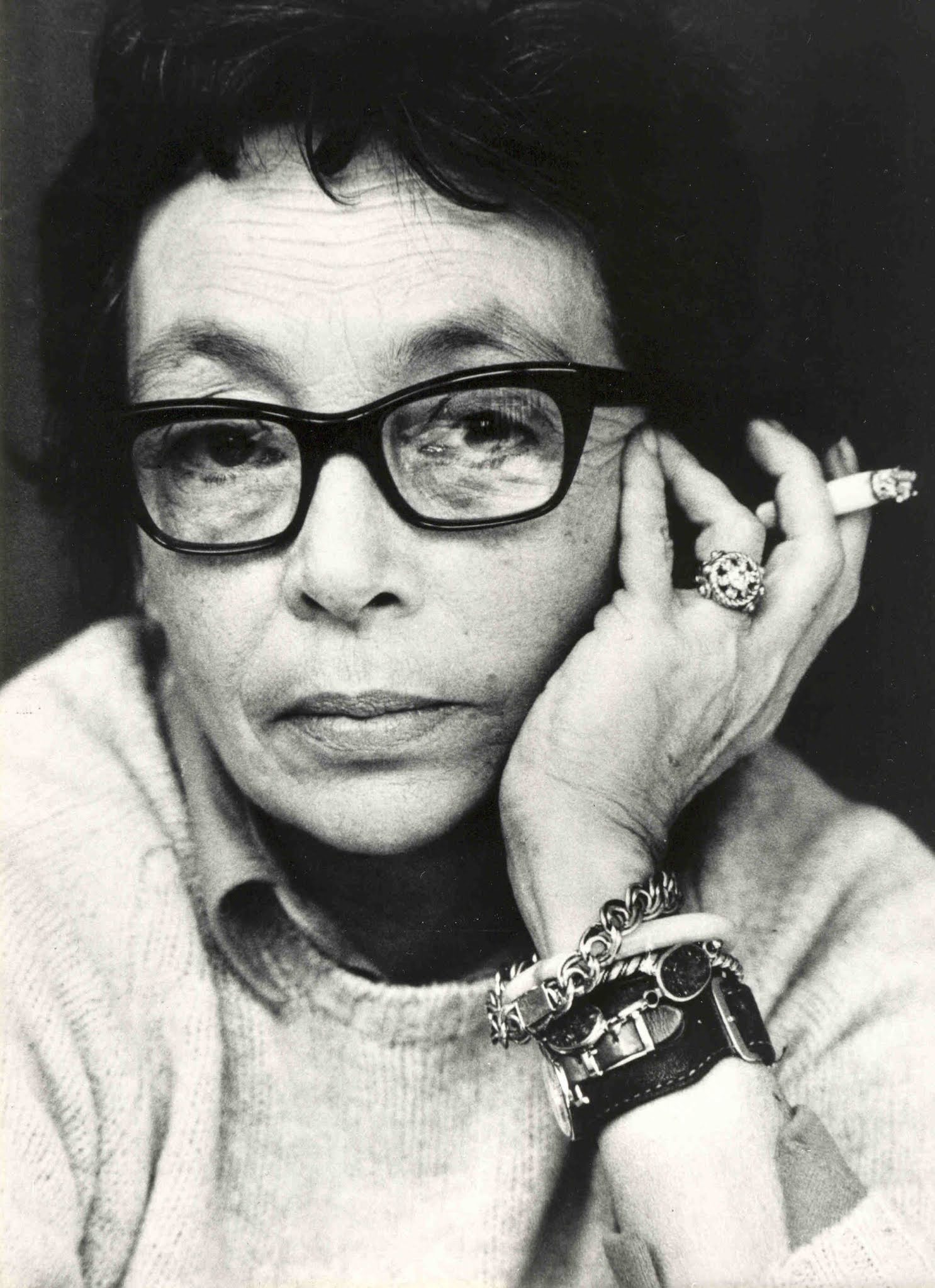
MARGUERITE DURAS, c 1970


The Writer:  Marguerite Donnadieu, known professionally as Marguerite Duras, was born on 4 April 1914 in Gia Dinh, a small colonial settlement located not far from the city of Saigon in what was then the French possession of Indochina and is today known as Vietnam.  Her father Henri Donnadieu, an expatriate mathematics teacher, became principal of the school at Gia Dinh where his wife Marie (née Legrand) worked on his staff between giving birth to their three children — Pierre, Paul and Marguerite, the baby of the family.  The future writer also had two older half-brothers, Jean and Jacques, by her father's first wife, a woman who had died some years previously in the northern Vietnamese city of Hanoi.
 
Henri Donnadieu's own health began to fail in 1918, seeing him repatriated to France where he too eventually died — in the house he had purchased in Duras (pronounced in the south of the country with a hard S to rhyme with 'glass') in his home département of Lot-et-Garonne — on 4 December 1921.  Marie was granted compassionate leave following his death and returned to France with her children in 1922, where they stayed with her family in the nearby town of Pardaillan until the middle of 1924 when, struggling to make ends meet, she took them back to Indochina, this time to the Cambodian capital Phnom Penh.
 
The family's stay in Cambodia was not a long one.  Marie and her children soon returned to Vietnam, living first in Vinh Long before relocating to Sa Dec and eventually to Saigon.  Still struggling financially and weary of the peripatetic life they had been living for the past five years, Marie was persuaded by the colony's male administrators to buy a rice plantation on the Cambodian coast approximately 80 kilometres from the southern provincial capital Kampot.  
 
The plantation, which legally became Marie's property in 1929 and was routinely inundated by the Pacific Ocean during the rainy season, proved impossible to cultivate and was virtually worthless, making her already dire financial situation that much worse.  The failure of her mother's scheme to build a wall that would protect her land from the ever-encroaching sea would haunt Duras for the rest of her life and become, along with the sexual relationship she had as a teenager with Huynh Tuy Le — the adult son of a wealthy Chinese merchant — a key theme of her writing that she would explore in the play L'Éden Cinema [The Eden Cinema, 1977], the novels Un barrage contre le Pacifique [A Barrier Against the Pacific, usually translated as The Sea Wall, 1950], L'Amant [The Lover, 1984] and the film scenario L'Amant de la Chine du Nord [The Lover from Northern China, 1991].


MARGUERITE DURAS, c 1930


By 1930 the family was once again living in Saigon where the strikingly beautiful sixteen year old Duras entered secondary school, obtaining her baccalauréat (equivalent to the North American SAT exam or the British GSCE exam) in philosophy which enabled her to return to France to complete her education.  Except for one brief visit to the colony in 1932, Duras would never again live in Indochina, settling instead in Paris with her family where she intended to study mathematics as her father had before her, only to change her mind and eventually obtain degrees in law and political science.

In January 1936 she met Communist writer Robert Antelme, becoming his lover and, a few weeks after the Nazi invasion of Poland on 1 September 1939 which marked the beginning of World War Two, his wife.  Within a year she was employed as a secretary at the Ministry of Colonies, a position she would retain until 1942 when, following a miscarriage that she never fully came to terms with, she was recruited by France's puppet Vichy government to work for Le Comité d'organisation du livre [the Committee for the Organisation of Books], a Nazi-sanctioned department responsible for distributing rationed paper to French publishing houses which functioned, in essence, as a kind of unofficial censorship bureau.

Working for the Vichy government did not prevent Duras from joining the Communist Party and, along with Antelme and her soon-to-be lover Dionys Mascolo, the Resistance movement.  Nor did it prevent herself and Antelme from hosting informal gatherings in their Paris apartment where the subjects of literature and politics were regularly and passionately discussed by some of the occupied city's leading scholars and intellectuals.  These visitors, who eventually became known as le groupe de Rue Saint-Benoît [the Saint-Benoît Street Group], encouraged Duras to write her first novel, Les Impudents [The Impudent Ones] which would be published by the firm of Plon in 1943 while she was still working for the Vichy government in close proximity to people like the collaborator Ramon Fernandez and his charming, socially prominent wife Betty whose life she would intervene to save following the liberation of Paris by the invading Allies in August 1944.

After being watched by the Gestapo for several months, Robert Antelme was finally arrested and sent to the Buchenwald concentration camp in June 1944, with Duras herself only evading capture through the efforts of her friend and comrade (and future President of France) François Mitterand.  It was probably her sexual relationship with the Gestapo agent Charles Delval that caused her husband to be transported rather than shot as so many members of the Resistance were — a relationship that did not prevent her from having Delval himself arrested and shot following the liberation.  It was Mitterand and Dionys Mascolo who located Antelme, who had been transferred to Dachau and now weighed only 38 kilograms, and arranged for his return to the French capital.  After nursing him back to health Duras divorced him in April 1947, marrying Mascolo just prior to the birth of their son Jean, her only child, in June of that same year.  (Antelme continued to work with Duras both politically and professionally following their divorce, living until 1990 despite suffering a paralyzing stroke in 1983.)


ROBERT ANTELME and MARGUERITE DURAS, c 1943


Although she had followed her debut novel with a second novel titled La Vie Tranquille [The Tranquil Life] in 1944, Duras would not publish her third novel Un barrage contre le Pacifique until June 1950, by which time she had been ejected (as had Antelme and Mascolo) from the Communist Party for indulging in the petit-bourgeois habits of visiting nightclubs and supposedly being 'too ironic' in her treatment of some of her fellow party members.  Her second marriage to Mascolo ended in 1956, allowing her to focus on what, in collaboration with friend and fellow novelist Gérard Jarlot, was a new career as a scenarist, playwright and script writer which resulted, in 1958, in her being asked to create an original screenplay by the young nouvelle vague [New Wave] director Alain Resnais.  The film Resnais made of her script, titled Hiroshima mon amour [Hiroshima My Love], was released in 1959 and became an international sensation, with critics making special mention of Duras's outstanding gift for dialogue.

Her film and stage work — her first play, Les Viaducs de la Seine-et-Oise [The Viaducts of the Seine and Oise Rivers], was performed in Marseille in 1960 — directly influenced her work as a novelist, seeing her abandon what fellow writer Raymond Queneau criticized as the 'romanticism' of Un barrage contre le Pacifique and her other early work for the oblique minimalism of the nouveau roman [New Novel] with its emphasis on direct speech and implied action and steadfast refusal to conform to the reader's expectations of what a novel 'should' be.  The latter half of the 1960s would see Duras apply these same techniques to the films she wrote and, beginning with Détruire, elle dit [Destroy, She Said] in 1969, directed — a decision prompted by her dissatisfaction with most if not all of the films which had thus far been adapted from her novels.  As with her work for the theater, much of Duras's film work was of an experimental, non-linear nature, often featuring images from one place or culture superimposed on top of another accompanied only by music and her own voice reading her own text.

Duras's decision to live alone in the town of Neauphle-le-Château, located in the Ile-de-France région not far from Paris, following her second divorce may have led, some of her friends came to believe, to her lifelong fondness for alcohol developing into uncontrolled dipsomania.  She was hospitalized for alcoholism in 1975 not long after meeting Yann Lemée, a homosexual writer thirty-eight years her junior who, following a relapse and further hospital stays in 1980 and 1985 (for emphysema this time) became, under the name Yann Andrea, her companion, secretary and, following her death, literary executor.  Duras wrote of her ongoing struggle with alcoholism in La Via Materielle [The Material Life], a collection of short essays published in 1987 three years after the phenomenal success of L'Amant had made her the most widely read living French author in the world.

Her success did not insulate her from her detractors, many of whom criticized her work for what they felt to be its lack of substance, with one critic going so far as to describe her as the 'vieux corbeau litteraire' [the old crow of literature] who should be 'jeter dans la Vologne' [thrown in the Vologne river].  Nor was Duras herself above criticizing other writers, several of whom — Jean-Paul Sartre and Roland Barthes to name just two — were considered iconic intellectual figures not only in their native France but in many other parts of the world as well.  
 
'Des gens très célèbres,' she told an interviewer in 1984 on a nationally televised programed devoted to examining her literary legacy, 'pour moi, n'ont pas écrit.  Sartre, il n'a pas écrit.  Pour moi il n'a pas su ce que c'était, écrire.  Il a toujours eu des soucis annexes, des soucis en second, de secondes mains.  Il n'a jamais affronté l'écriture pure.  C'est un moraliste, Sartre.  Il a toujours puisé dans la société, dans un espèce d'environnement du lui.  Un environnment politique, littéraire.  Ce n'est pas quelqu'un de qui je dirais: << Il a écrit >>.  Je n'y penserais même pas.  J'ai lu une chose du lui qui m'intérresait dans Situations, il parlait de la littérature américaine, oui.  Sans ça, rien… Mais vous savez ce n'est pas un jugement de valeur que je porte là.  Il y a des gens qui croient écrire, et puis les gens qui écrivent.  C'est rare, c'est très rare.'  [Very famous people, for me, don't write.  Sartre, he doesn't write.  For me he didn't know what writing was.  He always had other problems, second-rate problems, second-hand.  He never confronted the act of pure writing.  He was a moralist, Sartre.  He always had a position in society, in the specialized environment he inhabited.  A political, literary environment.  He's not someone of whom I would say: "He wrote."  I wouldn't even think that.  I read something of his which interested me in Situations, he spoke of American literature, yes.  Besides that, nothing… But you know this isn't a value judgement I'm making here.  There are some people who believe they write, and then some people who write.  That's rare, that's very rare.]


MARGUERITE DURAS, c 1990


Duras made a similarly controversial statement about Christine Villemin, mother of a four year old child named Gregory who was found murdered in October 1984 not far from his home in Lépanges-sur-Vologne, accusing the woman — who had refused her request for an interview — of having killed the boy herself.  (Villemin was arrested and convicted of the crime — partly on the strength, it was rumored, of what Duras wrote about her in an article titled Sublime, forcement sublime Christine V published in the French newspaper Libération — only to have her conviction overturned in 1993 due to lack of evidence.)

Duras published C'est Tout [That's All], a collection of her final thoughts dictated to Yann Andrea, in October 1995.  She died on 3 March 1996 in her apartment at 5 rue Saint-Benoît, the location of her wartime salon, and was buried four days later in Montparnasse cemetery, her plain gravestone identified only by the intials 'MD.'  In 1999 her son Jean Mascolo published a book of her recipes titled La Cuisine de Marguerite [The Cooking of Marguerite] which was soon withdrawn following a complaint from Andrea acting in his capacity as her literary executor.  Mascolo, who worked as an editor with his mother for many years, is also the founder of the publishing house Éditions Benoît Jacob which devotes itself exclusively to publishing her cinematic work and the many audio recordings she made about and for it.


Use the link below to read a 1991 article by journalist LESLIE GARIS about French writer and filmmaker MARGUERITE DURAS:


A French film adaptation of La Douleur, directed by EMMANUEL FINKIEL and starring MÉLANIE THIERRY as Marguerite Duras, BENJAMIN BIOLAY as Dionys Mascolo, EMMANUEL BOURDIEU as Robert Antelme and BENOÎT MAGIMEL as Pierre Rabier, was released in 2017.  It was released as Memoir of War in its subtitled English version and may be available to view via your preferred digital streaming service.  


You might also enjoy:


Thursday, 4 April 2024

The Write Advice 194: ANDRÉ BRETON


Put yourself in as passive, or receptive, a state of mind as you can.  Forget about your genius, your talents, and the talents of everyone else.  Keep reminding yourself that literature is one of the saddest roads that leads to everything.  Write quickly, without any preconceived subject, fast enough so that you will not remember what you’re writing and be tempted to re-read what you have written.


Manifesto of Surrealism (1924) 


Use the link below to read about the life and work of French surrealist writer and poet ANDRÉ BRETON (1896–1966): 


https://www.artnet.com/artists/andr%C3%A9-breton/


You might also enjoy:


The Write Advice 172: ANDRÉ GIDE


The Write Advice 158: ANDRÉ MAUROIS


The Write Advice 125: FRANÇOISE SAGAN


Thursday, 4 August 2022

The Write Advice 172: ANDRÉ GIDE


The only drama that really interests me and that I should always be willing to depict anew, is the debate of the individual with whatever keeps him from being authentic, with whatever is opposed to his integrity, to his integration.  Most often the obstacle is within him.  And all the rest is merely accidental.
 
 
Journal entry [1930]


Use the link below to read about the life and work of French writer and 1947 Nobel laureate ANDRÉ GIDE (1869–1951):


You might also enjoy:


Thursday, 16 June 2022

Tante Zulnie (1911) by FRANÇOIS MAURIAC

 
'Malagar'
The summer home of the Mauriac family
in Aquitaine
Photo credit: © Anaka


TANTE ZULNIE
[AUNT ZULNIE]

François Mauriac

 
Translated by 
BR


I remember the path in the Midi, which even during our most foolish games we would never dare to cross.  Aunt Zulnie would promenade along it all day, even during the hottest hours.  Hidden behind the St John pear tree, we would watch her as she passed to and fro: she rubbed, with what appeared to be a continuous gesture, her gouty fingers inside their torn gloves; her eyes, of which we never saw the whites, appeared to be eternally raised to heaven; between her lips a sliver of purple tongue was always visible.

One morning we approached her.  My cousin Camille, who was an audacious little girl, interrogated her:

'What do you do all day, Aunt Zulnie?'

Zulnie gave a start and answered:

'I listen.'

Camille grew more insistent.

'What do you listen to?'

But the old woman only said again:

'I listen.'

And she continued to slowly promenade like a tortoise when, after being picked up for a moment, it is put back upon the hot sand.

One afternoon in August, I was wandering with Camille in the orchard.  Some butterflies had landed on the violets, fluttering their wings.  Between the St John pear trees, we noticed Aunt Zulnie stop, her mouth open.  Her body cast a short shadow on the sand.  Despite this fearsome presence, Camille dared me to go ahead and eat one of the delicious pears which always made me sick.

'No one will see us,' she promised me.

But that night, we were deprived of dessert for having eaten this forbidden fruit.  Sister Marie-Henriette, who had consecrated her life to our grandmother's rheumatism, insinuated:

'It was your guardian angel who brought us this news…'

And grandmother said:

'It's my little finger…'

But on the grand staircase which led to our rooms, Camille shook her short curls at me and declared:

'Aunt Zulnie tattled on us, we'll have to take revenge on her…'

Already, by way of reprisal, Camille had applied herself to the task of allowing a blob of wax to drop onto each step while Aunt Zulnie paced up and down the path.  I was hesitant to go to war against Zulnie, so Camille pinched and scratched in a manner that made me submissive to her will.  During the siesta hour while the rest of the house, oppressed by silence, resonated with the double snoring of grandmother and Sister Marie-Henriette, we drew aside our mosquito nets and descended to the garden.

The wind carried a strong odor of burnt resin from the fires which, each night, we could see on the horizon, burning wildly.  Aunt Zulnie stood motionless in the atrocious heat, like a dazzled animal.  Following our plan, we approached her: Camille grabbed her right arm, I snatched her left arm, and we spun her round and round, slowly at first, then more quickly as though she were a monstrous top.  The old woman's bonnet fell off.  Her skull appeared, so ridiculously bald that Camille thought she would die from laughter.  Only a single grey tuft veiled her unlit face.  Suddenly, out of the blackness of her mouth, came the cry of a beast, sharp and prolonged, which scared us.  We let her go.  She swayed, then threw herself on a bench.

Already, Sister Marie-Henriette had come rushing out.  We were hidden between a clump of privet and the trees and could see the starched wings of her wimple shaking.  The sister questioned her:

'What is it, Aunt Zulnie?'

Terrified, we awaited her response.  But our victim used her twisted fingers, the nails of which had now broken through the seams of her glove, to brush the tuft of her hair from her forehead, and only murmured:

'I heard, I heard…'

And supported by Sister Marie-Henriette, she took herself off, repeating the only word of human language that she knew…

You are dead, all these years.  And tonight I think of you.  What did you hear, Aunt Zulnie?


© 1911 Les héritiers de François Mauriac
[© 1911 The Estate of François Mauriac] 


Use the link below to view more photographs of 'Le Domaine de Malagar,' the summer home of the MAURIAC family since 1843 located in the Aquitaine region of southwestern France.  (The site is worth visiting for the photographs alone even if you don't speak French.)


You might also enjoy:


Thursday, 19 May 2022

La planète des singes [The Planet of the Apes] (1963) by PIERRE BOULLE


Pocket/Le Livre de Poche France, 2017


Ce fut bientôt mon tour.  Pendant qu'un des gorilles montait la garde, l'autre pénétra dans ma cage et plaça devant moi une terrine contenant la pâtée, quelques fruits et un seau.  J'avais décidé de faire mon possible pour établir un contact avec ces singes, qui paraissaient bien les seuls êtres civilisés et raisonnables de la planète.  Celui qui m'apportait à manger n'avait pas l'air méchant.  Observant ma tranquillité, il me tapota même l'épaule d'un geste familier.  Je le regardai dans les yeux; puis, portant la main à ma poitrine, je m'inclinai cérémonieusement.  Je lus un intense surprise sur son visage, en relevant la tête.  Je lui souris alors, mettant toute mon âme dans cette manifestation.  Il était près de sortir; il s'arrêta, interloqué et poussa une exclamation.  J'avais enfin réussi à me faire remarquer.  Voulant confirmer mon succès en montrant toutes mes capacités, je prononçai assez stupidement la première phrase qui me vint à l'ésprit.
    << Comment allez-vous?  Je suis un homme de la Terre.  J'ai fait un long voyage. >>


It was soon my turn.  While one of the gorillas stood guard, the other entered my cage and placed in front of me a clay bowl containing mush, some fruit and a bucket.  I had decided to do everything possible to establish contact with these apes, who appeared to be the only truly civilized and reasonable beings on the planet.  The one who brought me my food was not spiteful.  Observing my tranquility, he even made the familiar gesture of patting me on the shoulder.  I looked him in the eye; then, bringing my hand to my chest, I  made a ceremonious bow.  I read intense surprise on his face as I raised my head.  I smiled at him then, putting all my soul into this demonstration.  He was close to me; he stopped, taken aback, and let out an exclamation.  I had at last succeeded in getting myself noticed.  Wanting to confirm my success by displaying all my capacities, I spoke the first foolish phrase which came to mind.
    'How are you?  I am a man from Earth.  I have made a long voyage.' 


Excerpts translated by
 
BR


The Novel:  Many of the world's most intriguing works of science fiction are based on what, on paper at least, appear to be the unlikeliest of premises.  A scientist gains the ability to travel backward or forward in time or discovers the secret to making themselves invisible or super strong or ant-sized.  Technology develops an agenda of its own and turns against its creators, pitting man against machine in a ruthless battle for control of Planet Earth.  An expedition sets out to explore a remote galaxy and discovers a world where apes have become the dominant species and human beings have devolved into their naked, speech-deprived inferiors, housed in zoos or laboratories where they're routinely subjected to arduous scientific experiments designed to test their intelligence and measure their physical capacities.


It is the latter scenario that French writer Pierre Boulle explored so effectively in his influential 1963 novel La planète des singes, known to the anglophone world as The Planet of the Apes.  His protagonist, a journalist and volunteer astronaut named Ulysse Mérou, is portrayed as a kind of baffled and embattled Christ figure, estranged from his fellow human beings and a source of suspicion to his incredulous ape overlords who view him and his uncanny gifts for engaging in abstract thought and learning their language as potential threats to their dominance.  He is, in effect, the Last Man –– an isolated survivor of the human race seemingly doomed to end his days on the remote planet Soror as a marginalized member of a simian society he will never understand but can never hope to escape.


Boulle tells Mérou's story using the literary device of a framing narrative, beginning with the discovery of his journal by two young travelers named Jinn and Phyllis who are spending their honeymoon in space 'le plus loin possible des astres habités' [as far as possible from the inhabited stars].  This journal –– the space-age equivalent of the 'message in a bottle' once so popular with earthbound castaways –– recounts Mérou's long voyage into space with his mentor the brilliant Professor Antelle and a young doctor named Arthur Levain, their mission to explore the Betelgeuse solar system and determine if there might be any planets in it capable of sustaining human life.  


They stumble upon what they believe to be an inhabitable planet and descend to it in their landing capsule accompanied by Hector, their pet chimpanzee and mascot.  Here they discover a lush and healthy world dotted with many cities and hundreds if not thousands of smaller, well established settlements.  Yet they find no visible signs of life and wonder if the population has been destroyed by some cataclysm until they discover a footprint which, after much debate, they conclude can only be that of a female human being.  They soon encounter this girl swimming in a pool created by a waterfall –– a beautiful naked creature, immediately christened Nova by Mérou, who is incapable of normal human speech as are her companions who, illogically terrified by the presence of Hector, impulsively slaughter the unfortunate beast in cold blood.


Mérou and his fellow travelers have little time to mourn the death of their beloved mascot, however, as they and their fellow humans are attacked the following morning by a group of talking gorillas decked out in hunting attire and carrying loaded guns.  Levain is killed in the raid, while Mérou and Antelle are taken into captivity along with Nova and dozens of her scared and quickly subdued brethren. They are transported by cart to a nearby settlement where, after their dead companions have been photographed by the gorillas who treat the human corpses as hunting trophies, Mérou soon finds himself locked in a cage inside a building known as l'Institut des hautes études biologiques [The Institute of Advanced Biological Studies].  Bewildered, frustrated and concerned for the fate of Antelle, Mérou unsuccessfully attempts to communicate with his gorilla attendants before becoming the research project of Zira, a female chimpanzee scientist.   


Unibolso Portugal, 1968


Zira's research is supervised by an elderly orang-outan named Zaïus with whom Mérou also tries to communicate, only to have his efforts met with patronizing scorn.  Desperate to make the Director understand that he's intellectually superior to his fellow captives, he imitates Zaïus's actions and speaks his name, making the orang-outan nervous but impressing Zira who cannot help but applaud what she deems to be his extraordinary gift for mimicry.  But Zaïus does not share his colleague's enthusiasm.  'Il dicta encore des notes à sa secrétaire, donna des instructions détaillées à Zira, qui les écouta d'un air peu satisfait, et finit par s'en aller aprés m'avoir lancé un dernier regard grognon.'  [He dictated more notes to his secretary, gave some detailed instructions to Zira, who listened to them with an air of dissatisfaction, and finished by walking out after throwing me a final grumpy look.]  The implications of Zaïus's reactions are obvious –– the freakish newcomer must be closely monitored to ensure he doesn't inspire his fellow humans to revolt against the established simian order.


In time Mérou is placed in a cage with Nova, only to be punished, after a reluctant Zira is ordered to describe his recent disruptive behavior to Zaïus, by having the girl moved to another cage occupied by a different male, ostensibly so the human mating ritual can be more meticulously observed.  Losing Nova –– a creature Mérou describes at one point as 'une des plus belles filles du cosmos' [one of the most beautiful girls in the cosmos] –– proves too much for his addled reason to bear, reducing him to a primitive state which earns him a rare smile from Zaïus who, sensing that a crucial victory has been won, orders that his lost companion be immediately restored to him.  (As Mérou admits, spending his days and particularly his nights caged up with such an attractive unclad girl is not without its compensations.  He is, after all, a red-blooded Frenchman despite his baffling predicament.)  


Mérou is no longer subjected to such close scrutiny by Zaïus following this incident, earning him the time required to learn the language of the apes and win the trust and respect of Zira.  With this sympathetic chimpanzee serving as his teacher and protector, Mérou makes rapid progress, eventually engaging in philosophical discussions with the female ape during which she makes it clear that her species descended from man and not, as he believes, the other way round.  Zira also warns her new friend not to antagonize Zaïus and his fellow orang-outans, explaining that this could easily result in him being murdered by them in the name of science –– a warning echoed by Zira's fiancée Cornelius, a chimpanzee professor at the city's prestigious scientific academy who uses his growing influence to arrange for Mérou to address a specially convened session of Soror's ruling congress. 


Zira and Cornelius also arrange for Mérou, who has now been given access to books and a suit of clothes to cover his nakedness, to be reunited with his lost friend and mentor Professor Antelle.  But their reunion is not a happy one.  Antelle has not fought his subjugation by the apes, becoming as torpidly uncommunicative as his fellow zoological specimens, his days now spent putting his arms through the bars of their enclosure to silently beg snacks from passing children.  The sight of this depresses Mérou, prompting a request that Antelle be removed from the zoo as soon as possible.  "Après le congrès," Zira promises, "quand tu auras été reconnu et accepté comme un être raissonable, nous nous occuperons de lui."  ['After the congress… when you've been recognized and accepted as a reasonable creature, we'll occupy ourselves with him.']


The day for Mérou to address the congress arrives, seeing him eloquently plead his case for freedom to a packed house containing all of Soror's leaders and its most important dignitaries.  Mérou tells the assembled apes, including a disapproving and soon enraged Zaïus, about Earth and the differences between ape and human evolution on their respective planets, ending with an impassioned plea for his own liberation so that his knowledge can be utilized to help establish contact between the two worlds.  So stressful is the situation Mérou now finds himself in — particularly after Zaïus angrily storms out of the chamber in contempt — that it causes him to faint, only to regain consciousness soon afterwards in a different room where he's informed by a beaming Zira and Cornelius that his speech was a resounding success.  They're going to do great things together, Cornelius predicts before announcing that the Grand Council has decided to grant Mérou his freedom and provide him with his own apartment at the Institute.  


A few days later the newly freed human is the guest of honor at a lavish civic reception –– an experience he also finds troubling because he can't escape his memories of Professor Antelle or come to grips with the idea that he too may be on the verge of losing his humanity.  A second attempt to communicate with the Professor does nothing to dispel these fears.  Visiting Antelle in his new home –– a cage at the Institute –– Mérou finds the older man cuddled up to a young girl and still unwilling or, he fears, incapable of communicating with him.  Mérou begs his former mentor for a word, repeating his request after the apes have tactfully left them alone together, only to be greeted by a long loud howl.


Luckily, some good new does await Mérou following this disturbing setback.  He now has the freedom of the city (plus several suits of tailormade clothing and a television set of his own) while his old enemy Zaïus has been replaced as Director of the Institute by Cornelius, a power shift which does much to mitigate the intellectual if not the physical loss of his friend Antelle.  He's also free to visit Nova as often as he likes, although this 'privilege' likewise raises some disconcerting questions for him.  Isn't Nova simply a beautiful animal?  An attractive member of what, at the end of the day, is and will probably always be an inferior species?  While the girl responds better than most humans to his efforts to teach her to speak, she still has a long way to go before she can be said to have mastered the concept of vocalized language.


Pocket/Le Livre de Poche France, c 1990


Mérou is distracted from these problems by an invitation to visit Cornelius at an archaelogical dig the ape is supervising in a far off desert region of Soror.  He flies to the site with Zira, engaging in another discussion during the journey about the differences between ape and human evolution, and is confronted upon arrival by what he soon becomes convinced must be the ruins of an ancient human city –– a conviction apparently confirmed by the discovery of a doll that's been preserved beneath the sand more or less intact and which, unlike the dolls given to ape children, is not a representation of an animal and is also fully clothed.  But another, even more profound surprise awaits the visitor when he's finally permitted to handle this precious archaelogical object.  'La poupée parle.  Elle parle comme une poupée de chez nous… Elle a prononcé un mot, un simple mot de deux syllables: pa-pa.'  [The doll spoke.  It spoke like one of our dolls… It pronounced a word, a simple word of two syllables:  pa-pa.]  Like Mérou, Cornelius is overwhelmed by the discovery of this artifact.  But not so the orang-outan specialist whose task it was to unearth it.  The ape prefers to treat it as a distant relic of ape history and not as what Mérou believes it to be –– concrete proof that homo sapiens was once the dominant species on Soror. 


Mérou is sent away from the dig the following day, taking with him far more questions than he can possibly hope to answer regarding the relationship between apes and mankind and the role imitation must have played in the accelerated evolution of the former.  What happened to the human population of Soror?  'Choc brutal?' he asks himself.  'Cataclysme?  Ou bien lente dégradation des uns et ascension progressive des autres?'  [Brutal shock?… Cataclysmic event?  Or the very slow degradation of one species and the progressive ascent of the other?]  Shaken to his core, he decides to calm himself by paying another visit to Nova.  But he arrives to find Nova gone, transferred to another part of the Institute because, Zira informs him, the beautiful 'creature' is now pregnant with his child.  


Mérou's joy at the prospect of becoming a father proves to be shortlived.  With Cornelius, he visits the surgical wing of the Institute where he's introduced to the work of another young chimpanzee, a doctor named Hélius whose job it is to conduct lobotomies and what are sometimes barbaric and degrading anatomical experiments on expendable human subjects.  One of these subjects, a comely young girl who has had electrodes attached to various parts of her head and body to help simulate the effects of epilepsy, reminds the horrified visitor of Nova –– an association which forces him to cry out in protest at what's about to be done to her.  Cornelius hurries him from the room, reminding him that he has only been shown these experiments because it is in his own interest, as his future scientific partner and collaborator, to comprehend their purpose.  But this is too much for Mérou, who fears the apes may have learned to imitate their human masters a little too well during the course of their uncannily rapid evolution from sub-dominant to dominant species.


Everything comes to a head with the birth of Mérou's son, a healthy baby boy whom he names Sirius.  He has great expectations for the child, seeing in him a new cause of hope for humanity.  (He even compares the boy to Christ and his mother to the Virgin Mary while watching him sleep on Nova's delightfully lush bosom.)  But this sudden surge of optimism is again cut short by the knowledge that his son's only chance of reaching his full potential will be to leave Soror and return to Earth, albeit to an Earth which has advanced seven hundred years in his absence.  (The original three man expedition traveled into space at light speed, hence the accelerated passage of time since its departure.  Or something to that effect, anyway.)  


Not even Cornelius can deny this after three more months pass and word spreads that Sirius, the child of the freak, is already able to talk –– a fact which makes him a serious threat to the planet's orang-outan administrators just as the continuing existence of his suspiciously intelligent father continues to challenge and frustrate them.  This time, Cornelius warns, Zaïus will not be dissuaded from taking action to ensure that any threat the boy may pose to simian superiority is ruthlessly and permanently neutralized.  Their only option, he declares, is to send Mérou and his family back to their home planet in the mother ship which is still orbiting Soror and can be accessed, he believes, using its original landing capsule which has now been recovered and repaired.  There is enough fuel, food and water aboard the mother ship to allow them to safely complete the return journey to Earth and several more besides, so the plan is quickly finalized.  Mérou, Nova and Sirius will be exchanged for the three human test subjects the apes shortly plan to launch into space inside the repaired landing capsule.  


Mérou is grateful and relieved, cheered by the belief that he can use the voyage to improve Nova's communication skills and teach Sirius everything he needs to know about life on his true homeworld.  The only task remaining, it appears, is to bid farewell to Zira who, while aware that her strange new friend definitely needs to leave, is nevertheless oddly upset to see him go.  'Elle est aussi bouleversée que moi.  Je vois une larme couler son mufle.  Ah!  qu'importe cette horrible enveloppe matérielle!  C'est son âme qui communie avec mienne… Je me force à appuyer ma joue contre sa joue.  Nous allons nous embrasser comme deux amants, quand elle a un sursaut instinctif et me repousse avec violence… <<Mon chéri, c'est impossible.  C'est dommage, mais je ne peux pas, je ne peux pas.  Tu es vraiment trop affreux!>>  [She was as overwhelmed as I was.  I saw a tear roll down her muzzle.  Ah, what does this material envelope matter!  I forced myself to put my cheek against her cheek.  We were going to kiss like two lovers, when she gave an instinctive jump and violently pushed me away… 'My dear, it's impossible.  It's a shame, but I can't, I can't.  You are really too ugly!'] 


Julliard France, 2001


Cornelius's plan goes off without a hitch and soon Mérou and his new companions –– Antelle does not join them for the return journey to Earth because he's clearly beyond help and seems content enough in his restrictive new environment –– are on their way to Earth.  The journey, which takes several years, allows Sirius and Nova to develop their communication skills as planned, with the latter becoming noticeably more rational and markedly less animalistic in her behavior by the time they reach their destination.  Finally they arrive, their capsule touching down at the Orly space port in Paris –– a city, Mérou is pleased to see, which has retained its famous Eiffel Tower.  Expecting a grand reception, Mérou is disappointed to see only one truck, and a very old truck at that, driving out to meet them.  And, to make matters worse, its driver and passenger aren't human.  They're gorillas, the mere sight of which is enough to send Nova and her son fleeing back to the capsule which a shattered Mérou pilots back to the mother ship that will be home to all three of them, he grimly realizes, for the remainder of their lives.


The story ends as it began, with the honeymooning Jinn and Phyllis reacting to what they've read in Mérou's journal and feeling, at least in the case of the latter, strangely moved by it.  But they don't dwell on these events or the emotions they've aroused for long.  Soon they too are on their way home, Phyllis pausing only long enough to give her hairy ears a scratch before powdering her adorably cute muzzle.


Like all worthwhile science fiction, La planète des singes is much more than a fantastic tale of space exploration gone horribly awry.  Unlike the string of uneven Hollywood films it inspired –– beginning with the excellent Planet of the Apes in 1968 and continuing with its gradually less engaging sequels throughout the 1970s before the franchise was successfully rebooted in 2001 –– the novel asks difficult questions about human nature and humanity's treatment of so-called 'dumb animals' that have never lost their relevance.  By copying us, the apes are able to create and maintain a civilization which, aside from a few technological advances, is virtually a mirror image of human civilization.  Yet in doing so they also inherit all of our most deplorable characteristics –– our penchant for violence and cruelty, our lack of compassion and misguided sense of superiority, our racism and, in the important and ironically drawn character of Zaïus, our pedantry and instinctive fear of anything that threatens to replace or even challenge the prevailing status quo.  The human inhabitants of the planet Soror hate and fear their sometimes brutal simian masters, most of whom dismiss them as so much disposable cattle, as easy to kill as they are to capture, imprison and use as subjects for their barbaric experiments.  Neither species understands the other nor makes any genuine effort to do so –– a situation eerily reflective of today's widespread culture of xenophobically-driven intolerance.  


Boulle was a clever writer who understood that the most frightening force in the universe is not some bug-eyed monster or acid-spitting alien hell bent on annihilating us, but rather ourselves and our unconquerable urge to act in ways guaranteed to bring about our own destruction.  Nowhere is this message more powerfully delivered than in the character of Professor Antelle, a genius who abandons his humanity to live in a cage where his most basic urges –– those for food, sex and shelter –– are readily and consistently satisfied, quickly reducing him to a state of total if blissful dependence on his ape overlords.  How far away are any of us, Boulle seems to be asking, from joining this gibbering simulacrum of a man inside his cage?


PIERRE BOULLE, c 1957


The Writer:  It is interesting to speculate if the name Pierre Boulle –– author of twenty-four novels, seven collections of short stories and numerous works of nonfiction –– would be remembered today were it not for the fact that two of his books were adapted into iconic Hollywood films.  His third novel Le Pont de la rivière Kwaï [The Bridge on the River Kwai, 1952] was adapted for the screen by British director David Lean in 1957 and won its star Alec Guinness that year's Academy Award for Best Actor.  Boulle's tenth novel La planète des singes [The Planet of the Apes, 1963] was adapted by North American director Franklin J Schaffner in 1968 and is now considered a classic of cinematic science fiction, so influential that it earned a place on The 500 Greatest Films Of All Time list as selected by the readers of Empire magazine in 2008.  In neither case did Boulle have anything to do with the adaptations of his work, although he did receive a screenwriting credit for The Bridge on the River Kwai because its true writers, Carl Foreman and Michael Wilson, had been blacklisted by the US government as a result of their alleged Communist affiliations.


Pierre François Marie Louis Boulle was born on 20 February 1912 in the city of Avignon in southeastern France, the son of an eccentric lawyer who preferred writing theater reviews for a local newspaper to practicing his chosen profession.  (Boulle's mother Thèrése was the daughter of the newspaper's managing editor.)  Boulle spent a peaceful childhood in Avignon with his sisters Suzanne and Madeleine, attending Catholic mass each Sunday with them and his parents. In 1918 he entered the local petit lycée –– a school for the students of privileged families who were expected to attend high school before continuing on to university. 


Boulle's father, with whom the future writer shared a lifelong love of literature, hunting and games, died of heart disease in 1926.  Feeling he had a duty to support his widowed mother, the fourteen year old Boulle worked hard to gain entry to the prestigious engineering school L'École supérieure d'électricité from which he graduated in 1933 with an engineering degree.  In 1936, at the age of twenty-four, he left France for what was then known as British Malaya where he became a technician on a rubber plantation located fifty kilometres from its capital Kuala Lumpur, experiences he would later incorporate into his second novel La Sacrilège malais [The Malay Sacrilege] published by Julliard in 1951. 


Boulle was still working in Malaya when World War Two began in September 1939 and immediately traveled to Vietnam (then known as French Indochina) to enlist in the French army.  After the fall of France in May 1940 and its subsequent occupation by the Germans he returned to Singapore where, as a loyal supporter of General Charles de Gaulle, he joined the Free French Mission whose commander, a former rubber planter named François Girot de Langlade, worked out of the British military base in the soon to be conquered and occupied island city.  Boulle was given the rank of Lieutenant and appointed the mission's liaison officer, responsible for coordinating the respective Free French and British war efforts and quickly recruited into Force 136 –– a unit of the British-run Special Operations Executive entrusted with the task of fomenting revolt among the local population and doing whatever else it could to hamper and deter the invading Japanese.  He was also issued with a false English passport which identified him as 'Peter John Rule.'  


Boulle was working for Force 136 in Indochina when he was captured in 1942 by French troops loyal to the Nazi-backed Vichy government.  Condemned as a traitor, he was sentenced to hard labour for the remainder of the war.  Two years later he managed to escape his captors and flee to Saigon and then to British-held Kolkata (then known as Calcutta) where he rejoined Force 136 and continued to engage in sabotage and other clandestine operations behind enemy lines, earning the Légion d'honneur, the Croix de Guerre, the Médaille de la Résistance and several other high level military decorations for his attendance to his patriotic duty.  In 1966 he published a memoir titled Aux Sources de la rivière Kwaï [translated as My Own River Kwai] which recounted his war experiences as both a prisoner and a spy.


PIERRE BOULLE, c 1984


Boulle returned to his former profession after being discharged from the army but, wishing to make something of his adventures, returned to France in 1949 with the intention of becoming a writer, selling everything he owned to finance the trip and support himself while he pursued his risky new profession.  Unable to afford an apartment of his own, he lived in a Paris hotel for a time before receiving permission from his recently widowed sister Madeleine to move in with her.  It was in her spacious apartment, temporarily free of financial burdens, that he began to write in earnest, using his young niece Françoise –– a child he helped to raise and unsuccessfully attempted to adopt –– as a sounding board for his ideas. 


His first novel William Conrad, a popular spy tale which earned encouraging reviews from the French critics, was published in 1950.  (It was later adapted for television in both North America and France.)  But it was the 1952 publication of his third novel Le Pont de la rivière Kwaï  [The Bridge on the River Kwai] that made his reputation, winning him the Prix Sainte-Beauve and introducing him to international readers via its translation into English and several other languages.  Although he continued to publish at least one book per year until 1992, it was La planète des singes, a self-described 'minor' novel that appeared in 1963, that made him a household name, with its original cinematic adaptation and subsequent spinoffs ensuring that it has never fallen out of print. 


Now recognized along with Jacques Spitz, René Barjavel and José Moselli as a pioneering figure in the field of French science fiction, Boulle continued to write and publish in more or less self-imposed seclusion until two years before his death, in Paris, on 31 January 1994 at the age of eighty-one.  He was survived by his beloved niece Françoise who, in 2005, oversaw the publication of what was to be his final novel, a previously unpublished manuscript probably written between 1949 and 1951 which appeared under the title L'Archélogue et le Mystère de Néfertiti [The Archaelogist and the Mystery of Nefertiti].  Françoise and her husband Jean Loriot also discovered a previously unknown sequel to La planète des singes among Boulle's papers, written in the form of a screenplay, which has yet to be published.


Use the link below to read an August 2014 article about the life and literary legacy of PIERRE BOULLE:


Film Poster, 2017


The various cinematic adaptations of Planet of the Apes have all been released on DVD and via streaming services at some time in most regions of the world.  The latest addition to the franchise, The War For the Planet of the Apes, was released in July 2017 and, like its predecessors, should not be hard to find.


The original 1968 film –– which starred CHARLTON HESTON as a North American version of Mérou renamed George Taylor, KIM HUNTER as Zira, RODDY McDOWALL as Cornelius, MAURICE EVANS as Zaïus and LINDA HARRISON as Nova –– also spawned a shortlived 1974 live action television series which was followed, one year later, by an equally shortlived animated series titled Return to the Planet of the Apes.     


Planet of the Apes has been adapted many times in comic book form, beginning in 1974 with a Marvel Comics version of the original 1968 film and continuing to the present day with various companies, including Dark Horse and Boom! Studios, offering readers their own interpretations of ape-related material.  


Marvel Comics, 1975

Dark Horse Comics, c 2001

Boom! Studios, 2011


Boom! Studios, 2018


You might also enjoy: