Pages

Showing posts with label North American Songwriters. Show all posts

Thursday, 19 February 2026

Thursday, 15 August 2024

Words for the Music 027: DORY PREVIN


DORY PREVIN
 22 October 1925 – 14 February 2012


 CHILDREN OF COINCIDENCE

DORY PREVIN

from the 1976 Warner Records LP

We're Children of Coincidence

and Harpo Marx


CHILDREN OF COINCIDENCE


If I hadn't made a left-hand turn

If you hadn't made a right

If I'd waited just a moment more

If you'd missed the light

If that car had never blown its horn

If that friend had stopped to talk

We'd have never met at all

If I didn't take that walk

I'd have gotten there too early

You'd have gotten there too late

We are childen of coincidence

Coincidence and fate


Crossed connections

Lost connections

Empty corners

Crowded intersections

Accidents

And incidents

We're children of coincidence 

And chance


If he hadn't stopped to pick it up

If she hadn't dropped her book

When she took it if she'd noticed him

How come we never look

If she hadn't been so very white

If he hadn't been so black

Would she smile and say hello to him

Would he have turned his back

If she cancelled her appointment

Would he break his other date

We are children of coincidence

Coincidence and fate


Crossed connections

Lost connections

Empty corners

Crowded intersections

Accidents

And incidents

We're children of coincidence 

And chance


If the planets were in perfect place

If your sign was on the rise

If my stars were in complete accord

But the sun was in your eyes

You'd have only seen my shadow

As I passed you on the street

And it might have been a hundred years

Before our souls would meet

And we would still be strangers 

Too early and too late

We are children of coincidence

Coincidence and fate


Crossed connections

Lost connections

Empty corners

Crowded intersections

Accidents

And incidents

We're children of coincidence 

And fate


Words and music by

DORY PREVIN


© 1976 Warner Records/Rhino Music


Dory Previn, who was born Dorothy Langan on 22 October 1925, began her career as a cabaret performer and lyricist, initially working most frequently with pianist and composer André Previn, the man who became her second husband in 1959.  


The couple wrote a number of well-received songs together while working under contract at MGM studios, garnering their first Academy Award nomination for The Faraway Part of Town that was performed by Judy Garland in the 1960 film Pepé and a second nomination for their 1962 song Second Chance which featured in Two For The See-Saw, a popular film starring Robert Mitchum and Shirley Maclaine.  


The next six years saw the couple compose many more cinema-related songs together including You're Gonna Hear From Me (recorded by Frank Sinatra among others) and five witty, tongue-in-cheek titles for the 1967 adaptation of Jacqueline Susann's scandalous 1966 bestseller Valley of the Dolls.  This is all the more impressive given that Dory Previn suffered a psychiatric breakdown in 1965 that saw her briefly hospitalized to undergo treatment for severe depression.


Previn's transition from witty Broadway-style lyricist to 1970s singer/songwriter was triggered by the second breakdown she experienced after learning that her husband, who had gone to the UK to work as the conductor of the London Symphony Orchestra, was having an affair with actor Mia Farrow and had fathered a child by her.  Previn's breakdown began on the aircraft she had boarded, despite her lifelong fear of flying, to take her to the English capital where she hoped to somehow salvage her doomed marriage.  


Writing, specifically about herself and her emotions, became a key component of her therapy and led to the creation of the songs that would appear on her critically acclaimed 1970 LP On My Way To Where.  (This was her second album, preceded by a jazz-based recording of original material titled The Leprechauns Are Upon Me that she released under the name 'Dory Langdon' in 1958.)  The album, which featured her accompanying herself on guitar along with other musicians, included the song Beware of Young Girls, a thinly veiled attack on Mia Farrow who married her former husband that same year, an event which saw Previn re-hospitalized to undergo another course of electro-convulsive therapy.  


The LP also featured the chilling cut With My Daddy in the Attic that spoke indirectly of Previn's difficult and possibly incestuous relationship with her father, an Irish-American World War One veteran who had been gassed in the trenches and was prone to episodes of extreme paranoia that, at their worst, saw him become violent toward his wife and children and, at one point, keep them literally imprisoned inside the family home for several months.  Despite this and his destructive habit of alternately overindulging and ignoring her, Previn's father was supportive of her decision to become a performer after she displayed genuine talent as both a singer and a dancer in her youth.


On My Way To Where was followed by six more LPs of original singer-songwriter material including Mythical Kings and Iguanas (1971), Reflections In A Mud Puddle (1971), the concept album Mary C Brown and the Hollywood Sign (1972), the self-titled Dory Previn (1974) and what was to be her next to last solo effort We're Children of Coincidence and Harpo Marx (1976).  She also found time to write two autobiographies, a television screenplay, a song for the controversial 1973 film Last Tango in Paris in addition to releasing the double LP Live At Carnegie Hall that went on to become her most enduringly popular recording.  


All of Previn's music features startlingly honest and strikingly original lyrics, many of which are as good as any of those penned by her 1970s singer-songwriter contemporaries, and clever arrangements that make the best use of her limited vocal range.  She was never afraid to tackle taboo topics like incest, artistic failure and the bogus spiritualist movement of the 1970s, often disarming listeners with her combination of high intelligence and what, on occasion, could be dark and even macabre humor.


Previn spent the 1980s focusing on stage work, often appearing under the name Dory Previn Shannon, and writing short stories and a novel titled Word-Play With An Invisible Relative.  All this work did not prevent her from co-writing the theme song for the 1980s sitcom Two Of A Kind for which she and her songwriter partner Jim Pasquale received an Emmy award in 1984.  That same year she married actor and artist Joby Baker, going on to collaborate with him on an illustrated edition of her 1970s song lyrics that appeared in 1995 as The Dory Previn Songbook.  


Two years later Previn revived her professional partnership with her former husband André Previn, collaborating with him on The Magic Number, a piece he composed for orchestra and solo soprano.  She allegedly contacted Woody Allen after the comedian was accused of sexually molesting his adopted daughter Dylan in 1992, suggesting that Mia Farrow had based the story of what had been done to Dylan inside the Farrow home on the lyrics of her song With My Daddy In The Attic.  Nor is it without significance that, like the decidedly menacing father figure in the song, Allen also plays the clarinet.


Despite suffering a series of minor strokes which affected her eyesight, Previn continued to work and managed to release a final LP — another conceptual work about the environment and the threat of nuclear war titled Planet Blue — in 2002, a decade before her death at the age of eighty-six on 14 February 2012.  


Use the link below to listen to more great music by lyricist, composer and cabaret/stage performer DORY PREVIN: 


https://www.youtube.com/results?search_query=dory+previn


Special thanks to everyone who takes the time to upload music to YouTube.  Your efforts are appreciated by music lovers everywhere.


Use this link to read a long post by JUSTIN LEVINE about the connections between DORY PREVIN and the more lurid aspects of the ALLEN/FARROW scandal:


https://levine2001.medium.com/the-woody-allen-controversy-reader-did-dory-previns-song-lyrics-influence-mia-farrow-in-accusing-6cb1f83038fe


You might also enjoy:


Friday, 11 August 2023

Words for the Music 026: NANCI GRIFFITH


NANCI GRIFFITH
6 July 1953 – 13 August 2021


THERE'S A LIGHT BEYOND 
THESE WOODS,
MARY MARGARET
NANCI GRIFFITH
from the 1978 BF Deal LP
There's a Light Beyond 
These Woods,
Mary Margaret


THERE'S A LIGHT BEYOND 
THESE WOODS,
MARY MARGARET
 
 
There's a light beyond these woods
Mary Margaret
Do you think that we will go there
And see what makes it shine
Mary Margaret
It's almost morning
And we've talked all night
You know we've made big plans
For ten year olds
You and I
 
Have you met my new boyfriend
Margaret
His name is John
And he rides my bus to school
And he holds my hand
He's fourteen
He's my older man
But we'll still be the best of friends
The three of us
Margaret, John and I
 
Let's go to New York City
Margaret
We'll hide out in the subways
And drink the poet's wine
Oh but I had John
So you went and I stayed behind
But you were home in time
For the senior prom
When we lost John
 
The fantasies we planned
Well I'm living them now
All the dreams we sang
When we knew how
Well they haven't changed
There's never been two friends
Like you and me
Mary Margaret
 
Nice to see your family growing
Margaret
Your daughter and your husband there
They really treat you right
But we've talked all night
And what about the light
That glowed beyond our woods
When we were ten
You were the rambler then
 
The fantasies we planned
Oh Maggie
I'm living ’em now
All the dreams we sang
Oh we damn sure knew how
But I haven't changed
There'll never been two friends
Like you and me
Maggie can't you see

There's a light beyond your woods
Mary Margaret


Words and music
NANCI GRIFFITH


© 1978 BMG Rights Management
Universal Music Publishing Group 


The unexpected death (of undisclosed causes) of North American country/folk artist Nanci Griffith on 13 August 2021 came as a great shock to her many fans all over the world and triggered an outpouring of grief on YouTube and other social media platforms as we struggled to come to terms with what remains, for all of us, a deeply felt loss.
 
It's no surprise that many of these of comments were posted by people who said that Nanci Griffith's music had helped them to survive the rough times in their lives — divorce, mental and physical illness, the death of their significant other, the list goes on.  This is a testimony to her gift for telling stories through the medium of music that consistently captured people's hearts, something she possessed an almost uncanny ability to do from the beginning of her recording career in 1978.  She wrote in plain language but the stories she told were anything but plain, inhabiting that haunting world between the real and the imaginary that novels, if they're good, also inhabit.
 
There's A Light Beyond These Woods, Mary Margaret is one Griffith's tenderest tunes, with words that never fail to bring a tear to my eye each time I hear them.  (She must have been especially fond of the song because she re-recorded it for her 1987 LP Lone Star State of Mind.)  The fact that the song tells an entirely true story — her best friend while she was growing up in Texas was named Mary Margaret and her high school boyfriend John did die in a motorcycle accident after escorting her to her senior prom — only adds to its poignancy, conjuring up the vanished world of childhood, its hopes and dreams and disappointments, before seamlessly time-shifting to the present day.  While the song is undeniably wistful in tone — friends growing up, moving on, fanciful dreams replaced by sometimes harsh realities — there's also a feeling of gratitude as Griffith acknowledges how lucky she was to have such a wonderful friend and how rare those types of friendships tend to be in life.  
 
I'm sure that, wherever she may be, Mary Margaret shares the same sense of grief we all continue to experience at the loss of one of North American music's most gifted and original songwriters.  And for her the grief must be all the more bitter because saying goodbye to a cherished childhood friend is never an easy thing to do.


Use the link below to listen to more great music by NANCI GRIFFITH:


You might also enjoy:


Thursday, 18 November 2021

Words for the Music 021: BOBBIE GENTRY

 
BOBBIE GENTRY
1967


ODE TO BILLY JOE
BOBBIE GENTRY
from the 1967 Capitol LP  
Ode To Billy Joe


ODE TO BILLY JOE
 
 
It was the third of June
Another sleepy, dusty delta day
I was out choppin' cotton
And my brother was balin' hay
And at dinner time we stopped
And walked back to the house to eat
And mama hollered at the back door
Y'all remember to wipe your feet
And then she said
I got some news this morning 
From Choctaw Ridge
Today Billy Joe McAllister
Jumped off the Tallahatchie Bridge

And papa said to mama
As he passed around the black-eyed peas
Well, Billy Joe never had a lick of sense
Pass the biscuits, please
There's five more acres in the lower forty
I got to plow
And mama said it was a shame
About Billy Joe anyhow
Seems like nothing ever comes to no good
Up on Choctaw Ridge
And now Billy Joe McAllister's
Jumped off the Tallahatchie Bridge
 
And brother said he recollected
When he and Tom and Billy Joe
They put a frog down my back
At the Carroll County picture show
And wasn't I talkin' to him
After church last Sunday night
I'll have another piece of apple pie
You know it don't seem right
I saw him at the sawmill
Yesterday on Choctaw Ridge
And now you tell me Billy Joe's
Jumped off the Tallahatchie Bridge
 
And mama said to me
Child, what's happened to your appetite
I been cookin' all mornin'
And you haven't touched a single bite
That nice young preacher
Brother Taylor dropped by today
Said he'd be pleased to have dinner on Sunday
Oh, by the way
He said he saw a girl
That looked a lot like you
Up on Choctaw Ridge
And she and Billy Joe was throwin' somethin'
Off the Tallahatchie Bridge
 
A year has come and gone
Since we heard the news 'bout Billy Joe
And brother married Becky Thompson
They bought a store in Tupelo
There was a virus goin' round
Papa caught it and he died last spring
And now mama doesn't seem
To want to do much of anything
And me, I spend a lot of time
Pickin' flowers up on Choctaw Ridge
And drop them into the muddy water
Off the Tallahatchie Bridge


Words and music © 1967 Bobbie Gentry


Some songs appear to break every established rule of songwriting and go on to achieve classic status in spite of it.  Ode to Billy Joe, title track of Bobbie's Gentry eponymous debut LP, reached #1 on the US Billboard chart in August 1967, won her three Grammy awards and has since been voted one of the 500 greatest songs of all time by the (predominantly male and white) readers of Rolling Stone magazine. 

Yet the song itself, released more than half a century ago, remains an enigma wrapped in a riddle.  Who exactly is Billy Joe McAllister?  What is the precise nature of his relationship with the song's unnamed female narrator?  What object did they throw off the bridge together before Billy Joe threw himself into the muddy waters of Mississippi's Tallahatchie River?  None of these questions are answered yet ultimately the lack of definite information doesn't seem to matter.  The song remains a masterpiece of allusion and understatement, an example of what I would describe as 'sonic cinema' which takes the listener on a compelling aural journey that possesses the cumulative power of a brilliantly conceived short story.

Gentry achieves this effect by continuously shifting the song's point-of-view.  Its shared past tense narrative begins in the fields, then moves to the family kitchen, then shifts again to a memory of the past before ending in the present day.  Yet none of this feels jarring to the listener because the accompaniment, like Gentry's voice, is deeply soulful, with orchestral backing used to emphasize certain key lines without ever becoming obtrusive or overly dramatic.  The technique is almost entirely cinematic, jump cutting between incidents and images in a way that never compromises the song's appeal as a straightforward piece of storytelling.  None of that is easy to do in a four minute pop song, requiring laser-like precision on the part of the writer and, of course, on the part of the vocalist performing it as well.

Ode to Billy Joe also has the distinction, shared by only a handful of popular songs, of serving as the basis for an entire motion picture.  This film, directed by Max Baer Jr (who played the character of Jethro in The Beverly Hillbillies television series) and starring Robby Benson as Billy Joe and Glynnis O'Connor as his girlfriend Bobbie Lee Hartley, was released in 1976 and attempts to 'solve' the mystery of the song via a plot which shows the typically small town southern teenagers grappling with their first experiences of love and sex and, in the case of the title character, his unadmitted homosexuality.  The script, stated in the credits as being penned by Herman Raucher, was allegedly co-written by Bobbie Gentry herself, with some of the scenes filmed on the farm owned by her grandparents in rural Mississippi where she grew up.  It was made for the minuscule sum of $1 million and grossed $50 million at the US box office, a considerable achievement in itself given its setting and, for the time, its somewhat controversial subject matter.  
 
Gentry is thought to have retained ten per cent of the film's profits for life in her deal with Warner Bros Studios, which may have helped to fund her disappearance from the music business — and from the public eye altogether — after her final live appearance in 1981 on the Bob Hope All Star Salute to Mother's Day television special.  She's now rumored to be living in Los Angeles where she continues to ignore all requests for interviews and information about herself. 
 
 
Use the link below to visit the UK-based Bobbie Gentry website which features a full biography of North American singer/songwriter BOBBIE GENTRY along with a news section, a full discography and a photo gallery:


Special thanks to everyone who takes the time to upload music to YouTube.  Your efforts are appreciated by music lovers everywhere.


You might also enjoy:


§ 

Thursday, 10 September 2020

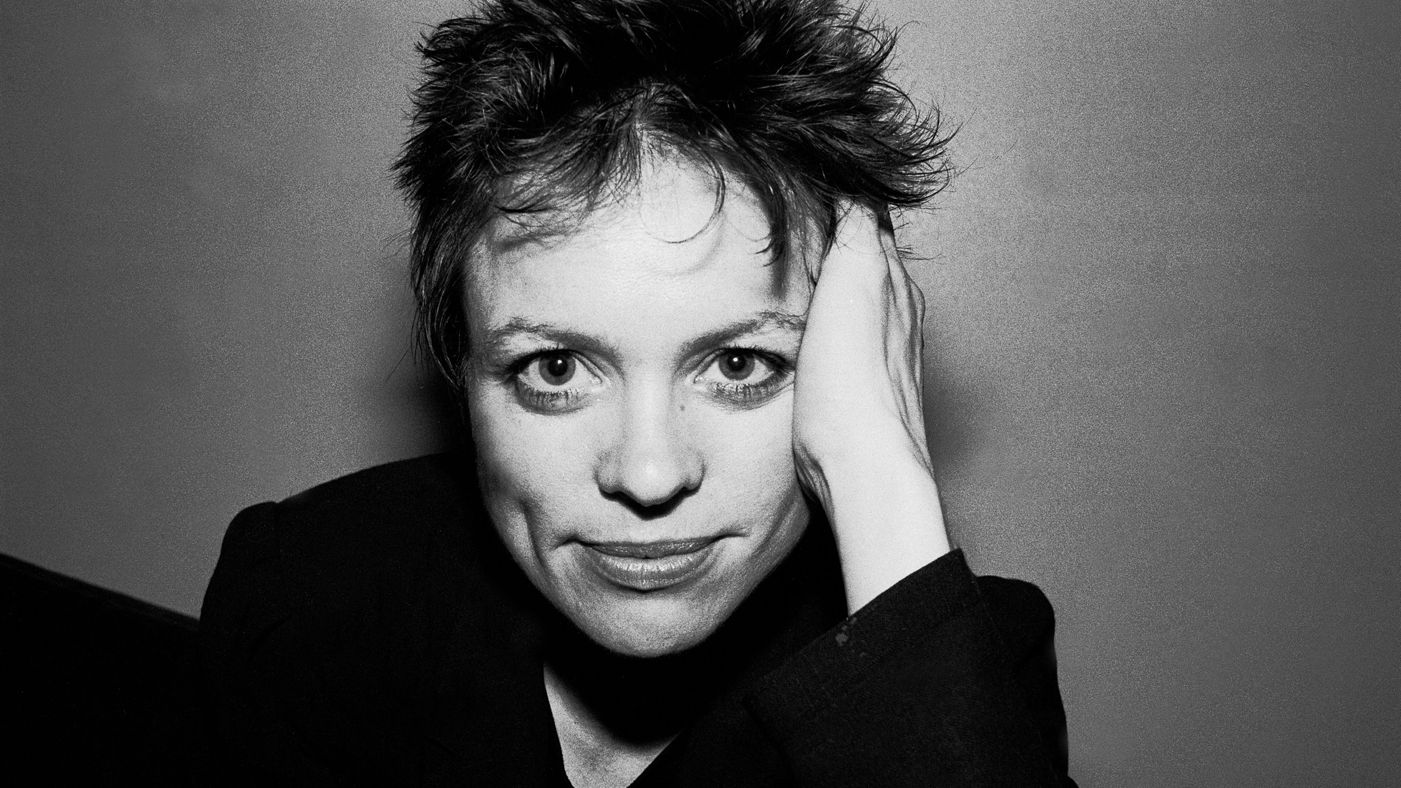
Words for the Music 019: LAURIE ANDERSON


LAURIE ANDERSON
c 1982


 LET X = X
LAURIE ANDERSON
from the 1982 Warner Bros LP Big Science


LET X = X


I met this guy
And he looked like he might have been a hat check clerk
At an ice rink
Which in fact
He turned out to be
And I said:
Oh boy
Right
Again

Let X equal X


You know
It could be you
It's a sky blue sky
Satellites are out tonight


Let X equal X


You know
I could write a book and this book 
Could be thick enough
To stun an ox
Cos' I can see the future
And it's a place 
About seventy miles east of here where it's lighter


Linger on over here
Got the time? 


Let X equal X


I got this postcard
And it read
It said:
Dear
Amigo
Dear partner
Listen, uh…
I just want to say thanks
So… 
Thanks
Thanks for all the presents
Thanks for introducing me to the chief
Thanks for putting on the feedbag
Thanks for going all out
Thanks for showing me your Swiss Army knife
Oh and uh ––
Thanks for letting me
Autograph your cast
Hug and kisses
Ex ex ex ex
Zero zero zero zero

Oh yeah
PS
I
I feel
Feel like
I am
In a burning building
And I gotta go
Cos' I
I feel
Feel like
I am
In a burning building
And I gotta go


[This YouTube clip includes the next LP track It Tango]


Words and music 
© 1982 Laurie Anderson


It seems nothing short of miraculous that an artist as uncompromisingly non-commercial as Laurie Anderson not only landed a record deal with a major US label but that her debut album for that label –– titled Big Science and released in 1982 –– delivered an unexpected hit in the form of O Superman, a minimalistic spoken word piece that clocked in at an unthinkable nine minutes.  It defies all logic, economic and otherwise, yet somehow it happened, launching the career of one of the world's most genuinely experimental artists and introducing an entire generation of clueless teenagers, myself among them, to the undiscovered pleasures of avant-garde electronic music. 

To the casual listener it may appear that Anderson isn't really doing very much in Let X = X.  The track begins as a quirky little tale about a guy who works at an ice rink and ends with what purports to be a direct quotation from a postcard, backed by gently pulsing synthesizers and subtle percussion enhanced by ethereal robotic vocal effects.  Anderson's beguiling vocal performance is a masterpiece of irony, each word carefully positioned and precisely phrased to emphasize its oddity and maximize its aural impact.  Let X = X transcends its various parts to emerge as a compellingly unified whole, part humorous anecdote and part sci-fi prophecy, quintessentially modern even as it seems to recall (and perhaps mourn for?) the vanished pre-digital world of 1950s North America. (How many hat check clerks do you ever meet these days?  And if you do meet any, how many of them are ever employed at ice rinks?)  

Some may argue –– and I used to be acquainted with several people who believed it to be their sworn duty to do so –– that Anderson's work depends on the listener reading their own meaning into what is essentially the audiophonic equivalent of a blank page.  But I'll say to you what I used to say to them –– isn't that the case, not just with her music, but with virtually every piece of music a human being is exposed to over the course of his or her lifetime?  Don't we all project our individual thoughts and emotions into the music we listen to, be it Let X = X or Ride of the Valkyries or Mood Indigo or Thank U, Next by Ariana Grande?  Consciously or not, we value a musical composition for its ability to transport us into the private realm of our mind and keep us temporarily suspended there without evoking unpleasant sensations of ennui, restlessess or both.

Of course, the work of an artist like Laurie Anderson does not just 'happen' as though it's the product of some benign cultural accident.  She had a long grounding in the world of performance art, beginning with her first symphony, written for automobile horns, which received its debut performance in 1969.  By 1981 she was sharing the bill with writers John Giorno and William S Burroughs on the spoken word LP You're The Guy I Want To Share My Money With and establishing herself –– with her waifish persona, trademark spiky hair and glowing electric violin –– as an artistic force to be reckoned with.
 
But it was the release of O Superman, part of an extended stage work titled United States, that introduced Anderson's music to a wider and surprisingly receptive audience.  Originally released on the small independent label One Ten Records, the piece became a breakout hit in the UK following repeated airplay by influential BBC disc jockey John Peel.  So many orders were received for this esoteric electronic curiosity that the buzz it generated brought Anderson to the attention of Warner Bros Records who quickly signed her to a seven album contract.  The timing could not have been better, given the changes that were beginning to occur in the early 1980s in relation to how popular music was recorded, promoted and marketed.  Suddenly, any music that sounded even vaguely futuristic was deemed to be 'cool' by mainstream urban audiences, while the film-clip for O Superman became something of an audio-visual cult object in itself which would go on to become a staple of the early MTV era.


Big Science was an album that reflected its time while simultaneously transcending it to become, in the truest sense, timeless.  And I'm far from being the only person who holds that opinion.  In her marvellously insightful review of the album posted on Discogs (and her own Bandcamp page), fellow Anderson fan Jenell Kesler does a superb job of capturing what continues to make Anderson's music so fascinating nearly forty years after its original release:

Laurie Anderson’s Big Science touched my heart in 1982. The movie Blade Runner was just out, with Laurie’s music sounding for all the world like some futuristic bedtime stories, designed to make us all feel comfortable in the electronic age… it was accessible, perplexing, intoxicating and dreamy, just listening to these tracks was akin to walking spiraling up through the Guggenheim museum. The album can be a bit scary, due mostly to Anderson’s deadpan delivery, while other tracks often come off as being prophetic and filled with nonchalant wisdom… In the end, Big Science, as the androids in Blade Runner, resounds with more humanity than almost anything you’ve ever, or ever will hear… where if you fall in love with a hat check clerk at an ice skating rink, then there’s actually hope this weary old world might spin on for a few more days. 

If you haven't been exposed to the work of Laurie Anderson then you're missing out on something very special.  I would urge you to seek out a copy of Big Science at your earliest opportunity, always remembering as you listen to it to keep your mind fully open along with your ears.


Use the links below to visit the website of North American artist, composer, musician and director LAURIE ANDERSON and read the complete review of Big Science by JENELL KESLER on the Discogs music website.  (Be sure to scroll down to the bottom of the page.)


Special thanks to everyone who takes the time to upload music to YouTube.  Your efforts are appreciated by music lovers everywhere. 


You might also enjoy:


Last updated 14 October 2021 §