Pages

Showing posts with label J is for Jazz. Show all posts

Wednesday, 14 October 2020

J is for Jazz 014: BING CROSBY


HAROLD LILLIS CROSBY JR
aka
BING CROSBY
3 May 1903 – 14 October 1977


There are virtuoso performers who have not found an identity.  That thumbprint is missing.  With Bing you knew right away who he was.  And you knew that he knew.  He really is the first American jazz singer in the white world.  Bing was an enormous influence.  You couldn't avoid him.  He had a good beat.  He was a jazz singer, he knew what jazz was, and could sing a lyric, say the words, and make you hear the notes.  Bing could swing.  When he sang, the tune swung, whatever it was.


ARTIE SHAW
From an interview conducted by GARY GIDDINS


Mention the name 'Bing Crosby' to most people and the first image that generally springs to mind is that of an avuncular, pipe-smoking sexagenarian crooning the festive Irving Berlin chestnut White Christmas over a lush if respectfully sedate accompaniment.  Even today, more than four decades after his death on a Spanish golf course, Crosby still seems to epitomize the term easy listening –– pleasant, predictable, featuring nothing in his choice of material, arrangements or orchestrations which could conceivably be described as 'cutting edge' or in the least sense challenging.


But this was not always the case for the vocalist, actor, producer, entrepreneur and philanthropist born Harold Lillis Crosby Jr on 3 May 1903 in the Washington port city of Tacoma.  There was another Crosby –– he earned the nickname Bingo, later shortened to Bing, from a neighbor thanks to his boyhood fondness for the comic strip Bingo From Bingville –– who, in the words of clarinet virtuoso and bandleader Artie Shaw, '… was the first hip white person born in the United States.'  This Bing Crosby was a sonic pioneer, the artist who singlehandedly invented the art of modern popular singing and privately funded the development of the tape recorder, influencing scores of performers both black and white who were as enraptured as the general public so quickly became by his mellifluous baritone voice and relaxed but acutely precise phrasing. 


Crosby was first introduced to music by his father Harry Crosby Sr, who brought home an Edison Talking Machine –– the round cylinder-playing precursor to the flat disc playing gramophone –– not long after the family moved from Tacoma to Spokane in 1906.  In time this machine was replaced by a Victrola and a collection of 78rpm records featuring the music of Gilbert and Sullivan, Irish tenor John McCormack, Scottish music hall star Harry Lauder and the nation's newest singing sensation, a brash young Jewish vaudevillian named Al Jolson whose 1912 hit The Spaniard That Blighted My Life would go on to sell more than a million copies.  Jolson's impact on the young Crosby was immediate and considerable.  ' "I'm not an electrifying performer at all",' he would later tell an interviewer.  ' "I just sing a few little songs.  But this man [Jolson] could really galvanize an audience into a frenzy.  He could really tear them apart." '  Crosby knew what he was talking about because he saw his idol perform live in the hit 1917 show Robinson Crusoe Jr while employed for the summer as a prop boy at The Auditorium, the most prestigious vaudeville theater in Spokane.  Jolson's repertoire would serve as the template for Crosby's earliest recordings as lead vocalist for The Rhythm Boys, with highly romanticized 'Songs of the Old Southland' (nearly all of which were churned out by professional songwriters in New York City) like Magnolia remaining staples of his own extensive repertoire for the rest of his career.  


But Crosby possessed qualities that Jolson, for all his energy and talent, could not realistically hope to equal –– a seemingly instinctual understanding of rhythm and swing, a genuine love of jazz and a gift for understated delivery that demonstrated his mastery of microphone technique at a time when the microphone itself was a new form of technology that could intimidate even the most seasoned performers both in and out of the recording studio.
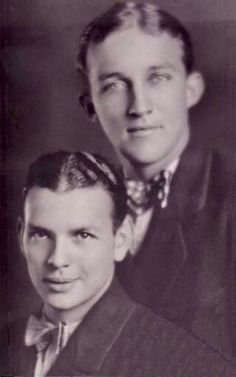


AL RINKER and BING CROSBY
c 1926


Crosby's career began in 1923 when he joined a band called the Musicaladers which had been formed by some Spokane high school students, one of whom was Native American pianist/manager Alton Rinker.  Crosby was the band's entirely self-taught drummer and occasional featured vocalist and was soon earning enough from its performances at local dances to feel confident enough of his future to drop out of college in his senior year.  Despite enjoying a modicum of success in Spokane, the band split up in the spring of 1925, prompting Crosby and Rinker to try their luck as a harmonizing duo, filling in between silent films at the city's newly converted Clemmer Theater –– an experience that would prove invaluable when, still determined to make it big in the music business, they relocated to Los Angeles in the fall.  


Luckily, Rinker's older sister was Mildred Bailey –– an already established performer of the 'racy' jazz and blues music popular in the city's speakeasies as illegal gambling and/or drinking clubs were then known.  (The Volstead Act, which prohibited the manufacture, sale and consumption of alcoholic beverages within the United States, had passed into law on 28 October 1919, giving the green light to organized crime to make millions by turning drinking into a 'sinful' and therefore desirable activity much favored by the young, including the perpetually thirsty and frequently intoxicated Mr Crosby.)  Bailey was impressed by their act and immediately started making calls to try to find them work.  She was also the person who introduced Crosby, with whom she would go on to forge a lasting and mutually appreciative friendship, to the recordings of black blues performers Bessie Smith and Ethel Waters and recommended that he listen to a young cornettist named Louis Armstrong who was currently recording for the OKeh label and playing up a storm each night in Chicago.  Crosby, who was already a fan of white jazz acts like The Original Dixieland Jazz Band and The Wolverines, took her advice, finding a new source of inspiration in Armstrong's astonishing talent for both instrumental and spontaneous vocal improvisation.  This was something he would soon learn to incorporate into his own, much smoother style of singing, using his voice to mimic instruments as he 'scatted' or improvised on melodies like a jazz musician.  While it hardly seems earth shattering now, it was a completely new sound in the mid-1920s, paving the way for his successful emergence as a solo artist and influential cultural force throughout the following decade.


But in 1925 all of this still lay ahead of the twenty-two year old crooner from Washington state.  His elder brother Everett was also living in Los Angeles at this time and it was he who allegedly got Bing and Rinker their first paying job at the Cafe Lafayette, a speakeasy whose house band was led by Harry Owens (future composer of Sweet Leilani, a faux Hawaiian song that would be a massive hit for you-know-who in 1937).  The job didn't last long and, thanks to the persistence of Mildred Bailey, the pair soon auditioned for and were offered a place in a traveling vaudeville revue titled The Syncopation Idea.  ('Syncopated music' was one of the early names for jazz, its use in the title of a revue confirming how popular the music had now become among mainstream white audiences.)  They toured in this show for thirteen weeks, developing a small but loyal following among college students, and then joined Will Morrissey's Music Hall Revue, earning the same $75 per week they had earned while appearing in their first show.  When the Morrissey revue closed, they joined another revue variously known as The Purple and Gold Revue, Bits of Broadway, Russian Revels and, after still more tinkering with its title and running order, Joy Week.


AL RINKER, BING CROSBY and HARRY BARRIS
aka 
THE RHYTHM BOYS
1927


It was while they were appearing in Joy Week at the Metropolitan Theater in Los Angeles that they were handed a note from Paul Whiteman, the most popular bandleader in the country who was billed –– not at all accurately –– as 'the King of Jazz.'  Impressed by their mixture of close harmony singing, comedic interludes and occasional use of exotic instruments like the kazoo, Whiteman offered them a featured spot with his band starting at a weekly salary of $150.  They made their debut with his organization at the Tivoli Theater in Chicago on 6 December 1926, two months after secretly recording the song I've Got The Girl for their new boss's former saxophonist in a converted warehouse in Los Angeles.  It was not an auspicious beginning to what would be Crosby's long and successful career behind the microphone.  The song was second-rate at best and somehow recorded at the wrong speed, making him and the higher voiced Rinker sound like a pair of harmonizing chipmunks when it was played at the standard 78rpm speed.  Thankfully, their names did not appear on the label of the Columbia release because, as employees of Whiteman, they were contracted to record exclusively for Victor, the same label which claimed exclusive rights to all of the bandleader's recordings.


CHANGES
PAUL WHITEMAN & HIS ORCHESTRA
featuring 
The Rhythm Boys with Jack Fulton [vocals]
and Bix Beiderbecke [cornet] 
Recorded 23 November 1927 


The opportunity to appear with the Whiteman Orchestra was equivalent to winning a million, pre-Depression dollars in showbusiness terms.  Not only would Crosby and Rinker be performing nightly with the most popular band in the country, they would also be touring with some of the very best white jazz musicians currently active in North America.  These included cornettist Bix Beiderbecke, guitarist Eddie Lang, trombonists Jimmy Dorsey and Jack Teagarden and saxophonists Frank Trumbauer and Tommy Dorsey, nearly all of whom would go on to have significant solo careers in both small group and big band jazz.  Appearing in Chicago also allowed Crosby to visit the Sunset Cafe to hear and meet Louis Armstrong, of whom he was later to say, ' "I'm proud to acknowledge my debt to the Reverend Satchelmouth.  He is the beginning and the end of music in America.  And long may he reign." '  Armstrong returned the compliment in his 1930 recording of I'm Confessin' (That I Love You), consciously mimicking some of his white friend's vocal mannerisms in his own inimitable style.  Crosby and Armstrong would go on to perform together many times on both radio and television and would even record a disappointing LP of Dixieland tunes in 1960 titled Bing and Satchmo following their much beloved duet Now You Has Jazz in the film High Society four years earlier

 
The thus far successful career of Crosby and Rinker hit its first snag when the Whiteman Orchestra arrived in New York City.  Routines that had wowed audiences during the band's tour of the midwest fell flatter than a pancake during its six day engagement at the Paramount Theater, prompting Whiteman to heed the advice of the theater manager and remove the new arrivals from the bandstand.  (Crosby later claimed he didn't mind being replaced because it gave him the chance to explore the city's thriving jazz scene while indulging his other passions for chorus girls and alcohol.)  This did not prevent Whiteman from using the duo as the 'vocal refrain' on Pretty Lips, a tune his orchestra entered the Victor studio to record on 18 February 1927.  Other recording dates followed, including Crosby's first solo chorus on Muddy Water, another sentimental paean to an entirely fictional 'southland' that white audiences couldn't get enough of at the time.  Crosby was also occasionally featured at an establishment called Club Whiteman co-owned by his boss which, after consistently losing money, closed its doors for good on 24 May.  Whiteman's only choice, it seemed, was to send the team out to perform under its own name on the vaudeville circuit –– something he may well have done had Crosby and Rinker not been introduced to pianist, comedian and songwriter Harry Barris who almost immediately joined the act under its new name The Rhythm Boys, a spoof on the name of popular radio team The Happiness Boys.


The Rhythm Boys were an instant hit with audiences and also with Whiteman who negotiated a separate contract for them with Victor and sent them back into the studio in June with some of his best musicians, a group which included Crosby's hotel roommate (and third great musical influence) Bix Beiderbecke, violinist Matty Malneck and saxophonist Jimmy Dorsey.  Their first recording featured a co-written Barris original, yet another catchy ode to the genteel 'old plantation' image of the antebellum south titled Mississippi Mud which established the pattern for virtually all their future recordings –– lots of percussive vocal effects, bantering wordplay and, as time progressed, the featuring of Crosby's smooth baritone with Barris and Rinker more often than not relegated to the roles of harmonizing sidemen.  This, combined with Crosby's continuing musical education courtesy of Beiderbecke and other musicians attached to the Whiteman organization plus his own growing confidence as a performer, soon saw him being handed regular solo spots by Whiteman's arranger Bill Challis.  By April 1928 his name was appearing beneath the bandleader's on record labels and in March 1929 he released his first side under his own name, a soulful number titled My Kinda Love on which he was accompanied only by piano, violin and guitar.


MY KINDA LOVE
BING CROSBY
accompanied by
Matty Malneck [violin], Edward 'Snoozer' Quinn [guitar]
Roy Bargy [piano]
Recorded 14 March 1929
Columbia 1773-D, mx W 148073-3


The music business was changing and tastes were changing with it, aided in part by the advent of talking pictures and the enthusiastic reception of early movie musicals like The Broadway Melody and The Hollywood Revue of 1929.  The public's fondness for the brashness of Jolson (still modestly billing himself as 'The World's Greatest Entertainer') was replaced by a new craze for crooners like Rudy Vallee, Chick Bullock and Cliff 'Ukulele Ike' Edwards, making Crosby's shift to a full-time solo career a foregone conclusion.  Although The Rhythm Boys survived as a group until 1930, it was as a solo artist that Crosby was to find his greatest success and establish himself as the pre-eminent white male vocalist in North America and, in time, throughout much of the Western world.  Many of the songs he would record under his own name during the 1930s –– Wrap Your Troubles in Dreams, Just A Gigolo, Sweet and Lovely, How Deep is The Ocean? and I Surrender, Dear to name just a few –– would go on to become well-respected standards, performed not only by vocalists he directly influenced like Frank Sinatra, Dean Martin and Perry Como but also by many important jazz artists including Thelonious Monk, Miles Davis and Sonny Rollins.  


Crosby's growing presence on the cinema screen –– he had appeared in King of Jazz in 1930 as a member of the Rhythm Boys and would star in a series of comedic shorts for the Educational/Sennett company between 1931 and 1933 –– and on radio in his own nationally syndicated programs brought his music to even an wider audience and, for close to two decades, saw him consistently voted the number one male vocalist in the United States.  While his recordings quickly became less directly jazz influenced, featuring elements of Tin Pan Alley, Latin, Hawaiian and Irish music, this didn't prevent him from appearing in the 1941 film Birth of the Blues, a fictionalized account of the early days of jazz, or from recording albums like Bing and The Dixieland Bands, featuring the band of his younger brother Bob Crosby, in 1951 or the outstanding Bing With A Beat featuring Bob Scobey's Frisco Jazz Band six years later.  The jazz influence may have become submerged due to commercial considerations and the orchestrations written for him by his longtime arranger John Scott Trotter, but it was always there in his phrasing and in the way he made even the most banal material glide and swing. 


For me, Crosby's greatest jazz performance will always be his 1932 recording of St Louis Blues with Duke Ellington and his Orchestra.  While it wasn't his first performance with Ellington –– that was a version of Three Little Words he'd cut with the bandleader as a member of The Rhythm Boys in 1930 –– it was certainly his best, proving to anyone who doubts it that he had a feeling for jazz that was, given his race and upbringing, nothing short of remarkable.  I've often wondered why he never recorded with Ellington again and what marvels may have been produced had they focused exclusively on interpreting the bandleader's own distinctively evocative compositions.  Although Crosby would go on to do many great things before his death in 1977 –– including funding the development of the tape recorder for commercial use and revolutionizing the way radio programs and records were created, marketed and broadcast –– nothing ever quite equalled what he achieved as a young solo star in the third decade of the twentieth century where, as he always insisted, he just happened to be in the right place at the right time.


 ST LOUIS BLUES
DUKE ELLINGTON & HIS FAMOUS ORCHESTRA 
featuring
BING CROSBY [vocal]
Recorded 11 February 1932
Brunswick 20105, mx BX 11263-A 


Use the links below to visit the website of North American vocalist, actor, producer and philanthropist BING CROSBY and The Bing Crosby Internet Museum, an informative website devoted to his life and career created and maintained by STEVEN LEWIS:


Special thanks to everyone who takes the time to upload music to YouTube.  Your efforts are appreciated by music lovers everywhere.


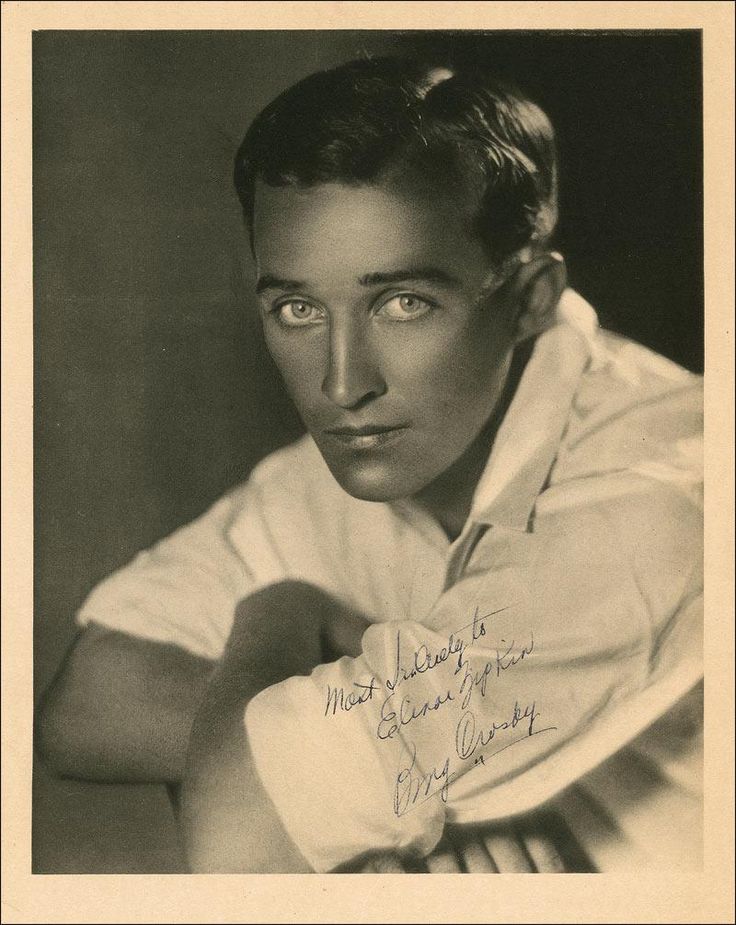
BING CROSBY 
c 1931


You might also enjoy:


§
 

Thursday, 16 July 2015

J is for Jazz 013: ROY HAYNES


ROY HAYNES
c 1966


I am constantly practicing in my head I'm always thinking rhythms, drums.  When I was very young I used to practice a lot; not any special thing, but just practice playing.  Now I'm like a doctor.  When he's operating on you, he's practicing. When I go to my gigs, that's my practice.  I may play something that I never heard before or maybe that you never heard before.  It's all a challenge.  I deal with sounds.  I'm full of rhythm, man.  I feel it.  I think summer, winter, fall, spring, hot, cold, fast and slow –– colors.  But I don't analyze it.  I've been playing professionally over 50 years, and that's the way I do it.  I always surprise myself.  The worst surprise is when I can't get it to happen.  But it usually comes out.  I don't play for a long period, and then I'm like an animal, a lion or tiger locked in its cage, and when I get out I try to restrain myself.  I don't want to overplay.  I like the guys to trade, and I just keep it moving, and spread the rhythm, as Coltrane said. Keep it moving, keep it crisp.

ROY HAYNES
From the liner notes for Praise 
(1998) 


Some jazz musicians burst on the scene in a blaze of glory, instantly capturing the public's attention as though this, and this alone, was what they were put on earth to do.  Others can take much longer to receive the recognition they deserve, their genius eclipsed –– at least temporarily – by musicians who, while no less brilliant or inspiring in their way, are more representative of the prevailing fashion for this or that sound, this or that 'school' or method of interpretation.  The problem can be compounded to some extent if the undervalued musician in question happens to be a drummer.  In jazz the rhythmic element is often something the listener takes for granted, without fully appreciating that a drumkit can be every bit as expressive as a trumpet, a saxophone, a piano or a guitar in the right hands.  Drummers drive the sound.  Without them, jazz as we know it would not and could not exist.


In a career spanning more than six decades, Roy Haynes has proven time and time again what a gifted and irreplaceable musician he is and how he fully he deserves his fondly bestowed nickname 'Snap Crackle.'  Even a cursory glance at his resumé reads like a Who's Who of modern jazz, with names like Lester Young, Charlie Parker, Thelonious Monk and Sarah Vaughan appearing alongside those of the next generation of iconoclasts including John Coltrane, Eric Dolphy, Stan Getz, Oliver Nelson, Andrew Hill, Chick Corea and Roy Hargrove.  With his idiosyncratic approach to melody, focusing on creating new cymbal patterns over a consistently crisp and driving snare, his playing has become the yardstick by which all other drummers –– jazz and rock alike – are frequently measured.  As his grandson and fellow drummer Marcus Gilmore explained it in a 2013 interview recorded for National Public Radio:  'What people don't realize, when they talk about people like Roy Haynes as one of the great jazz drummers, is that really he is one of the original drummers creating the language for everybodyBut people don't think about it like that; they think of him as a jazz great. But the thing is really the drum – the trap set –– is pretty new, maybe like 100 years. If you're playing that much drums in 1945, that means you're one of the pioneers of the instrument.'


  REFLECTION
PHINEAS NEWBORN JR [piano]; PAUL CHAMBERS [bass]
ROY HAYNES [drums]
Recorded 14 November 1958
From the New Jazz Records LP  
We Three 


Roy Owen Haynes was born on 13 March 1925 in Roxbury, a predominantly immigrant neighborhood in the Massachusetts city of Boston.  His parents had come to the United States from the Caribbean island of Barbados and Haynes and his elder brother grew up surrounded by people of other races and cultures.  'We had an Irish family on one side of our home,' he remembered in a 2008 interview he gave to jazz journalist Marc Myers, 'French-Canadians on the other and a synagogue in front of our house.  It was great growing up with all different kinds of kids.'  His earliest musical influence was 'Papa' Jo Jones, drummer for the Count Basie Band and someone he actually met – by telling the doorman at the venue he snuck into that he was his hero's son –– when the Basie orchestra passed through Boston in the late 1930s.  It was through his brother, however, that Haynes obtained his first pair of drumsticks which, he explained, had been lying '…around the house' for some time. 

 
Largely self-taught, Haynes was playing semi-professionally by his mid-teens and was famous enough in and around the Boston area to receive an offer to join the eighteen piece big band of pianist and arranger Luis Russell –– an offer made on the recommendation of a mutual friend because, at the time it was made, Russell had not yet heard him play.  One of his first gigs with the bandleader, whose organization he joined full-time in 1945, was at New York's legendary Savoy Ballroom.  'You learn a lot keeping time for a big band people are dancing to,' he told Myers, 'especially one that had to be on top of its game at the Savoy.  I found out after I got back to Boston that I had changed the sound of that band after playing with them for more than a year.  Luis didn’t tell me.  Musicians had told my brother.'  Being based in New York also allowed him to explore the emerging be-bop sound being explored at that time in Fifty-Second Street nightclubs like Minton's and Small's Paradise and to participate in some of the after-hours jam sessions that would prove crucial not only to its development but to the development of what, by the end of the 1940s, was being defined as 'modern jazz.'

 
By 1947 Haynes was a member of saxophonist Lester Young's band – a position he would relinquish in 1949 to work briefly with pianist Bud Powell and trumpeter Miles Davis before joining the Charlie Parker Quintet.  He recorded with all these artists on several occasions and also played on recordings by saxophonists Wardell Gray and Stan Getz.  In 1953 he joined the band of vocalist Sarah Vaughan, touring with her for the next five years and appearing on many of her most outstanding 1950s EmArcy LPs including Images (1954), Sarah Vaughan in the Land of Hi-Fi (1955) and the breathtaking Sarah Vaughan with Clifford Brown (1955).  In 1954, the Emarcy label also released Busman's Holiday, the drummer's first album as a leader featuring pianist Adrian Acia, saxophonists Sahib Shihab and Bjarne Nerem, trombonist Ake Persson and bassist Joe Benjamin.  This was followed later in the year by The Roy Haynes Sextet on the Vogue label, another 10 inch LP featuring the French pianist Henri Renaud and his guitarist countryman Jimmy Gourley.

 
The late 1950s saw Haynes consolidate his position as one of the most influential and in demand drummers in jazz, his 1959-1960 work as a member of pianist/composer Thelonious Monk's band leading to a two year stint with groundbreaking saxophonist Eric Dolphy which in turn saw him work again extensively with Stan Getz and then with improvisational saxophone giant John Coltrane between 1961 and 1965.  The 1960s also saw him contribute as a sideman to many of the most memorable jazz LPs of the decade, including The Blues and the Abstract Truth (1961) by saxophonist/arranger Oliver Nelson, Domino (1962) by saxophonist and multi-instrumentalist Roland Kirk and Black Fire (1963) and Smokestack (1963) by underrated pianist/composer Andrew Hill.  Nor did his own work as a leader fall by the wayside, seeing him release four albums under his own name including 1962's Out For The Afternoon featuring the stellar playing of Roland Kirk, pianist Tommy Flanagan and bassist Henry Grimes.

 
In 1968 Haynes began what was to become a long, fruitful but intermittent working relationship with Chick Corea, with the release of the LP Now He Sings, Now He Sobs – an album which also featured the solid bass playing of Czech musician Miroslav Vitous – in March of that year marking a watershed in the development of trio jazz and a major leap forward in the pianist's compositional technique.  This session also marked the first appearance on record of the flat ride cymbal created by the Paiste cymbal company, offering drummers a 'tighter, brighter sound' that seemed tailormade for Haynes's fluid and by now legendary snappy style of playing.

 
The final two years of the decade were busy ones for Haynes, seeing him tour extensively with Stan Getz and as a member of the working band of vibraphonist (and former Getz alumnus) Gary Burton.  The 1970s saw him release nine more albums as a leader and appear as a sideman on recordings by pianists Dave Brubeck and Tommy Flanagan, Jamaican born trumpeter Dizzy Reece and many other artists.  In 1983 he reunited with Chick Corea, appearing on three different albums and remaining a member of the pianist's working trio until 1987.  Two years later he performed on Question and Answer, an LP by Pat Metheny which marked the beginning of another important collaboration that was to endure well into the 1990s and eventually see the guitarist appear as a sideman on Haynes's 1996 LP Té Vou.  That year also saw Haynes win the Best Drummer category in the annual DownBeat Readers' Poll Awards and receive a prestigious Chevalier des Ordres des Artes et des Lettres decoration from French President Jacques Chirac.


SCRAPPLE FROM THE APPLE
STAN GETZ [tenor saxophone]; GARY BURTON [vibes]
STEVE SWALLOW [bass]; ROY HAYNES [drums]
Recorded live for BBC TV UK, 1966


Other awards were to follow as the new millennium saw Haynes formally recognized as the artistic giant he is in his native land, with his 2004 induction into the DownBeat Hall of Fame followed by a 2011 Lifetime Achievement Award presented to him by the National Academy of Recording Arts and Sciences (better known as the people who hand out Grammy Awards each year).  This was followed in September by the release of Roy-Alty, his first LP as a leader since the 2006 release of Whereas and the 3 CD/1 DVD career retrospective A Life in Time: The Roy Haynes Story 1946-2006.  Haynes, who turned ninety in March 2015, was still performing as recently as 2013 as a member of Fountain of Youth, the new band he formed in 2004.

 
Thankfully, the legacy of Roy Haynes will not die with him when he's eventually forced to leave us.  His son, trumpeter Graham Haynes, still plays and records regularly, as does his twenty-seven year old grandson a no less formidable drummer who has played on albums by trumpeter Clark Terry, saxophonist Ravi Coltrane and, for a time, filled the drum chair in the Chick Corea Trio.  When asked to provide a reason for his grandfather's incredible longevity, Gilmore was quick to point out that it is his musical open-mindedness that has allowed Roy Haynes to remain at the forefront of jazz for more than sixty years.  'Another reason,' he added, 'is that it was just something he was born with, because in some ways, his playing hasn't changed that much.  It's evolved, but in some ways he was playing all that same bad shit in the 40s.  I don't know where he got it from.  To have him is a treasure.  A treasure to the family, but also as a national treasure, too, actually.'  While no one who has heard him play would argue with this, it is no exaggeration to say that Roy Haynes personifies jazz in many respects –– a trailblazer whose recorded works will remain the yardstick by which drummers will be measured for as long as human beings continue to compose, perform and record music together.  


ROY HAYNES
2005


To read the full 2008 ROY HAYNES interview conducted by jazz journalist MARC MYERS visit his website JazzWax.


Special thanks to everyone who takes the time to upload music to YouTube.  Your efforts are appreciated by music lovers everywhere.


You might also enjoy:


Last updated 2 October 2021 §     


Thursday, 22 January 2015

J is for Jazz 012: HELEN MERRILL


HELEN MERRILL
1956


I fall deeply into the music. I hear a lot of information when I sing.  Back then and today, I'm able to go into a hypnotic state when performing.   Even to this day it takes me about 15 minutes to come out of whatever it is that permits me to go up there.  It’s kind of a self-hypnosis that I think a lot of performers probably have.  I don’t do it knowingly, you know.  It just happens.  I start out nervous but then just close my eyes, start singing and that fearful part of me disappears. But I’m still terrified before I go out on stage.  On the positive side, that feeling, as painful as it is, keeps your adrenaline in the right place and keeps your passion alive.

HELEN MERRILL
Interview by MARC MYERS 
published on his website JazzWax
2 February 2009


The question 'What makes a singer a jazz singer?' can be a difficult one to answer.  Many people, artists and fans alike, assume that a jazz singer is somebody who performs selections from 'The Great American Songbook' (that is, classic songs written by the Gershwins, Cole Porter, Irving Berlin et al) with full orchestral accompaniment, usually in arrangements that are both pleasing to the ear and satisfyingly 'safe' in the artistic and all-important commercial sense.  But to categorize such performers as jazz singers is misleading.  You may adore Rod Stewart's version of These Foolish Things or swoon over Carly Simon's rendition of All The Things You Are but to call these artists jazz singers makes as much sense as it does to place the music of jazz performers like Sarah Vaughan and Billie Holiday in the easy listening category.  The question is not simply one of repertoire, backing and arrangement.  To mistake what's often nothing more than a blatantly commercial attempt to milk the 'So-and-So Sings Standards' cash cow for a jazz performer's uniquely personal interpretation of the same material is to do the performer and the music itself a great disservice.  


Jazz singing, like jazz itself, is about digging deep into yourself and making the music express more than its literal surface meaning, the idea being that the interpretation of the material should be as individual as the artist performing it is capable of making it.  The best jazz singers –– Vaughan and Holiday, Ella Fitzgerald, Louis Armstrong in his creative heyday during the 1920s and early 1930s –– were capable of making any song they performed unmistakably their own, bringing something to the lyrics and melodies that made them as moving as they've proven to be popular and enduring.


Helen Merrill is a textbook example of what separates a pop singer from a jazz singer.  Her voice is as hauntingly expressive as any of the arrangements created to accompany it, her deeply personal, never predictable interpretation of each lyric a kind of masterclass-in-action in how to wring the maximum amount of emotion from language that, for all its beauty, can often be mired in the most cloying type of sentimentality.  She transcends the limitations of the material and succeeds in transforming it into something far more subtle and expressive, emotionally and artistically, than the sum of its parts might seem to suggest is possible.  She has the ability to make the listener believe that she's singing to them and only to them –– a gift, as any vocalist will confirm, that only the most talented performers can be said to possess.  Merrill's style is so intimate, her delivery and intonation so quintessentially feminine and alluring, that listening to her can sometimes make the listener feel like the aural equivalent of a spy or Peeping Tom.


YOU'D BE SO NICE TO COME HOME TO
HELEN MERRILL [vocal]
 & unknown musicians
Live in concert at Juan-les-Pins, France 
 July 1961


The singer was born Jelena Ana Milcetic in the Chelsea section of Manhattan on 21 July 1930 and grew up in the New York City borough of The Bronx, the second of four daughters of a Croatian immigrant and his wife.  She was raised largely by her elder sister, who assumed the role of primary caregiver when her mother fell ill and entered hospital, where she remained for several months until her death.  It was Merrill's mother, who enjoyed singing Croatian folk songs and often did so round the house before becoming sick, who inspired her love of music and her own desire to perform.  As a girl she would climb inside closets to practice so as not to irritate her father and sisters while attempting to imitate the jazz performers she heard on the radio each day.  'I’d hear Jimmie Lunceford, Count Basie, Billie Holiday and others,' she told music journalist Marc Myers in a 2009 interview.  'I wasn’t allowed to change the dial, so I learned all the songs that way.  My real interest was in the musicians, the soloists.  Billie, of course, was really a musician with that voice of hers.  I also loved Lester Young and Ben Webster –– I couldn’t believe his dynamic range.  I’d pick up all these things in a natural way.  I was always very sensitive and could hear things in music that others couldn't.'  Although she never learned to read music and never received any formal vocal training, Merrill had a fantastic ear and an irrepressible willingness to learn from the many professional jazz musicians whose paths she was soon fortunate enough to cross.      

 
The venue for these meetings was the 845 Club in The Bronx whose owner Johnny Johnson she talked into giving her a job as an afternoon fill-in act when she was barely into her teens.  The club was a popular daytime hangout for many of the city's top jazz musicians and it was here that the budding vocalist would meet and be befriended by era-defining artists such as Charlie Parker, Miles Davis and legendary be-bop pianist Bud Powell.  She was also heard at the club by Earl 'Fatha' Hines, the bandleader who first rose to prominence as Louis Armstrong's pianist in the 1920s.  Hines soon hired Merrill as the second singer for his band, a decision no doubt influenced by the fact that she had briefly worked with the Reggie Childs Orchestra in 1946 and that her new husband –– the saxophonist Aaron Sachs whom she had married in 1948 – was then employed as a member of his own reed section.   The two years Merrill spent with the Earl Hines Sextet would prove to be fortuitous ones for her career, allowing her to record for the first time (a 1952 track titled A Cigarette For Company) and introducing her to many of the musicians –– including trombonist Bennie Green and a struggling young trumpeter-turned-arranger named Quincy Jones –– who would become instrumental to the launching of her solo career.  (Before this could happen, however, she gave birth to a son named Alan on 19 February 1951 –– a son she would go on to raise largely alone following her separation and 1956 divorce from Aaron Sachs.  Alan Sachs would grow up to become a successful singer in his own right under the name 'Alan Merrill.'  In addition to becoming the first non-Japanese popstar in Japan, he also co-wrote the rock anthem I Love Rock and Roll for his band Arrows – a song that would later be covered by, among others, Joan Jett and Miley Cyrus and go on to earn him a fortune in royalties.)  

 
1953 saw Merrill record her first solo single with guitarist Jimmy Raney and bassist Red Mitchell for the tiny Roost label –– a date that earned her a contract with the nationally distributed Mercury label and its new jazz subsidiary EmArcy Records for whom her friend Quincy Jones had recently begun to work as a staff arranger and conductor.        

 
It was Jones who would both arrange and conduct Merrill's debut 1955 LP for EmArcy, a self-titled vocal jazz classic which also featured the flawless playing of a relatively unknown trumpeter by the name of Clifford Brown.  The album would make Merrill and Brown two of the most talked about figures in modern jazz and remains the singer's best known and biggest selling album, having earned her and itself cult status in Japan in the six decades since its release.  Yet the circumstances of its recording were anything but extraordinary.  As the singer herself explained:  'We were both a little frightened by it all I think he [Clifford Brown] felt the same shyness that I did.  So he was very protective of me, musically We didn’t talk much at those sessions.  We just smiled at each other a lot.  What we had to say to each other was unspoken.  It came through the music, and you can still hear that unspoken conversation on there today.'     

 
Like everyone who knew and worked with Brown, Merrill was devastated by the young trumpeter's 1956 death in a car accident.  'When talent like that disappears in a flash,' she later remarked, 'you can't believe it.  You deny it.'  She was in the studio, about to begin recording her second EmArcy LP with arranger Gil Evans and producer Bob Shad, when the news reached them that Brown had been killed.


YESTERDAYS
HELEN MERRILL [vocal];  CLIFFORD BROWN [trumpet];        
DANNY BANKS [flute];  JIMMY JONES [piano];  
BARRY GALBRAITH [guitar];  MILT HINTON [bass];  
OSIE JOHNSON [drums];     
QUINCY JONES [arranger]     
Recorded in New York City 24 December 1954    
From the 1955 EmArcy LP  
Helen Merrill    


That recording session was cancelled but the album, featuring Evans' complex orchestral arrangements and released later that year as Dream of You, would see Merrill gain many new fans who had been attracted by the carefully fabricated 'torch singer' image EmArcy had created for her.  The same formula was used for her third LP Merrill at Midnight, this time featuring the arrangements of film score composer Hal Mooney.  Like its predecessor, this LP also failed to transform her into the crossover pop artist that EmArcy and its parent label Mercury had envisioned her becoming.  After recording a final album for Mercury –– released in 1958 as The Nearness of You and featuring some stellar piano work from Bill Evans and two 1959 LPs American Country Songs and You've Got a Date With The Blues for the Atlantic and Verve labels –– albums which likewise failed to transform her into a crossover artist – she left her home soil for London, performing on BBC Radio with pianist Dudley Moore (the same Dudley Moore who worked with fellow comedian Peter Cook and starred in the 1979 film 10 with Bo Derek) before traveling to Belgium to sing at a festival there.  It was in Belgium that she met pianist Romano Mussolini, jazz musician son of the former Italian dictator, and received an invitation to perform with his quartet in Rome.         


The Italian capital would remain Merrill's home for the next four years –– an arrangement that got her out of her contract with Atlantic Records, allowed her to distance herself from the ongoing pain caused by a recently ended love affair, and saw her place her son in a Swiss boarding school.  Rome was also a popular destination for many visiting North American jazz musicians during the early 1960s, many of whom, such as trumpeter Chet Baker and tenor saxophonist Stan Getz, she would perform with in addition to performing and recording with many of Italy's finest jazz players.  In addition to recording a bilingual album titled Parole e Musica [Words and Music] for RCA Italia and performing live on Italian television, she also found time to contribute a few songs to the soundtrack of the film Smog directed by Franco Rossi   


Despite all this activity, she found life in Europe lonely and, following a second tour of Japan which she quickly abandoned for personal reasons, gladly returned to New York.  Back in the city she knew so well and loved so much, Merrill immediately returned to the studio to record a new LP of folk-based material, featuring several of her old musical collaborators including guitarist Jimmy Raney and drummer Osie Johnson, released in 1965 as The Artistry of Helen Merrill.


MY ONLY MAN 
HELEN MERRILL [vocal] & PIERO UMILIANI [arranger]
From the Italian film  
Smog 
Recorded in Rome, 1962   


1965 also saw Merrill record what was arguably her finest LP since the release of her debut album a decade earlier.  The Feeling Is Mutual, arranged by pianist Dick Katz, brought to the fore all those qualities –– seductive intonation, a gentle if pervasive sense of melancholy, flawless renderings of what were by now familiar lyrics to most music lovers –– which had originally made her stand out as a vocalist's vocalist and a quiet if commanding force to be reckoned with.  A follow-up LP titled A Shade of Difference –– for which Katz once again handled the piano and arranging chores — was released in 1968 and earned similar accolades from the critics for its combination of interesting and challenging material meticulously performed by a singer whose voice had somehow become even more alluring and expressive with the passing of the years.    


By then Merrill was living in Tokyo, which had become her new home following her 1966 marriage to Donald J Brydon, an Asian-based executive employed by the United Press International newspaper syndicate.  Tokyo would remain the couple's home until the mid-1970s, allowing Merrill to capitalize on what had become her cult status there with regular concert and television appearances and her own weekly program on Japanese radio.  She also continued to record, accompanied by many well-known Japanese musicians such as Masahiko Satoh and by visiting North American artists like pianist Teddy Wilson.  Their 1970 release Helen Sings, Teddy Swings was, in her words, '…the easiest date in the world for me,' with the (non-playing) presence of another piano legend Thelonious Monk adding to the pleasure of the occasion for everyone concerned.  


LONELY WOMAN
HELEN MERRILL [vocal]; DICK KATZ [piano, arranger]
THAD JONES [flugelhorn]; HUBERT LAWS [flute]
JIM HALL [guitar]; RON CARTER [bass]
ELVIN JONES [drums]
from the 1968 Milestone LP  
A Shade of Difference


By 1976 Merrill was back in her homeland, living first with her husband in Chicago and then, following their 1979 separation, back in her 'spiritual home' New York City.  The 1980s saw her branch out into production, producing albums for pianists Tommy Flanagan and Al Haig to which she also contributed several guest vocal tracks.  'I left the composer and song choices to the musicians,' she explained.  'I sat in the booth and determined the takes and the track order.  It’s my taste on there.  But I didn't have to do much with those guys, they were so brilliant.'  1980 also saw the release of her new solo LP Casa Forte, a Latin-tinged offering arranged and produced by Torrie Zito –– a pianist who, twelve years later, would become the singer's third husband.    

 
The latter years of what would prove to be a particularly tough decade for jazz saw Merrill attain living legend status among her peers and audiences alike, prompting her to record with fellow legends Stan Getz and an ailing Gil Evans, with whom she revisited the arrangements of their 1956 collaboration Dream of You for an award-winning 1987 LP titled, naturally enough, Collaboration.  She also took the unprecedented and wholly unexpected step of recording four songbook albums featuring the work of Jerome Kern, Rodgers and Hammerstein, Irving Berlin and Cole Porter –– a move that may have been inspired by the sudden resurgence of interest in standards spearheaded by Linda Ronstadt and other pop performers who had begun to revitalize their stalled careers by mining this treasure trove of familiar, highly melodic material for albums tailored to a new generation of listeners who were neither aware of nor particularly interested in exploring more challenging jazz-based interpretations of it.  Standards were, of course, far from being new or uncharted territory for Merrill.  This was the music she'd been performing throughout her career and was still performing –– in live settings if not as frequently in the studio – as recently as 2013, with her final LP Lilac Wine appearing in 2004.      

 
The one thing that has remained consistent throughout the career of Helen Merrill has been her unwillingness to compromise her artistic integrity – something, she freely admits, that probably cost her the chance to become the kind of universally admired diva that Ella Fitzgerald, Billie Holiday and her former label mate Sarah Vaughan have become since their deaths.  A life spent in the shadows may have been something Merrill was prepared for all along, if the following remarks, made during an interview she gave to DownBeat columnist Don Gold in 1957, are anything to go by: 
  
 
I'm not dissatisfied with the degree of success I've foundI guess I don't have a burning need to be everybody's favorite singer.  I try to do what I can to the best of my ability and in the best taste I can.  I'm fortunate I was able to do what I want to do and make a good living at it.

 
I would disagree with this statement on one point only.  It is we, the fans of Helen Merrill, who have been the fortunate ones.  She has given us everything we could possibly demand from a jazz singer for more than half a century and remains, for my money, one of the world's most gifted vocalists.


HELEN MERRILL
c 1995


To read the full five part 2009 HELEN MERRILL interview conducted by jazz journalist MARC MYERS visit his website JazzWax.  


To read an earlier 2006 interview with HELEN MERRILL visit the All About Jazz website.    


Special thanks to everyone who takes the time to upload music to YouTube.  Your efforts are appreciated by music lovers everywhere.  


You might also enjoy:


Last updated 2 October 2021 §