Pages

Showing posts with label Marc Bolan. Show all posts

Thursday, 8 April 2021

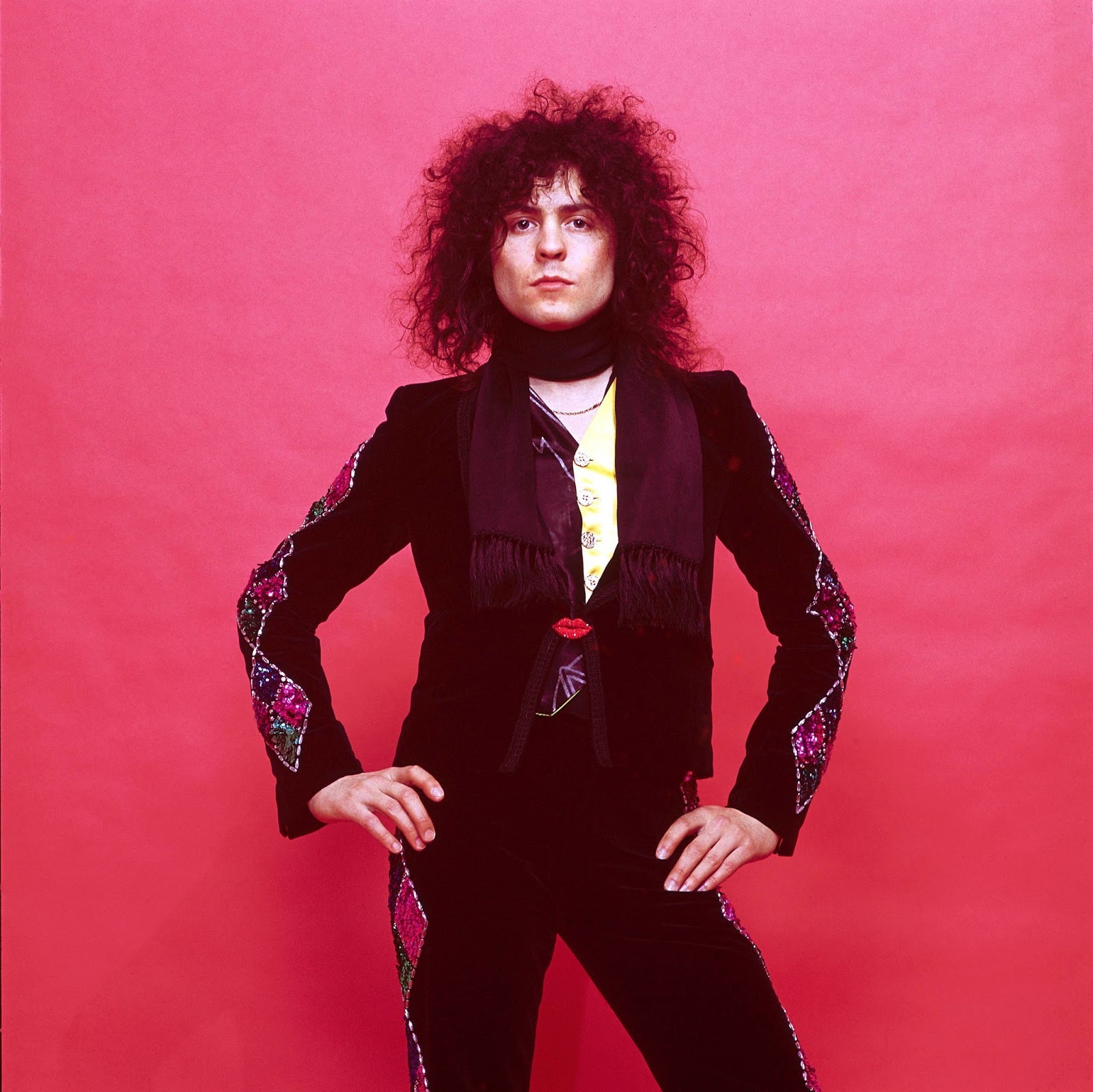
Words for the Music 020: MARC BOLAN


MARC BOLAN
30 September 1947 – 16 September 1977


TEENAGE DREAM
MARC BOLAN and T REX
from the 1974 EMI / T Rex Wax Co LP 
Zinc Alloy and the Hidden Riders of Tomorrow
– A Creamed Cage in August  
Produced by TONY VISCONTI


TEENAGE DREAM


Whatever happened to the Teenage Dream?

Surprise surprise, the boys are home 
My guardian angel's rung down my telephone
The heat's on mister, can't you hear them scream?
Whatever happened to the Teenage Dream?

The curfew comes at the crack of night
The sad old wino aches to dissipate the fright
The jet junk jiver speeds past in his machine
But whatever happened to the Teenage Dream?

A broken god from a musty world
Sweetly mouthed touched an onyx girl
His prison bars were very hard to clean
But whatever happened to the Teenage Dream? 
Yeah

Do it, do it, do it to me, babe
Want it to be, babe

Whatever happened to the Teenage Dream?

The Wizard of Oz and the bronzen thief
Ruled my girl with teutonic teeth
But all was lost when her mouth turned green
Whatever happened to the Teenage Dream?

Silver Surfer and the Ragged Kid
Are all sad and rusted, boy they don't have a gig
Believe me Pope Paul my toes are clean
Whatever happened to the Teenage Dream?

Black is black and white is white
Some go to Heaven and some get it light
Your barber's a groove but his wig it screams
Whatever happened to the Teenage Dream? 


Words and music by Marc Bolan
© 1974 Wizard Artists (Bahamas) Ltd


Marc Bolan, or Mark Feld as he was born in the East London borough of Hackney on 30 September 1947, allegedly saw himself not as a musician but as a poet — a perhaps surprising claim given his role as a pioneer of Glam Rock and the focal point of what, in the early 1970s, was the adoring teenage screamfest otherwise known as 'T Rextasy.' 

While it's not always easy to locate the poetic element in a classic T Rex song like Get It On or Telegram Sam, it's easier to hear what Bolan was referring to in a song like Teenage Dream with its striking mixture of Dylanesque imagery and contemporary pop culture references.  Like his friend and rival David Bowie, Bolan was a canny accumulator and re-interpreter of influences and ideas, creator of what became a trailblazing personal style which blended elements of 1950s rock 'n roll à la Gene Vincent and Eddie Cochran, the quintessentially British fantasy world of novelist JRR Tolkien and a Beat Poet aesthetic which valued words more for their rhythmic and sonic qualities than for their literal dictionary meanings.  Bolan's best songs generally have a tinge of the fantastic about them which, combined with his inimitable delivery and overlooked talent as a guitarist, make them as irresistibly appealing as they are, for the most part, instantly and consistently memorable.

Bolan's career was, in many respects, the product of dogged perseverance and a prodigious gift for self-invention.  It began in 1956 when, after being given a guitar for his ninth birthday by his parents, he formed his first band — a skiffle outfit called Susie and the Hula-Hoops which featured his twelve year old neighbour Helen Shapiro on lead vocals.  (Ms Shapiro would go on to have two #1 UK hits as a solo artist when she was fourteen and a guest spot in the 1962 Billy Fury film Play It Cool, afterwards touring the nation supported by a new act from Liverpool which called itself The Beatles.)  By the age of fifteen he'd been expelled from school and was working as a model for John Temple, a fashionable London menswear store which specialized in the new style known as Mod.  This resulted in young Mr Feld being featured on the cover of the September 1962 issue of Town, Britain's leading men's magazine.  Two years later he had a manager and was recording a demo called All At Once in the style of Cliff Richard, only to ditch this clean-cut persona almost immediately for a new identity as Toby Tyler, a folk singer not entirely dissimilar to everyone's new hero Bob Dylan.  

A new manager arranged for the fledgling folkie to record demo versions of Dylan's Blowin' In The Wind and a song by Dion DiMucci, former lead singer of North American doo-wop group Dion and The Belmonts, titled The Road I'm On.  Neither tune generated much excitement among record company executives, although the same was not true of a self-penned ditty titled The Wizard which impressed Decca enough for the company to offer him a recording contract in 1965.  The Wizard, credited to Marc Bolan, was released in November of that year and promptly sank without a trace. 


 JOHN'S CHILDREN
1967
Marc Bolan front left with red guitar


Bolan moved to Parlophone records in 1966, releasing
Hippy Gumbo, another bluesy Dylanesque single which, like his previous Decca release, failed to chart despite the involvement of a new, well-connected manager in the form of Simon Napier-Bell.  Napier-Bell, who also managed top rock acts The Yardbirds and John's Children, arranged for Bolan to join the latter group the following year as guitarist, back-up vocalist and primary songwriter.  Desdemona, one of the singles Bolan wrote for the group (which became a minor hit in Australia), was banned by the BBC for including what the corporation deemed to be the unacceptably salacious line 'lift up your skirt and fly.'  

Desdemona also failed to chart in the UK and Bolan left the band after touring with them in Germany as the support act for The Who, only to re-emerge in 1968 as lead vocalist of the acoustic folk/hippie duo Tyrannosaurus Rex in which he was backed by multi-instrumentalist Steven Ross Porter (whose stage name Steve Peregrin Took had been borrowed from a character in JRR Tolkien's epic fantasy novel Lord of the Rings).  Their music, an unlikely blend of English mysticism and acoustic non-traditional folk, became popular enough thanks to its championing by influential BBC disc jockey John Peel to see them release three well-received if low charting LPs, all of which were produced by Tony Visconti, a US citizen who had moved to London to escape being drafted and sent to fight in Vietnam.  The meeting with Visconti proved critical to Bolan's career, just as it would in 1969 for David Jones, another young ex-hippie and Dylan aficionado who had recently adopted the stage name David Bowie.  

It was Visconti who produced the first 'electric' track released by the newly named T Rex, a catchy blend of rock and roll riffing and Bolan's mystical lyrics titled Ride A White Swan which, by 1971, had risen to #2 on the UK singles chart, his highest placing so far.  But this was not to be the last appearance T Rex would make at the top of the charts.  Hot Love, released in February 1971, reached #1 as did its successor Get It On which also managed to rise to #10 on the US Billboard chart the following year.  

1972 was a watershed year that would see T Rex score five more UK hits in Jeepster, Telegram Sam, Metal Guru, Children of the Revolution and Solid Gold Easy Action.  The band were now playing sold-out shows all over Britain to crowds of screaming fans of both sexes, with many critics comparing their success to that of The Beatles and describing the seemingly unstoppable phenomenon they had become as a new form of Beatlemania they dubbed 'T Rextasy.'  Bolan's androgynous persona was the key to the band's appeal, his fondness for spangly costumes and lavish use of make-up both on and off the stage making him a pioneering figure, along with Bowie and the Bryan Ferry led band Roxy Music, in what was now being marketed as Glam Rock.

But Bolan's astonishing run of hits did not endure.  By 1973 the original line-up of T Rex had disbanded, with none of the group's subsequent singles –– including Twentieth Century Boy, which would go on to become his most frequently covered song in years to come –– rising any higher than #3 on the singles charts or generating the kind of sales generated by almost all of its previous releases.  Bolan continued to record with new line-ups under the name T Rex, consolidating an incredibly loyal fanbase which expanded considerably following his death and ensured that neither he nor his music would ever be forgotten.  While later LPs like Zinc Alloy and the Hidden Riders of Tomorrow (1974), Light of Love (1975), Futuristic Dragon (1976) and Dandy in the Underworld (1977) sold nowhere near as well as earlier LPs like Electric Warrior (1971) and The Slider (1972), they demonstrated that Bolan still had a knack for crafting universally catchy pop material and undoubtedly would have continued to evolve as a songwriter had he lived.

A low-key UK comeback tour, following a period spent in North America and Europe for tax reasons, was generally well-received, as were his regular appearances on the children's television show Supersonic and his own after school 1977 Granada TV program Marc which saw him perform his classic hits interspersed with appearances by new and emerging acts including The Jam, Generation X and The Boomtown Rats.  (He had by this time begun to promote himself, somewhat misleadingly, as the 'Godfather of Punk' in an effort to attract younger fans and the attention of the ever fickle British music press.  While his work did inspire this younger generation of musicians, it was in no sense angry, political, unpolished or anti-melodic.)  What turned out to be the final episode of the show, taped on 7 September 1977, ended with him jamming on the blues with his old friend David Bowie –– a performance cut disappointingly short when Bolan accidentally stumbled off the studio's low built stage.  


 DAVID BOWIE and MARC BOLAN
Performing live on the final episode of Marc
7 September 1977 


By the time the final episode of Marc aired on 28 September, Bolan had been dead for twelve days, killed instantly when the Mini 1275GT driven by his girlfriend, North American soul singer Gloria Jones, struck a fence post in southwest London before slamming into a tree.  (Gloria Jones, the mother of Bolan's only child Rolan, recorded the original 1965 version of Tainted Love which went on to become a #1 hit in 1981 for UK synth-pop duo Soft Cell.)  But his legacy didn't perish with him, thanks largely to the fact that many of his songs were covered by artists ranging from Siouxsie and the Banshees to Guns 'n Roses and Def Leppard to pop supergroup The Power Station, whose 1985 revival of Get It On reached #6 on the US Billboard pop chart, four places higher than Bolan's original version had managed to climb at the height of his fame thirteen years earlier.  Even ex-Smiths frontman Morrissey saw fit to pay tribute to him, regularly performing an affecting live version of the Bolan tune Cosmic Dancer during his 1991 Kill Uncle tour.  

Bolan's music has also featured in many motion pictures, resulting in healthy sales for the various compilation LPs that have been released on a semi-regular basis since his death.  He remains an unignorable presence in British popular music, an artist whose mercurial skill as a songwriter was often outshone by his flamboyance as a performer and his brief but hard-earned period of legitimate superstardom.  While his music may sound simple, it is not simplistic and neither are his lyrics which were very much ahead of their time in terms of combining disparate and, at first glance, potentially antithetical elements to create images that were totally unique, particularly in the many affecting ballads he composed.  Even today Bolan remains that rarest of all recording artists –– an unabashed and unapologetic pop star whose songs have proven to be the opposite of disposable.


Use the link below to watch more clips featuring the music of MARC BOLAN and his band T REX on YouTube, including the fascinating 2007 BBC documentary Marc Bolan: The Final Word narrated by his contemporary SUZI QUATRO:


Special thanks to everyone who takes the time to upload music to YouTube.  Your efforts are appreciated by music lovers everywhere.


You might also enjoy:
 
 
§

Thursday, 6 December 2012

Some Books About... MODS!


Photo source: The Scooterist


Q.  What were David Bowie, Rod Stewart and Marc Bolan (teen idol frontman of T Rex) before they eventually found fame as era-defining 1970s rockstars?  


A.  1960s Mods.


What was a Mod?  In the eyes of the popular British press –– and Mod, or 'Modernism' to give the movement its full title, was an almost exclusively British phenomenon (see below) during the first, pre-psychedelic half of the 1960s –– it was young hooligans dressed in war-surplus khaki anoraks, riding round on Vespa or Lambretta motor scooters, causing riots in peaceful English seaside towns like Brighton where they gathered in large quantities to brawl with their ideological enemies, the Rockers.  They were smart-mouthed, sharply dressed zealots who allegedly had their hearts set on disrupting the prevailing social order by going on benzedrine-fuelled binges that resulted in all kinds of nasty and just plain frightening behaviour.  Mods were dangerous!  Mods were pilled-up drug addicts!  Mods were a threat to the peace loving, royalty revering British way of life!


For the most part this jaundiced, media-created view of the movement had virtually nothing to do with what it meant to be a true Mod.  Being a Mod, to quote legendary 'Ace Face' Pete Meaden, was all about 'clean living under difficult circumstances.'  Modernism was (and remains) a youth movement which stressed individuality over conformity, preferred what was new and exciting (modern North American jazz and Motown music, Jamaican Blue Beat Ska, sharp Italian suits, Continental hairstyles) to what was old and conservative ('safe' 1950s British rock and roll and trad jazz, male and female fashions which hearkened back to 1939 for inspiration, the long sideburns and greasy ducktails worn by Rockers), and sought to break completely with Britain's grubby, socially-divisive, war-obsessed past.  It was an inclusive, rather than an exclusive movement, open to anyone –– white, black or otherwise –– who could afford to buy a smartly tailored suit and preferred the sounds being made by the Modern Jazz Quartet or Georgie Fame & His Blue Flames to those being made by Cuddly Duddley or Cliff Richard & The Shadows.


But why take my word for it?  Check out these books (and songs!) and discover for yourself why Mod remains a valid worldwide phenomenon that continues to influence everything from art and fashion to music and motoring up to the present day.  


How many other 'youth movements' can you still say that about and mean it?


I'll Keep Holding On
The Action, 1966


Too Hot
Prince Buster and All Stars, 1967


Can't Help Thinking About Me
David Bowie with The Lower Third, 1966


I'm A Boy
The Who, 1967


Plexus Publishing UK, 1991


Mods! (1991) by RICHARD BARNES       


This is regularly cited as being the definitive book on the original 1960s Mod scene –– a gritty, first-hand look at what it meant to be young, progressive and constantly on the alert for whatever was new and interesting while you stylishly displayed your contempt for what constituted 'everyday life' in drab post-war Britain.  Its author Richard Barnes was a young 'Face' himself, granting him unlimited access to places –– sweaty London nightclubs, the streets and piers of Brighton –– that were inaccessible to journalists and other unhip representatives of the prevailing adult Establishment.   Be warned, however, that Mods! consists almost entirely of candid, sometimes hastily snapped black and white photographs.  If you're looking for explanations, style tips or in-depth socio-historical analysis, this book is not the place to find them.  (It does, on the other hand, contain a long essay by Barnes which is well worth reading, describing life in the London clubs, the city's thriving early 1960s rhythm and blues scene and his friendship with all four members of The Who.)  It nevertheless remains an essential purchase for anyone interested in moving beyond the clichés (the over-exploited Target symbol, designer anoraks, Ben Sherman theme stores) to discover what made the movement so vibrant, so interesting and ultimately so important to the development of what writer Colin MacInnes described, in his inspirational 1959 novel Absolute Beginners, as 'the whole teenage epic.'  


Although it is reputed to be out of print, copies of Mods! may still be available from your local bookstore or preferred online retailer. 


Helter Skelter Publishing UK, 2009


The Sharper Word: A Mod Anthology (2009) by PAOLO HEWITT [editor]     


This is a revised edition of a collection of Mod-inspired pieces originally published by the Helter Skelter Press in 1999.  The selections are diverse and, for the most part, interesting, casting some much needed light on the beliefs, opinions and fashion obsessions of the original Mods and helping to explain why so much of what they stood for has been misunderstood, misinterpreted and grossly over-simplified by the mass media since the movement first emerged during the early 1960s.      


Some of the highlights include a piece about the 14 year old Marc Bolan (yes, the T Rex guy in his Mark Feld/Jewish youth group days), a Mary Quant article about why '…the new feminine styles' were important (there were, of course, just as many female Mods as male Mods whose stories, unfortunately, remain largely untold) and brief excerpts from Mod-related novels including Absolute Beginners (1959), Tony Parsons's Limelight Blues (1987) and Alan Fletcher's The Blue Millionaire (1998)(The latter forms Part 3 of Fletcher's Mod Crop Trilogy, now considered the definitive novels about the original 1960s Mods but typically long out of print.)  There's also plenty of material from 'youth culture' experts including journalists Nik Cohn and Tom Wolfe, plus some illuminating insights offered by authentic 1960s participants including Richard Barnes, Pete Meaden and Irish Jack (who is said to have been the inspiration for Pete Townshend's 1973 masterpiece Quadrophenia and the 1979 film of the same name, effectively novelized by the aforementioned Alan Fletcher).  While some purists have criticized Hewitt for failing to draw his material from a broader cross section of Mod-related literature, The Sharper Word remains a useful introduction for anyone unfamiliar with the movement who seeks to understand what inspired, drove and came to define it.      


The Sharper Word may still be obtainable from your local bookstore or preferred online retailer. 


Omnibus Press UK, 2000


Mod: A Very British Phenomenon (2000) by TERRY RAWLINGS   


Books like this –– big, glossy and designed to be sold by corporate mega-retailers like Virgin and HMV –– are proof, if anyone still needs it, of the continuing international relevance of the Modernist aesthetic.  This is, to put it bluntly, a mass market coffee table book rather than a serious examination of the rise and rise of this '…very British phenomenon.'  That said, it's appealingly designed and a lot of fun to flick through on a wet afternoon while listening to The Action or The Small Faces.   What makes the book worth owning, for the inquisitive non-purist like myself, are its photographs.  There are quite a number of them and they're generally printed in colour, with many being drawn from the contemporary advertising of the era, making the book, if nothing else, an interesting glimpse into the recent British past and a fascinating social document in its own right.


Unfortunately, the writing that accompanies the images lacks the punch and polish of what you'll find in the wider ranging, more diligently researched The Sharper WordThis deficiency is partially compensated for by the inclusion of a final, frustratingly sketchy chapter devoted to the Quadrophenia-inspired Mod Revival movement of the late 1970s and early 1980s.  Reading it may prompt you to want to explore that just-as-interesting scene and hear (or, in my case, revisit) the inspirational music made by what were then 'new' Mod bands like The Jam, The Chords and Nine Below Zero.  The Mod Revival was a legitimate extension of the original movement and is still going strong today in many parts of the world, inspiring its own specialized collections of books, films, blogs and lifestyle-based websites which continue to promote the Modernist ethos of '…clean living under difficult circumstances.'     


Mod: A Very British Phenomenon may still be obtainable from your local bookstore or preferred online retailer.


Since this post was originally published in December 2012 there has been something of an explosion in the publication of Mod-related literature, both nonfiction like the books discussed above and fiction in the form of so-called 'Mod novels' like Out of Time by PAUL DAVIS.  Visit the excellent Modculture website to read more about what's currently available. 


The Eton Rifles
The Jam, 1979 


So Far Away
The Chords, 1980


Eleven Plus Eleven
Nine Below Zero, 1982   


Time For Truth   
        The Riots (Russia), 2013         


Those interested in exploring the world of MODERNISM, past and present, may also like to visit the following blogs and websites (if they're still online):  


Mod Radio UK       


Special thanks to those who take the time to upload music to YouTube.  Your efforts are appreciated by music lovers everywhere.   


You might also enjoy: 


Last updated 5 October 2023 §