Pages

Thursday, 6 March 2014

A Lost Lady (1923) by WILLA CATHER


Penguin Twentieth Century Classics UK, 1999


It was what he held most against Mrs Forrester, that she was not willing to immolate herself, like the widow of all these great men, and die with the pioneer period to which she belonged; that she preferred life on any terms.  In the end, Niel went away without bidding her good-bye.  He went away with weary contempt for her in his heart.


The Novel:  As a boy, Niel Herbert is fascinated by Marian Forrester, the beautiful new wife of Captain Daniel Forrester, builder of the midwest's new 'lifeline' –– otherwise known as the Chicago, Burlington and Quincy Railway.  His is a fascination shared with every other male in the small prairie town of Sweet Water, who treat the gracious and elegant Forresters like its uncrowned king and queen.  For them, the enchanting and flirtatious Marian represents everything that is sophisticated, glamorous and morally irreproachable, the magical 'other side' of the humdrum, occasionally venal lives most of them are forced to lead as residents of a dull and isolated frontier community.


Niel feels proud, as he grows to manhood, to be included in the Forrester's circle of friends and flattered to find himself included on the guest lists for Marian's lavish dinner parties and more intimate card evenings.  But his feelings for his idol change after he smells liquor on her breath one day and accidentally overhears her laughing with her lover, Frank Ellinger, while strolling past her bedroom window a few mornings later –– an unforgivable betrayal, as he sees it, of the Captain's unstinting love for her and his own, highly romanticized vision of what she is and, more significantly, of what she represents to the community.  Marian's betrayal is soon compounded by the Captain losing most of his railroad fortune as the result of an unforeseen bank failure and suffering the first of several debilitating strokes which, without permanently paralyzing him, in time reduce him to a helpless shadow of his former vigorous self.


Niel goes east to college and returns to Sweet Water several years later only to find the Forresters and the town whose social life they once dominated both greatly changed.  Marian has now been reduced to doing her own housework and either selling or renting most of their land to outsiders to keep herself and her incapacitated husband clothed and fed.  While she strives hard to retain her old flirtatious manner, she has visibly aged and seems somehow tarnished by her new life of impoverishment and unwilling social exile, still seeking compliments and flirting with men like the attractive young hostess she no longer is and will never be again.  Insult is added to injury when she learns that Ellinger –– a man she still loves despite his casual rejection of her –– has married a young girl he originally met at one of her no longer fashionable soirées.   


Marian's semi-hysterical reaction to the news of her former lover's wedding is enough to permanently shatter Niel's already unfavorable image of her and he soon leaves town again, hearing no more of her until several years pass and he happens to run into another former Sweet Water resident while visiting a Chicago hotel.  Mrs Forrester is dead, his friend informs him, but not before she found the opportunity to regain at least some of her former status by remarrying a cranky Englishman who owned vast land holdings in Brazil, where she was once again free to play her former role as the sparkling society hostess they had known and admired so much in their youth.  Niel finds, after this, that he can and must forgive Marian for her shallowness and her various moral and social weaknesses, realizing that she represents not only the passing of his own boyhood but also the passing of a never-to-be-recaptured era in North American life.  Marian truly is a 'lost lady' –– as 'lost' as the rapidly vanishing remnants of 'the Old West' she once so colorfully personified.  Like the past, she has become the victim of that terrible but ever-recurring disease the world describes as 'progress.' 


Alfred A Knopf first US edition, 1923


A Lost Lady appeared at a time when the United States –– and particularly the frontier which had for so long dominated the world's image of its newest and most vibrant democracy –– was undergoing a period of rapid and irreversible social change.  These changes are embodied in the characters of the highly adaptable Marian and the idealistic if somewhat naïve Niel and, to a lesser extent, in those of Captain Forrester, Frank Ellinger and Marian's final Sweet Water lover, the greedy and unscrupulous lawyer Ivy Peters.  Cather viewed the passing of the Old West –– a place she had known first-hand during her own Nebraska girlhood –– as a tragedy not only in terms of what it was going to cost the nation socially and culturally but also, more disturbingly, in terms of the effect it would have on the character of the North American people in a financial, political and particularly in a moral sense.  


Like many of her generation, Cather equated the term 'modernity' with immorality and viewed the rapacious commercial exploitation of the frontier as the first step towards stripping her compatriots of their values, their ideals and ultimately of their souls.  Yet she also recognized that these changes were inevitable and, as such, couldn't be halted but only resisted on an individual basis for as long as this remained possible.  As Marian tells Niel on his first visit home from college:  'Money is a very important thing.  Realize that in the beginning; face it, and don't be ridiculous in the end, like so many of us.'  It is Cather's honest exploration of this conflict –– between money and honor, illusion and reality, acceptance of facts and the desperate and ultimately futile efforts of the Forresters and others to ignore and deny them –– which makes A Lost Lady the most realistic and, in my view, the most engaging of her many fine novels.


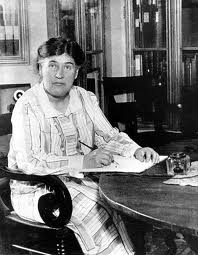
WILLA CATHER, c 1900


The Writer:  Wilella 'Willa' Cather was born on 7 December 1873 on her family's farm in the small Virginia town of Back Creek Valley.  Her paternal grandfather, a farmer of Irish descent, moved to Nebraska in 1877, leaving their sheep farm, called Willow Shade, in the care of Cather's father.  When Willow Shade burned down in 1883, the now homeless Charles Cather was also forced to move his young family to Nebraska –– a place his clever ten year old daughter initially found to be 'as bare as a piece of sheet iron.'


In September 1884 Willa and her family –– she already had a younger brother named Roscoe and would eventually have three more –– moved from her grandparents' house into a comfortable home of their own in the growing prairie town of Red Cloud.  Here she attended school for the first time and met the immigrant Czech, Russian, Scandinavian, French and German farmers whose lives she would later portray so vividly and movingly in her breakthrough 1918 novel My Àntonia.  Although she would do a lot of traveling and live in many different towns and cities during the next sixty-three years, Cather always thought of Red Cloud as home and maintained strong ties with many of the people, especially women, she had known there as a girl.  Indeed, all her closest relationships, outside those with members of her immediate family, were with intelligent, cultured and artistically-minded women who, like herself, had quietly refused to don the straitjacket of conformity their ultra-conservative midwestern upbringing demanded they should wear. 


After graduating from high school, Cather attended a prep school where she did well enough in Greek, Latin, chemistry and mathematics to earn a place at the University of Nebraska.  In 1891 an essay of hers titled 'Concerning Thomas Carlyle' appeared in the Nebraska State Journal.  It was her first appearance in print and persuaded her to abandon science, her original choice of career, to try her hand at writing.  Within a year she'd become literary editor of the university paper Hesperian, with many of her earliest stories and poems subsequently appearing in its pages.  During this time she was also active in the university debating and theatrical societies and began to dress in male clothes, a habit she soon dropped –– along with those of referring to herself as 'William Cather' and keeping her hair cut mannishly short –– in order not to make a spectacle of herself and thereby embarrass her family.


1893 saw Cather begin to contribute regularly to the Nebraska State Journal –– a practice she would continue, although not in any regular sense, until 1900.  In 1895 she graduated and became associate editor of the Lincoln Courier.  Soon bored with this newspaper job, she applied for an instructor's position at her old alma mater.  When she failed to be offered the position, she impulsively moved to Pittsburgh, where she shortly became the editor of Home Monthly, a widely circulated women's magazine.  In addition to her magazine work, she wrote and published stories, poems and drama reviews both locally and in nationally distributed literary journals like The Overland Monthly.  Pittsburgh was to remain her home until 1906 –– she had by this time become a well-traveled woman, spending her summers with an ever-expanding circle of friends in New York, Washington DC, Ohio as well as in 'emerging' western states like Wyoming, New Mexico and Arizona –– when she moved to New York to take up yet another editing post at McClure's Magazine.  It was while working here that she met Edith Lewis, a fellow editor who was to remain her confidante and companion for the next thirty-nine years.


Cather spent much of the time between 1908 and 1914 traveling.  During this period she met new friends like novelist Sarah Orne Jewett (who encouraged her to find her own voice as a writer and to write about the place where she'd grown up) and visited London and the Continent both for pleasure and in her new professional capacity as Managing Editor of McClure's Magazine.  Her first novel, Alexander's Bridge, was published by the magazine in three installments in February 1912 before being republished in book form by the firm of Houghton Mifflin in May.  It received a mixed reception, with several critics comparing it unfavorably to the work of Henry James, who was still considered North America's greatest (if physically absent and no longer publishing) novelist at the time.  Cather's second novel O Pioneers! –– a story based on her Nebraska childhood which appeared in 1913 –– was more popular and helped to cement her reputation as one of the country's most promising new literary talents.  The publication of her third novel, The Song of the Lark, in 1915 prompted the esteemed critic HL Mencken to state that she had 'stepped definitely into the small class of American novelists who are seriously to be reckoned with.'  


Mencken's praise did little to improve the sales of her fourth novel My Àntonia (1918), which sympathetically examined the life of a Czech immigrant girl and remains one of the most emotionally affecting and realistically drawn portraits of the immigrant experience ever published anywhere.  As had been the case with all of her previous novels, Cather chose to make its narrator a man.  This may not seem so surprising when you remember that she generally preferred the work of dead male writers to that of living female ones.  'When a woman writes a story of adventure,' she once wrote, 'a stout sea tale, a manly battle yarn, anything without wine, women and love, then I will begin to hope for something great from them.' 


WILLA CATHER, c 1930


The latter half of Cather's career saw her move further afield than her childhood memories of Red Cloud for inspiration and material.  Although the early chapters of One of Ours (1922) –– a bestseller which won her that year's Pulitzer Prize, despite the criticism leveled at it by some reviewers who accused its author of romanticizing what had been a very brutal and costly war –– and all of A Lost Lady (1923) were set in Nebraska, her next two novels The Professor's House (1925) and Death Comes For the Archbishop (1928) revealed a new interest in the landscapes and native cultures of the southwest.  Cather changed direction again with Shadows on the Rock (1931), her first genuinely 'historical' novel, which tells the story of a young girl's coming of age in seventeenth century Québec.  This was followed in 1935 by Lucy Gayheart, a contemporary tale about a young opera singer and her struggle to fulfil her artistic potential which saw Cather return once more to Nebraska for inspiration, albeit to a Nebraska that was in the process of undergoing radical social and economic change that would soon make it unrecognizable as the rugged frontier state she had known so well and loved so unreservedly for most of her life.


Cather published her final novel, Sapphira and the Slave Girl, a tale of slavery set in antebellum Virginia, in 1940.  By then her style of writing had come to seem irrelevant and old-fashioned to younger, left-leaning critics like Edmund Wilson, causing several of them to dismiss her and her work as outmoded relics of a bygone age.  She planned to write another novel set in France but was unable to complete more than a few dozen pages of it due to a painful hand condition and other recurring health problems which plagued her during her later, increasingly reclusive years.  Her early work enjoyed something of a revival during World War Two, earning her hundreds of letters from grateful GIs who wanted to thank her for bringing to life a 'vanished' North America that many of them wanted and needed to believe they were fighting to defend.  Although her last years were marked by ill health and grief at the loss of family members and many old friends, she did manage to complete a final book of stories, The Old Beauty and Others, which appeared, posthumously, in 1948.  


Willa Cather died on 28 April 1947 and was buried –– not, as might seem obvious, in her hometown of Red Cloud –– but in Jaffrey, New Hampshire, close to the Canadian island where she had spent at least part of every summer with her partner Edith Lewis since 1922.


Use the link below to visit THE WILLA CATHER ARCHIVE, a website maintained by the University of Nebraska which offers further information on every aspect of the writer's life and career:


http://cather.unl.edu/   


You might also enjoy:


Ethan Frome (1911) by EDITH WHARTON


Come Back to Sorrento (1932) by DAWN POWELL


The Secret Agent: A Simple Tale (1907) by JOSEPH CONRAD


Last updated 21 September 2021


Thursday, 27 February 2014

The Write Advice 044: GEORGES SIMENON


Unconsciously I probably always have two or three, not novels, not ideas about novels, but themes in my mind.  I never even think that they might serve for a novel; more exactly, they are the things about which I worry.  Two days before I start writing a novel I consciously take up one of those ideas.  But even before I consciously take it up I first find some atmosphere.  Today there is a little sunshine here.  I might remember such-and-such a spring, maybe in some small Italian town, or some place in the French provinces or in Arizona, I don’t know, and then, little by little, a small world will come into my mind, with a few characters.  Those characters will be taken partly from people I have known and partly from pure imagination — you know, it’s a complex of both.  And then the idea I had before will come and stick around them.  They will have the same problem I have in my mind myself.  And the problem — with those people — will give me the novel...as soon as I have the beginning I can’t bear it very long; so the next day I take my envelope, take my telephone book for names, and take my town map — you know, to see exactly where things happen.  And two days later I begin writing.  And the beginning will be always the same; it is almost a geometrical problem: I have such a man, such a woman, in such surroundings.  What can happen to them to oblige them to go to their limit?  That’s the question.  It will be sometimes a very simple incident, anything which will change their lives.  Then I write my novel chapter by chapter.

The Art of Fiction #9 [The Paris Review #9, Summer 1955)


Use the link below to read more about the life and work of Belgian novelist GEORGES SIMENON:


https://www.theguardian.com/books/2008/jun/11/georgessimenon


You might also enjoy:

 
Betty (1961) by GEORGES SIMENON

 
The Write Advice 013: FRANÇOIS MAURIAC

 
The Write Advice 012: SIMONE DE BEAUVOIR 
 

Thursday, 20 February 2014

Poet of the Month 014: JOSHUA JENNIFER ESPINOZA


JOSHUA JENNIFER ESPINOZA
2012


[2 untitled poems]


i will always be the person who went to the grocery store in cigarette-burned pajamas every day for five months


i will always be the person who wanted to die and didn’t


i will always be the person who lost twenty pounds
in one month and i will always be the person who gained it back


i will always be the person who decided, while crying
in the passenger seat of your car, to be better


i will always be the person who paused when you first said “i love you” just to take the moment in


i will always be the person who survived the unsurvivable 


i will always be the person who fought like hell for it


*


i read a bunch of words in front of people
and then i drive on the freeway and feel okay.
i realize that everything is a freeway
me speaking aloud is a freeway
you touching my hand is a freeway
my nervous smile is a freeway
you pulling away from me is a freeway
and tomorrow is coming whether i want it to or not
with or without me there.
it doesn’t matter
most things don’t, i guess,
so it evens out and everything does matter
in comparison to everything else.
red lights create space for their paths
i create space for my path
i am a red light flying seamlessly over asphalt
i am fucked in a great many ways
it is perfect to be this
it is perfect to be anything.


Published online December 2013


The following biographical statement appears on the poet's Tumblr blog.  [It is re-posted here for recommendation purposes only and, like the poems, remains its author's exclusive copyright-protected intellectual property.] 

hello friends, my name is joshua. i’m 25 years old and i write mostly about having panic attacks on freeways and wanting to die and not wanting to die and my girlfriend and being trans and being mentally ill and trying to survive and live life to the fullest. i’ve been published in word riot and in/words. please feel free to be my facebook friend!


Joshua Jennifer Espinoza is also the author of two poetry collections titled Synthesia and I Had A Dream About The End of the World and You Weren't In It and a powerful short story titled Adam.


Everything she writes is incredibly honest and deeply moving.  I urge everyone to read her. 


Use the links below to visit the blog of North American poet, writer, musician and spoken word performance artist JOSHUA JENNIFER ESPINOZA and find the collection Synthesia on the pay-to-download site Scribd:


http://blankslate.tumblr.com/


http://www.scribd.com/doc/157777715/synesthesia 


You might also enjoy:


Poet of the Month 013: KARYS PK


Poet of the Month 012: CLEMENTINE VON RADICS


Words for the Music 001: DAVID BOWIE


Last updated 18 March 2021


Thursday, 13 February 2014

Some Books About… TONY HANCOCK


TONY HANCOCK 
and friend, 1962


Anthony Aloysius St John Hancock was a comic fiction who lived in an imaginary place called East Cheam and had total reality for millions of people.  Anthony John Hancock (12 May 1924 –– 24 June 1968), clown, was not content with this and searched for more reality, and more truth until he finally lost himself in a fantasy world.
DAVID NATHAN


Those unfamiliar with the work of Tony Hancock, the great English radio, television and variety comedian, may like to watch this 2 minute clip from season seven of his hit BBC TV series Hancock's Half Hour, which originally aired on 23 June 1961.  It's a comedic masterpiece titled The Blood Donor which captures everything that made him such a beloved figure in every part of the British Commonwealth prior to his death, while shooting a new television series in Australia, in June 1968. 


The Blood Donor
1961
2 minute clip


Arrow Books/Random House, 2000


When The Wind Changed: The Life and Death of Tony Hancock (2000) by CLIFF GOODWIN

Books about dead celebrities tend to fall into two categories –– warts and all exposés which focus exclusively on the more salacious aspects of their subjects' lives or highly respectful 'authorized biographies' written with the full cooperation (and sometimes under the strict supervision) of their subjects' relatives and legal executors.  The truth, as it does with most things, probably falls somewhere between these two extremes and, in the case of Cliff Goodwin's When The Wind Changed: The Life and Death of Tony Hancock, can make for illuminating if occasionally confronting reading.  

The author is obviously an admirer of Hancock's work but never allows that admiration to cloud his judgement when it comes to revealing what drove and tormented the comedian prior to his 1968 suicide in Australia, where he had gone in a last-ditch effort to salvage what was left of his alcohol and drug ravaged career.  It's a balanced biography, neither condemning nor condoning Hancock's erratic and often irrational behaviour, which traces his life year by year to reveal how his performing persona developed and the influence, largely negative, that success had on him both in and out of the spotlight.  The comedian's life was a charmed one in many ways but one which began to unravel and then spiral out of control as his alcoholism worsened and his habit of disassociating himself from those who had been instrumental to his success –– his writers Ray Galton and Alan Simpson, his comedic foil Sid James, his agent Phyllis Rounce –– took its understandable toll on these friendships and, in time, on his ability to make effective use of his gifts as a performer.  

Goodwin's plain journalistic style of writing –– which occasionally assumes a needlessly melodramatic tone in an effort to heighten the drama of events which were dramatic enough without requiring further embellishment –– enables the reader to get a real feel for the showbusiness world of 1950s and 1960s England, its variety theatres, radio and TV studios and locally staffed film sets (an unthinkable proposition in the very different, predominantly outsourced film industry of the twenty-first century).  Hancock knew and was friendly with most of the great names of the golden era of British radio, film and television comedy –– Peter Sellers, Harry Secombe, Spike Milligan, Eric Sykes, John Le Mesurier and Jimmy Edwards to name just a few –– and Goodwin's many references to them, and to his co-stars Sid James, Bill Kerr, Kenneth Williams and Hattie Jacques, helps to place Hancock's story firmly in the context of his times, shedding valuable light on how his idiosyncratic and largely inimitable style of comedy was born and laboriously perfected.  

If you only want to read one book about Hancock's short but troubled life, then this is probably the book to choose.  It's thoroughly researched, contains a full chronology, extensive notes and complete cast lists, and also includes a transcription of the comedian's 1960 Face to Face interview with BBC journalist John Freeman –– a probing analysis of his personality which exposes the banal, pre-rehearsed 'celebrity interviews' of today as the crass, self-indulgent time fillers they so often are.  It was Freeman's interview, many of Hancock's friends believed, that provoked the endless questioning of his talent which, as the years went by, warped, eroded and eventually destroyed it.   

The photograph chosen for the cover of this book, taken by French photographer Henri Cartier-Bresson, is also one of the best I've seen of Hancock, capturing in one unguarded moment much of the inner anguish and confusion he hid so well from the public during his time as Britain's best loved comedian.

When The Wind Changed: The Life and Death of Tony Hancock is no longer in print. 


Ariel Books/BBC, 1986


Hancock (1986) by FREDDIE HANCOCK and DAVID NATHAN

Freda 'Freddie' Hancock (née Ross) met a rising star named Tony Hancock while he was performing  in the English resort town of Bournemouth in 1954 and became first his press agent, then his mistress and finally, in December 1965, his second wife.  (His first wife, a former Lanvin model named Cicely Romanis whom he'd married in 1950, also became an alcoholic and followed him to an early grave in 1969 at the age of thirty-eight.)  The marriage officially lasted one year, his alcohol-fuelled self-destructiveness effectively crushing a relationship which had been, in some respects, the most stable and rewarding of his life.  But Freddie realised, as so many others associated with Hancock came to realise prior to his death, that hers was a choice between trying to keep him alive and sober or attempting to save her own threatened sanity.  'I loved Tony,' she told her co-author David Nathan while they were originally preparing this short but lovingly written biography, 'and I never ceased to love him.  But loving him and living with him were vastly different propositions.'

Hancock is as much the story of a relationship as it is the story of a doomed comic genius whose weekly half hour radio and television broadcasts literally brought the entire British nation to a standstill every Friday night for seven successful years.  Freddie's attempts to make her client and lover see what he was doing to himself –– which included leaving him on numerous occasions and once tipping an entire bottle of brandy over his head when he was supposed to be abstaining from alcohol and had thoughtlessly asked her to pour him a drink –– fell on deaf ears, resulting in five failed suicide attempts on her part before she finally found the courage (and the sense) to walk out on him for good in July 1966.  Despite this, and the frequent beatings Hancock subjected her to after she attempted to wrench vodka bottles from his hand, she never ceased to hope that he would one day conquer his demons and begin to appreciate, as she and so many of his contemporaries in the British entertainment industry did, what a rare and exceptional talent he possessed.  Nor was she alone in finding this portly, round-shouldered man (the result of contracting rickets as a child) with 'funny feet' ('look like two kippers strapped to my ankles, they do' was how Hancock himself described them) and a remarkably expressive face irresistibly attractive.  Freddie was only one of many people, female and male, who fell in love with Hancock and drove themselves to the brink of madness in the quest to relieve his largely self-inflicted suffering.

It's a tribute to Freddie's generosity of spirit that she chose not to make her biography the muckraking tell-all exposé it could have so easily become in unkinder, less affectionate hands.  While it can by no means be described as an exhaustive biography, it remains a useful and enlightening one for any admirer of the comedian, revealing him as a deeply flawed man with chronic emotional problems and not, as some would have it, a humorless monster obsessed with becoming an international superstar in the style of his more successful friend and rival Peter Sellers (another inspired comedian who was no stranger to addiction, psychiatry and prolonged episodes of masochistic self-destruction).  Freddie admits that she was naïve, that she ignored the advice of her family and that of Hancock's friends who tried to make her see she had to leave him, but nowhere does she state that she ever regretted having him in her life.  'He was an exciting personality,' she recalls.  'He did not smile all that often, but when he did it was worthwhile.  His eyes smiled a lot.  He had a lasting effect on me from that moment.'  This book is a testament to the love she felt for him, tragically misguided and spurned though it ultimately was.

Hancock was last reprinted in 1996.  Lady Don't Fall Backwards, a similar 1988 memoir by JOAN LE MESURIER, his mistress and the wife of the comedian's friend and occasional Hancock's Half Hour guest star JOHN LE MESURIER, may also be available. 


Methuen Publishing Limited, 1999


Hancock's Last Stand: The Series That Never Was (1999) by EDWARD JOFFE

Edward Joffe was a South African-born, Scottish-based television director who was given the unenviable task of directing Hancock's last ever television series, provisionally titled Hancock Down Under, which had been commissioned by Australia's ATN7 network and featured brand new, tailormade scripts authored by Melbourne-based writer Hugh Stuckey.  The program, which was filmed entirely in the Seven network's Sydney studios and featured Hancock as a newly arrived immigrant trying to come to grips with his new home and the Australian way of life, was considered by the comedian's agent and virtually everyone who knew him to be his last chance to recapture and perhaps replicate the success of his BBC years, when Hancock's Half Hour, in both its radio and television formats, had regularly been enjoyed by audiences numbering in the millions.  Hancock himself apparently knew this was his last chance to salvage what was left of a career all but ruined by his addictions to alcohol and prescription medications and approached the project with a newfound sense of purpose and, at least initially, with the intention of remaining sober and drug-free throughout the long and, for him, tedious months of filming.  

He flew to Australia in March and, after spending some time in hotels, eventually moved into a house on Birriga Road in the upscale eastern Sydney suburb of Bellevue Hill with Joffe, his wife Myrtle and their three children.  The Joffes occupied the upper two floors of the house, while Hancock lived alone in a small, self-contained flat on the ground floor overlooking the garden.  It was an arrangement the producers of the show had encouraged, believing that having his director so close would in turn encourage Hancock to curb his drug and alcohol intake, both of which once again became prodigious within a few weeks of his arrival in Australia.  It was in this Birriga Road flat that Hancock was found, dead in his underwear with a cigarette clamped between his badly scorched fingers, by Joffe on the morning of 24 June 1968.

This was, of course, a dismal end to what had been a sad and wasted life and it's a tale that might have been more poignantly told by a writer other than Joffe, whose style has a tendency to become annoyingly glib at times.  The book's one saving grace is that it reveals Hancock trying to understand and confront his own self-destructiveness and its consequences, fighting to regain control of a career which had hit rock bottom following his separation from Freddie Ross and the failure of his one man show –– which saw him turned down flat by his former writers Galton and Simpson after begging them to provide him with new material –– to wow audiences at London's Festival Hall and other 'safer' venues in Aden, the Isle of Man and Australia.  

These were dark days for Hancock and this is, at times, a very disturbing book.  Nor is what was actually filmed of Hancock Down Under –– a program plagued by disaster from day one that was only screened in edited form following the comedian's death –– a fitting memorial to a performer who had previously been able to make audiences laugh simply by raising his eyebrow or impatiently muttering the phrase 'Stone me!' to himself.  While the program does offer a few brief glimpses of the old, mobile-faced, incredibly subtle clown of the Hancock's Half Hour days, there are too many moments when the old magic simply isn't there, when it becomes tragically obvious that you're watching a sick and scared man trying to regain public favour by sheer force of will.  The show, like Joffe's book, is not a must-own item for any but the most obsessive of Hancock fans, who will most likely be disconcerted or at the very least disappointed to read of the pitiable conclusion to what had been, before the comedian was destroyed by his own insecurities, a sparkling career.

Hancock's Last Stand has not been reprinted since it was originally published in 1999. 


Arrow Books/Random House UK, 2004


50 Years of Hancock's Half Hour (2004) by RICHARD WEBBER

'One thing,' author Richard Webber writes in his introduction to this fine and indispensable book, 'needs clarifying from the beginning: this is not another Tony Hancock biography.  The tragic life story of one of the nation's finest comedy actors has already been meticulously detailed by other authors… this book is a biography of a radio and television series, a celebration of a show which, even now, fifty years later, provides pleasure to the millions who continue to listen to or watch Hancock's Half Hour.'   

Mr Webber is clearly a man of his word.  His book is an affectionate, lovingly detailed celebration of a program which, amazingly, has remained popular with audiences for over half a century –– an audience which includes people, like myself, who were not yet born when it originally aired and have only discovered Hancock thanks to the canniness of the BBC marketing department which wisely chose to repackage, re-release and re-promote what most of the world's other major entertainment conglomerates would have thrown away or left to ignominiously rot in their rarely opened vaults.  

The continuing popularity of Hancock's Half Hour is a testimony to its star's ability to simultaneously personify and lampoon what may be termed a quintessentially English personality and a quintessentially English view of life.  Hancock was appealing because he behaved no better and no worse than anybody in his audience behaved, was unafraid to portray himself as a deluded buffoon whose pretensions were as numerous as they were ludicrous, a clown whose antics nevertheless revealed, in the beautifully chosen words of novelist and playwright JB Priestley whose two part 1968 novel The Image Men features a character based on Hancock, '…a suggestion of depth… somebody close to "mass man" of today, coming out of the faceless crowd, hopeful, near to glory for some minutes, before the lid comes on again, before he shrugs his way back into the dark.'  That shrug, it could be argued, was the key to what made 'the lad himself' so popular –– a willingness to get on with it and not linger over his latest defeat that became, in time, the endearing hallmark of the flawed, all too human 'Everyman' he so effectively portrayed.

This book doesn't dwell on the alcoholism, the drug abuse, the affairs or the two failed marriages, the long slow fall from grace that led to what had probably been the comedian's always inevitable decision to take his own life.  Instead, it turns the spotlight on what should always be the first and last consideration when we speak of Tony Hancock –– his ongoing ability to make people laugh.  That somebody so beloved, who had, in the words of his friend Spike Milligan '…no enemy but himself' should die such a lonely premature death only makes a book like this that much more valuable as a celebration of what, in anybody's terms, must rank as a unique and precious legacy.  Containing full episode guides to all his BBC radio and television programs, a complete unaired script penned by Galton and Simpson (who also provide a short and rather silly introduction), full rundowns of cast and crew details plus a complete bibliography and (nowadays all but irrelevant) list of LP, cassette and video releases, it's a book that deserves a place in the collection of any Tony Hancock fan.

50 Years of Hancock's Half Hour is still in print and may be obtainable from your local bookstore or preferred online retailer. 


Macdonald Queen Anne Press UK, 1987


The Illustrated Hancock (1987) by ROGER WILMUT

Like Richard Webber's book, Roger Wilmut's The Illustrated Hancock is a celebration of a body of work rather than a lament for a sadly squandered talent.  What makes the book worth owning, as should be obvious from its title, is the assortment of stunning black and white photographs it contains, covering all aspects of the phenomenon that was Tony Hancock from his early days as a variety performer through his radio and television years and his work as both a star in the films The Rebel (1960) and the unfairly scorned The Punch and Judy Man (1962) and as a supporting actor in big budget extravaganzas including Those Magnificent Men In Their Flying Machines (1965) and The Wrong Box (1966).  Each section is preceded by a short introduction which provides a context for the images and includes quotes from many of those who knew, loved and worked with him.  The book is a brief but fitting tribute to a comedian who almost singlehandedly raised the bar of British comedy, paving the way for later and equally gifted generations of 'comedy of embarrassment' performers including John Cleese, Harry Enfield, Kathy Burke, Jennifer Saunders, Catherine Tate, Steve Coogan and Ricky Gervais.

The Illustrated Hancock has not been reprinted since it was originally published in 1987.  ROGER WILMUT was also the author of Tony Hancock: Artiste, a 1978 biography that was fully revised and expanded in 1983.


Special thanks to the person who posted this clip from The Blood Donor on YouTube.  Your efforts are appreciated by comedy fans everywhere.


You might also enjoy:

 
Some Books About... BUSTER KEATON

 
Some Books About... MODS!

 
Some Books About… BOOKS


Last updated 14 July 2023 §