Pages

Thursday, 5 January 2023

'The Polish James Dean' REMEMBERING ZBIGNIEW CYBULSKI


ZBIGNIEW CYBULSKI
3 November 1927 – 8 January 1967


Actors are divided into those who transform their personalities and those who perpetuate them. I'm more interested in acting within certain individual characteristics. I realise that it is both difficult and dangerous…
Quoted in Film, No 2
 [1987]


The death of renowned Polish theater and cinema actor Zbigniew Cybulski on 8 January 1967 marked the end of what had been Poland's post-war cinematic renaissance, drawing a line between the generation which had come of age under the shadow of Nazism and the generation which had come of age under the equally oppressive shadow of Josef Stalin.  
 
 
Cybulski was the most charismatic and, as some critics have suggested, most emblematic representative of that earlier generation of actors, writers and directors, an artist who found international fame thanks to his era-defining role in Andrezj Wajda's 1958 masterpiece Popiól i diament [Ashes and Diamonds], only to perish after trying to leap aboard a moving train nine years later.  
 
 
Cybulski's appearance in Popiól i diament, as the troubled young Home Army/anti-Communist assassin Maciek, was nothing short of electrifying.  His performance earned him the (not altogether accurate) nickname 'The Polish James Dean' but it became a role that, as the years progressed, he found it increasingly difficult to disassociate himself from despite the fact that he appeared in more than twenty other feature films and many notable stage productions.  
 
 
But it's not difficult to understand why the character of Maciek so thoroughly captivated post-war audiences both in Poland and abroad.  Described by one Polish critic as a 'jazz existentialist,' Cybulski/Maciek seemed to personify the disaffection and unease of the Cold War 1950s, an idealist filled with doubt, searching for meaning and purpose in what had become a very restrictive society in which every aspect of life was dominated by Poland's Soviet-backed Communist Party.  Cybulski's identification with the Maciek character was total, extending even to the outfit — jeans, jacket, white shirt, sunglasses — he wore onscreen.  As the film's director Andrzej Wajda once explained in an interview:  'He wore his own clothes even though, historically, they were completely wrong… he rejected the costume we had prepared for him, he was in his own things with a small green haversack and that's how he came into the film…he wasn't able to think about the hero… as [being] anyone other than himself.' 


DVD cover, date unspecified


Zbigniew Hubert Cybulski was born on 3 November 1927 in Kniażu, a small Polish village in what is now western Ukraine where his grandfather was a property owner.  His family background was not in any way theatrical.  His father Aleksander Cybulski (1896–1965) was an official in the Ministry of Foreign Affairs while his mother Ewa Jaruzelska (1903–1987) was a homemaker of Polish-Armenian descent.  His younger brother Antoni (1931–2009) grew up to become a lawyer.  
 
 
Cybulski was educated in the southwestern Polish town of Dzierżoniów, subsequently moving to Krakow to pursue further study in the Consular Department of that city's Academy of Commerce and then in the Journalism Department of the School of Social Sciences before transferring again to the National Art Academy from which he graduated as an actor in 1953.  That year also saw him make his stage debut in the Polish port city of Gdańsk in Intrigue and Love, a 1784 play written by German poet and dramatist Friedrich Schiller.

 
In 1954 Cybulski obtained his first film role, appearing briefly but memorably in Andrzej Wajda's Pokoleniu [A Generation] alongside future controversial director Roman Polanski.  Another small part in the spy thriller Kariera [Career], directed by Jan Koechera, followed, although his name did not appear in the film's credits.  
 
 
1954 also saw him relocate semi-permanently to Gdańsk where he worked as a member of the Seashore Theater company and co-founded a student cabaret, called Bim-Bom, with his friend and future co-star Bogumił Kobiela.  (Kobiela would appear alongside him in Popiól i diament and also die young as the result of an accident, in his case involving an automobile.)  While not able to directly criticize the repressive state regime, Bim-Bom staged five productions between 1955 and 1960 that were notable for their tone of biting satire and their popularity with audiences both in Poland and in other European nations including France and Belgium.  'Bim-Bom was everything,' Cybulski would reminisce to a friend shortly before his death.  'Our mother, our brother, and our teacher.  It was our bread.  I don't know if it was theater, fun, a dream or a book…Through Bim-Bom I approached humanity.'
 
 
But it was in the world of cinema that Cybulski now began to distinguish himself as an actor, appearing as a cyclist in Trzy startsy [Three Starts] directed by Stanisław Lenartowicz and as a coalminer in Tajemnica dzikiego szybu [The Secret of the Wild Shaft] directed by Wadim Berestowski.  In 1957, the same year he and Kobiela founded their experimental Rozmow theater company,  he played the lead role in Koniec nocy [End of the Night], the tale of an unlikeable truckdriver who knocks down a pedestrian and eventually loses his job, only to sink into a life of alcoholism and petty thievery.  His stage work continued to be equally impressive, culminating in him starring as drug addict Johnny Pope in the North American play A Hatful Of Rain under the direction of Andrzej Wajda, a production that travelled to several Polish cities in 1959 following the success of Popiól i diament and was acclaimed by critics and audiences alike. 
 
 
The strength of Cybulski's performance in Koniec nocy earned him the lead role of Piotr Terlecki in Ósmy dzień tygodnia [The Eighth Day of the Week], directed by Alexsander Ford, the controversial story of frustrated young lovers trying to make a life for themselves in grey and grimy post-war Warsaw.  Unfortunately, the film met with disapproval from the state censors following its premiere in West Germany and remained unreleased in Poland until 1983.


ZBIGNIEW CYBULSKI and SONJA ZIEMANN
The Eighth Day of the Week
1958


Cybulski's next major film role in Popiól i diament was one he nearly failed to get.  Wajda's original choice for the part of the doomed Home Army soldier Maciek was Tadeusz Janczar, a choice he revised at the urging of his assistant director Janusz Morgenstern who would himself go on to direct Cybulski in Do widzenia, do jutra [Goodbye, See You Tomorrow] in 1960.  Like Ósmy dzień tygodnia, Wajda's film created a lot of controversy upon its release, attracting criticism from the state authorities and from his fellow director Alexsander Ford who questioned the 'counter-revolutionary nature' of its plot and called for it to be banned.  
 
 
Maciek is shown to be as much a victim of forces beyond his control as the Communist bureaucrat he's assigned (and initially fails) to assassinate, making him an immediately sympathetic figure and possibly explaining his popularity with Western audiences accustomed to seeing films featuring doomed anti-heroic leading characters.  (This explains why Maciek was compared with Jim Stark, the character portrayed by James Dean in the 1955 film Rebel Without A Cause directed by Nicholas Ray.  Cybulski allegedly attended a screening of Ray's film at Cannes and may have based aspects of his performance on that of the recently deceased Dean, although the two films have nothing in common politically and deal with very different subject matter.) 
 
 
The film's plot also deviates significantly from the plot of the popular 1948 novel (by Jerzy Andrzejewski) from which it was adapted, making Maciek its protagonist rather than a supporting character and introducing a romantic subplot which sees the young man fall in love with a barmaid named Krystyna who is at first reluctant to become involved with him but to whom he promises to return following the completion of his mission.  
 
 
Fortunately, Andrzejewski was respected enough as a cultural figure to be listened to when he insisted that the film was not anti-ideological and should be released without any cuts — a decision that saw it viewed by more than one million of his fellow Poles and go on to win an award at the Venice Film Festival after being banned and withdrawn from the Cannes competition.  In recent years Popiól i diament has again become the subject of controversy for its 're-working' of the true events of 1945, the year in which it is set.  It was in fact the Communists who hunted down and executed members of the Home Army rather than the other way round, a falsification of history that angered many Poles following the fall of Communism throughout Eastern Europe.


ZBIGNIEW CYBULSKI
c 1962


To a large extent the remainder of Cybulski's film career was defined by his portrayal of Maciek, with many of the projects he starred in — Wajda's Niewinni czarodzieje [Innocent Sorcerers, 1960] and the aforementioned Do widzenia, do jutra [1960] (which he also had a hand in writing) — seeing him play characters who experience similar forms of existential angst and which, in some respects, challenge the romantic idealism presented in the character of the doomed young assassin.  In Jak być kochaną [How To Be Loved], a 1962 production directed by Wojciech Has, Cybulski played Wiktor Rawicz, a wartime actor accused of killing a Nazi who is hidden by Felicja, a fellow actor who's in love with him, in her room.  When the war ends Rawicz flees her apartment to seek the fame he feels he's been wrongly denied by the war, only to see Felicja accused of collaboration because she took a job in a German-run theater to prevent him from being discovered and arrested by the Nazis.  Rawicz fails to find success and becomes a hopeless alcoholic who, after being found by Felicja in a grubby bar, is taken back to her apartment where, once more faced with the prospect of living there indefinitely, he kills himself by leaping from its window.  The bar scene is a direct parody of a similar scene in Popiól i diament between Maciek and his lover Krystyna, designed to contrast the former's idealism with Rawicz's unappealing venality.
 
 
Cybulski appeared in many more films as the 1960s progressed, including the 1964 Swedish drama Att Älska [To Love] and the bizarre 1965 historical satire Rękopis znaleziony w Saragossie [The Saragossa Manuscript], adapted from the 1815 novel by Jan Potocki in which he portrayed the Napoleonic army captain Alfons van Worden — one of the few roles for which he did not wear his trademark tinted eyeglasses.  Always in demand, Cybulski acted in nine more films and two television dramas over the next two years, combining this with work in radio and theater as he had done throughout most of his career.  
 
 
Ironically, the theater offered him a wider range of roles and also gave him the chance to direct, including a well received adaptation of Ernest Hemingway's 1938 play The Fifth Column in which he played the leading role of Philip Rawlings.  Nor was that his only venture into Western drama.  In addition to The Fifth Column and his earlier starring role in Michael Vincent Gazzo's A Hatful of Rain Cybulski also performed in Polish adaptations of works by William Gibson, William Faulkner, Terence Rattigan, Truman Capote and British screenwriters Ken Hughes and Philip Mackie.
 
 
The actor's hectic work schedule was partly responsible for his unexpected death.  Long known as 'a man in a hurry' to his friends, he frequently ran late for professional appointments and was often in the habit of arriving at railway stations at the last minute and leaping aboard moving trains as they were pulling out from the platform.  (He also did this in several films, beginning with his cinematic debut in Pokoleniu [A Generation] and ending with Salto [Jump] in 1965.)  This was what he did on 8 January 1967 at Wrocław Główny railway station in an effort to board the 'Odra' express to Warsaw so he could begin rehearsals at a television studio after completing principal photography on what was to be his final film Morderca zostawia ślad [The Murderer Leaves a Trace].  Unfortunately, Cybulski misjudged the distance between the carriage and the platform and tumbled into the gap.  His body was struck by the next oncoming carriage, causing major damage to his head, chest and liver.  Although he was rushed to hospital where he immediately underwent emergency surgery, the extent and severity of his injuries saw him die within an hour. 
 
 
The untimely passing of Zbigniew Cybulski was viewed as a national tragedy in Poland where he remains a revered and much loved artist to this day, with the government choosing to honour his life and artistic legacy by naming an acting prize in his honor.  He was survived by his wife Elżbieta Chwalibóg, a set designer he married on 30 August 1960, and their son Maciej (1961–2019) and buried in his family tomb in the southern city of Katowice after two separate funeral services — the Catholic ceremony preferred by his relatives and the secular ceremony preferred by the Communist Party.  In 2007 a stone with a cross and a bas-relief of his face were placed on the tomb to mark the fortieth anniversary of his death.  Ceremonies were also held in 2017 to mark the fiftieth anniversary of that tragic event.
 
 
Perhaps the most fascinating tribute to Cybulski was the film Wszystko na sprzedaż [Everything For Sale] made in 1968 by his old friend and collaborator Andrzej Wajda.  The film, one of the director's best, explores the efforts made by a group of actors to complete a project starring a deceased colleague, a man who died in circumstances that remain unclear and cause them to question their own careers, relationships and personal and professional motivations.  The film has a quasi-documentary feel to it and perfectly mirrors the situation Wajda found himself in at the time of Cybulski's passing.  It is well worth seeking out by anyone interested in the idea of celebrity and the mythical status some performers attain following their deaths. 


Film poster, 1968


Use the link below to view a series of interviews with ANDRJEZ WAJDA (with English subtitles) in which he discusses the life, work and legacy of Polish film, television, radio and theater actor ZBIGNIEW CYBULSKI:


You might also enjoy:


Thursday, 29 December 2022

Think About It 083: ANNE HELEN PETERSEN


To be valuable in American society is to be able to work.  Historically, more work, more toil, more commitment, more loyalty, more grit — all of that could make you more valuable.  That's the very foundation of the American Dream.  But in our current economic moment — often referred to as 'late capitalism,' to evoke how much of the economy is predicated on the buying and selling and leveraging of things that aren't, well, things — hard work only becomes truly valuable when accompanied by existing connections (also known as class status and privilege) or credentials (diplomas, recommendations, resumés).
      Which explains our current 'best practices' for achieving middle-class success:  Build your resumé, get into college, build your resumé, get an internship, build your resumé, make connections on LinkedIn, build your resumé, pay your dues in a soul-sucking low-level position you're told to be grateful for, build your resumé, keep pushing, and eventually you'll end up finding the perfect, stable, fulfilling, well-paying job that'll guarantee a place in the middle class.  Of course, any millennial will tell you that this path is arduous, difficult to find without connections and cultural knowledge, and the stable job at the end isn't guaranteed.
      And yet it's easy to see how parents of all classes would become fanatical about college prep:  If you can just get on the path, that good, stable job is in sight!  To make things better for the next generation, you don't need revolution, or regime change, or raised taxes.  All that's necessary, at least to start, was your kid's college acceptance letter… Instead of raising kids, so many parents, conciously and subconsciously, began raising resumés.


Can't Even: How Millennials Became The Burnout Generation (2020)


Use the link below to read a September 2020 article about North American writer and journalist ANNE HELEN PETERSEN and her latest book Can't Even: How Millennials Became The Burnout Generation:


https://www.theguardian.com/lifeandstyle/2020/sep/22/anne-helen-petersen-millennial-burnout-work-life


You might also enjoy:


Thursday, 22 December 2022

Poet of the Month 082: BERTOLT BRECHT


BERTOLT BRECHT
1898–1956


SONG ABOUT THE GOOD PEOPLE


1
 
One knows the good people by the fact
That they get better
When one knows them.  The good people
Invite one to improve them, for
How does anyone get wiser?  By listening
And by being told something.


2
 
At the same time, however
They improve anybody who looks at them and anybody
They look at.  It is not just because they help one
To get jobs or to see clearly, but because
We know that these people are alive and are
Changing the world, that they are of use to us.


3
 
If one comes to them they are there.
They remember what they
Looked like when one last met them.
However much they've changed––
For it is precisely they who change––
They have at most become more recognisable.


4
 
They are like a house which we helped to build
They do not force us to live there
Sometimes they do not let us.
We may come to them at any time in our smallest dimension,
but
What we bring with us we must select.


5
 
They know how to give reasons for their presents
If they find them thrown away they laugh.
But here too they are reliable, in that
Unless we rely on ourselves
They cannot be relied on.


6
 
When they make mistakes we laugh:
For if they lay a stone in the wrong place
We, by watching them, see
The right place.
Daily they earn our interest, even as they earn
Their daily bread.
They are interested in something
That is outside themselves.


7
 
The good people keep us busy
They don't seem to be able to finish anything by themselves
All their solutions still contain problems.
At dangerous moments on sinking ships
Suddenly we see their eyes full on us.
Though they do not entirely approve of us as we are
They are in agreement with us none the less.


c 1939


Translated by
 
FRANK JELLINEK


Poet, actor, playwright and pioneering theater director Eugen Berthold Friedrich Brecht was born in the southern German city of Augsburg on 10 February 1898.  His early life was heavily influenced by his maternal grandmother and her devotion to the Lutheran church, seeing him become intimately acquainted with the Bible and its teachings by the time he reached adolescence.
 
 
The outbreak of World War One in August 1914 prompted many of Brecht's friends and classmates to enlist in the German army.  Initially a supporter of the war, he quickly became horrified by the carnage it created and an outspoken critic of the Prussian military establishment, almost being expelled from school after composing an essay that satirized the rabid patriotism of his countrymen.  
 
 
Seeking to avoid conscription, Brecht enrolled as a medical student at Munich University in 1917.  It was in Munich, capital of the state of Bavaria, that he first studied drama and became a passionate admirer of playwright and cabaret performer Frank Wedekind.  He had by this time also become a theater critic for an Augsburg newspaper, signing his articles 'Bert Brecht.'  Although he was conscripted in 1918, he was assigned to work as a medical orderly in an army clinic in Augsburg which specialized in the treatment of venereal diseases.  He was still working in this clinic when the Armistice was signed on 11 November.
 
 
1918 also saw Brecht write Baal, his first full length play.  The play would not be staged until 1923, by which time the young dramatist had already established his reputation as a risk taker with a 1922 production of his second full length work for the stage Drums In The Night.  He soon re-located to Berlin where he befriended many of that city's most talented playwrights, poets, musicians and cabaret performers and several members of the emerging Dadaist movement who, disgusted by the needless suffering and destruction caused by the war, viewed it as being their duty to attack and ridicule the bourgeoisie at every opportunity.
  
 
Brecht followed the example of the Dadaists, using biting satire to dramatize his emerging Marxist political views.  In May 1924 he had his first encounter with the Nazis when they staged a protest at the Munich premiere of Im Dickicht der Städte [In The Jungle of Cities], blowing whistles inside the theater and pelting the actors with stinkbombs.  Ironically, Brecht's eldest son Frank (born in 1919 to his first love Paula Banholzer) would die in 1943 fighting for Hitler on the Russian front.
 
 
The nine years between 1924 and 1933 were a period of intensive artistic achievement for Brecht, seeing him create some of his earliest masterpieces including the 'ballad operas' Die Dreigroschenoper [The Threepenny Opera, 1928] and Aufstieg und Fall der Stadt Mahagonny [Rise and Fall of the City of Mahagonny, 1930] written in collaboration with composer Kurt Weill.  In these and other works he continued to develop his concept of 'epic theater,' a style of production and performance that sought to shake audiences out of their passivity by constantly reminding them they were watching a play, not observing so-called 'real' events as they naturally unfolded.  This technique, which became highly influential in later decades in many parts of the world, saw him adopt a variety of devices — objective narrators who commented on the action without participating in it, actors stepping out of character to directly address the audience, musical and dance numbers that juxtaposed catchy melodies with dark despairing lyrics, minimalist sets that featured few or no props, the use of placards and signs to announce the beginnings and endings of scenes — that were as innovative as they were confronting or, as some critics described them, alienating. 
 
 
The appointment of Adolf Hitler to the post of Chancellor of Germany in January 1933 saw Brecht, his second wife Helene Weigel and many of their colleagues from the worlds of theater and the arts — people the Nazis accused of 'unGerman decadence' and soon began rounding up and sending to concentration camps — become voluntary exiles in other countries.  Following brief stays in Prague, Paris and Zurich Brecht and Weigel eventually settled on the small Danish island of Funen, remaining there until April 1939 when the prospect of war saw them flee again to Stockholm in nearby Sweden.  Following the Nazi invasion of Norway they fled yet again to Finland, remaining there until May 1941 when they were finally granted permission to emigrate to the United States.
 
 
It was while living in exile in the United States that Brecht created what came to be regarded as his most iconic works for the theater, a list which includes Fear and Misery of the Third Reich (first performed 1938), Life of Galileo (first performed 1943), Mother Courage and Her Children (first performed 1941), The Resistible Rise of Arturo Ui (first performed 1958) and The Caucasian Chalk Circle (first performed 1948).  Most if not all of these plays were conceived as direct attacks on Fascism, with The Resistible Rise of Arturo Ui cleverly parodying Hitler's rise to power by re-imagining the German dictator as a Prohibition-era gangster taking over the city of Chicago.  Brecht also staged several adaptations of plays written by other playwrights — including a 1946 production of The Duchess of Malfi by Jacobean dramatist John Webster co-adapted with English poet WH Auden — during this period as he'd previously done in Berlin prior to the war.
 
 
Brecht left the United States in 1947 following his decision to testify before the House Un-American Activities Committee, a Congressional body convened to investigate what the Government defined as the 'alleged disloyalty and subversive activities' of US citizens, civil servants and the nation's public institutions.  Brecht's decision to cooperate with the Committee was viewed by many of his colleagues as a betrayal of his Marxist principles and saw him initially seek refuge in Switzerland before returning permanently to what was now a divided Berlin in 1949.  It was in East Berlin, with the full political and financial backing of the new Communist state, that he and Helene Weigel created the Berliner Ensemble, a theater company specifically formed to stage his own works.  Ironically, he wrote almost no new plays following his return to Europe, instead composing much of his finest poetry while mounting new productions of his old dramas utilizing the techniques he'd developed throughout his impressive thirty year career.
 
 
Bertolt Brecht died in East Berlin of a heart attack on 14 August 1956.  But he remained a controversial figure even in death, revered by some as a great originator and reviled by others as an opportunistic plagiarist who knowingly and ruthlessly exploited his collaborators and many of his friends.  He also attracted fierce criticism from some feminist critics who derided him for the many affairs he pursued both before and after his marriage to Helene Weigel including a longstanding relationship with Danish writer Ruth Berlau which ended acrimoniously in 1944.  
 
 
Weigel, who was the mother of two of Brecht's four children, outlived him by fifteen years, serving as Artistic Director of the Berliner Ensemble until her own death on 6 May 1971.     


Use the link below to read about the pioneering work of poet, actor, playwright and director BERTOLT BRECHT and his groundbreaking contributions to twentieth century theater: 


You might also enjoy:


Thursday, 8 December 2022

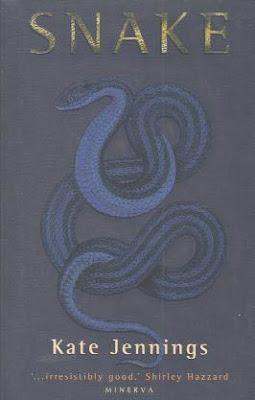
Snake (1996) by KATE JENNINGS


HarperCollins UK, 2001


She leaned the bike against the railing and, with the baby on her hip, threaded her way along the bank, stepping carefully between clumps of sticky paspalum, on the lookout for the telltale bright green feathery foliage of the asparagus plants but also for snakes, the brown variety: long, fast, deadly.  All you saw of them was the dull glitter of scales or a tail section soundlessly exiting, unless you were unlucky enough to step on one, in which case the snake formed as S-shape with its forebody and, jaws fixed in a hideous rictus, struck repeatedly.


The Novel:  Rex, a returned soldier, and Irene, a former member of the Australian Women's Army Corps, meet at the end of World War Two and marry shortly afterwards.  Rex, a farmer descended from a long line of agricultural workers — none of whom were particularly successful — takes his twenty year old bride to the 'irrigation farm' he has recently been employed to manage on behalf of his patronising father-in-law.  The newlyweds settle down in a comfortable but basic house located several miles from a town called Progress and do precisely what's expected of a young married couple in the conformist atmosphere of post-war rural Australia, quickly producing two children they refer to as 'Girlie' and 'Boy' and becoming, in time, accepted if uninvolved members of their local community.  
 
 
But Irene, a proud and intelligent woman who enjoyed a number of sexual liaisons with visiting GIs and other men during the war, soon finds herself growing disenchanted with her restrictive new life and, as the years pass, becoming increasingly infuriated by its seemingly rigid limitations.  She tries to lose herself in her hobbies — sewing, preserving fruit, planting a lavish native garden she takes tremendous pride in — but her feelings of dissatisfaction persist along with a growing resentment of her timid, overly needy daughter and dull, unambitious husband.  'Irene could go for days,' we're told, 'without speaking, sleeping with her back to him, doing her chores with tears in her eyes… Then, in the bedroom, the children asleep, she unknitted her lips and words poured from her, black as pitch.'  Occasionally Rex objects to these strident tongue lashings, beseeching his angry wife to 'Have a heart' only to find his pleas for mercy falling on deaf ears. 
 
 
One day Rex stumbles upon a letter Irene has written to a former North American GI sweetheart in which she laments that her beautiful son, her Boy-O as she calls him, was born of her union with her uninspiring spouse and not of her infinitely more passionate union with him.  And the situation quickly worsens.  At a Saturday night dance in town, Irene allows herself to be led outside by a flirtatious fertilizer salesman named Hans. They have sex propped up against his car, with the adulterous Irene revelling 'in the act, which she found to be deliciously obliterating… Years later she would remember the feel of the cold metal against her bare backside.'


Minerva Publishing first UK edition, 1996


The passage of time does nothing to improve Irene's outlook.  She continues to despise Rex, criticise Girlie and indulge Boy (encouraging her son to sit and chat with her while she soaks naked in their claw-footed bathtub as she did when he was small) as the years go by, finding a degree of solace only in the secretarial position she manages to obtain at the local radio station.  Her boss, an ugly would-be politician, introduces her to the delights of classical music and modern literature — discoveries that, instead of sweetening her nature, only make her more conscious of everything she's missed out on in life.  'Fate,' she feels, 'had been cruel to marry her to a farmer.  Such a dull, mean, ordinary existence!  She chewed on the injustice of it like a dog with a piece of hide.'  
 
 
Still, her newfound enthusiasm for music leads her to befriend Hildegarde Hochswender, a motorcyle riding immigrant from Germany who has settled in Progress with her svelte female companion.  It is now 1959 and Hildegarde becomes a frequent Saturday visitor to Irene's home, subsequently taking her, Girlie and Boy on a long anticipated camping trip to the Murrumbidgee River, seventy-five miles from town.  Late that night, after being put to bed by their mother, Girlie and Boy see her and Hildegarde strip off their clothes and plunge naked into the river together, their cries of amusement fading to an unsettling silence until their tryst is abruptly interrupted by a herd of thirsty cows which have blundered into the campsite.

 
As Irene ages she grows ever more bitter and critical, a force of nature her husband and children learn to withstand by deliberately avoiding her.  Even being injured in a serious car accident does nothing to diminish her sense of outrage at the dirty trick she feels that life has played on her.  She remains as resentful as ever of her predicament until, one day, her children do what children inevitably do and grow up.  Girlie is the first to leave the farm, taking with her 'a low-cut, lolly-pink ballgown' and 'a push-up brassière,' and is soon followed by her brother, footloose and fancy free again after getting his girlfriend pregnant and taking her to the bustling metropolis of Sydney to undergo an abortion.  
 
 
The departure of their offspring sees Irene and Rex lead increasingly separate lives, with Rex running the farm as he always has while Irene stays out late at night, returning only as and when she feels like it.  With their primary reasons to remain together now living their own lives far away in the city, Irene enters the kitchen one hot January morning carrying a suitcase and takes it out to her car which she then drives away without uttering so much as a single word to her equally silent if not entirely shocked husband.  
 
 
Rex calmly watches his wife leave, making no effort to stop her.  Yet her absence causes him to go a little mad, seeing him walk obsessively around the farm as if determined to expunge every memory of her from his mind.  He neither sleeps nor eats for five days, then falls into a stupor, eventually emerging to discover that his hair has turned white and he too now is now seething with unreleased anger.  He impulsively burns all Irene's possessions — the many, that is, that she never bothered to take with her when she fled the farm — then buys the pigs he's always wanted to raise and allows them to run wild in her treasured native garden.  A month later he re-sells the animals at a profit and becomes a regular visitor to the town pub, a place he's seldom visited before and from which he often needs to be carried home, dead drunk, by his neighbours.  
 
 
Six months to the day after Irene's wordless departure, Rex gets into his car and drives it into the Murrumbidgee River, seated stiffly in the driver's seat as the water covers 'his chest, his shoulders, his chin.'  He leaves no note for his estranged wife or long absent children to find.  'For years,' we're informed, 'he had felt that they were passengers on a train going God knows where, and he was a solitary figure by the railway line, waving, at first cordially, but then like a man possessed, until he was waving at nothing.'

 
Irene now has what she's always most fervently desired — her freedom.  Having left Progress the same day she abandoned Rex, she takes up with a new man and moves to the sub-tropical state of Queensland with him.  But contentment still eludes her.  As the years pass and her beloved son comes to visit, she persistently makes a point of asking him where those missing years went, how she can reclaim them and somehow unmake the many self-defeating mistakes she made throughout her life.  Her tone is not sad or nostalgic, but querulous and demanding, as if she expects to be compensated for the loss of her youth by whatever unseen power was cruel enough to unite her with a walking disappointment like Rex in the first place.


Black Inc Books Australia, 2011


My initial reaction to reading Snakes was one of acute envy.  Few books possess the emotional power of this extraordinary debut novel, a power not diminished but rather made all the more resonant by its brevity.  (The length of the latest edition of the book, published in 2011, is 160 widely spaced pages.)  Jennings pulls off the rare feat of telling the story of Irene and Rex and their disastrous relationship in a series of short, vividly imagined vignettes without the narrative ever feeling in the least way laboured or disjointed.  The reason for this is her astoundingly precise use of language.  The novel could not cover the vast amount of territory it covers — rural Australia from the mid-1940s until roughly 1980 — and do so with such flawless economy had she not paid scrupulous attention to the way each and every word is used.  Each of its 79 chapters is like a masterclass in the art of literary concision, with no chapter exceeding more than 4 pages and many falling well short of that far from elaborate length.  Yet by the end of the book the reader knows its four principal characters as intimately as they might know the members of their own family, so expert is Jennings at capturing their narrow rural existence in all its humour, resentment, isolation and tragedy.
 
 
So why did she choose to title the novel Snake?  I think the answer can be found in the quote used to introduce this post.  Snakes are a frequently mentioned threat in the book, as they are in many parts of rural Australia, but they also serve as an arresting visual metaphor for Irene and her furiously unforgiving nature.  Fail to pay a snake the required amount of attention its presence demands and it will attack and possibly kill you.  Fail to pay Irene the attention and respect she feels entitled to and she may do the same, regardless of whether you happen to be her confused and feckless husband or her bewildered, consistently resented daughter.  (Her son, of course, escapes this treatment because, as a handsome and charming young man, he's incapable of doing any wrong in her eyes.)  While she possesses all the qualities typically associated with a sociopath — selfishness, utter ruthlessness, a heightened and unrealistic sense of self-importance and the inability to forgive anyone she feels has failed, betrayed or otherwise disappointed her — Irene is also an absurd and, at times, richly amusing figure, too full of complaints about what life has denied her to be bothered trying to identify the underlying reasons for her perpetual lack of contentment.  But this doesn't make her someone who can be written off as a fool.  The volcanic rage that underpins her skewed sense of injustice makes her dangerous to everyone who enters her orbit, a force to be feared rather than a human being to be accepted, pitied and loved despite her numerous imperfections.
 
 
What Jennings — who based Irene on her own mother and the novel on her own experiences of growing up in a country town as the daughter of a domineering woman who consistently sought the attention of men other than her husband and generally disliked other women — wants to show us is the messy life of a messed-up wife and parent, a person constitutionally incapable of making the emotional compromises necessary to enjoy a semi-satisfying existence.  Even the funnier moments of Snake, of which there are many, can't fully disguise the grim nature of what Irene's decades of simmering hatred ultimately cost her helpless, love-starved husband.  Nothing is harder to negotiate than relationships and Snake serves as a powerful reminder of how much of human life is governed by luck of both the positive and negative varieties.


KATE JENNINGS, c 1985


The Writer:  'I wrote my novel Snake,' Kate Jennings recalled in a 2011 interview to mark its republication by the Black Inc Press, 'through two long winters at the beginning of the nineties out on Long Island.  No distractions from re-imagining life on an Australian farm in the fifties… As for the style of the book — the shortness of the chapters, the precise language — I trained as a poet.'  

 
It was not as a poet but as an editor of poetry that Kate Jennings — born Catherine Ruth Jennings in Temora, a small town in the Riverina region of New South Wales, on 20 May 1948 — first made her mark on the Australian literary scene.  She edited a 1975 collection of feminist poetry titled Mother I'm Rooted which caused great controversy at the time for its depictions of women struggling against the oppressive power of a male-dominated society, following it that same year with Come To Me My Melancholy Baby, her first solo collection of poetry. 
 
 
Editing what was deemed by the male establishment to be such a strident if not dangerous publication was by no means Jennings's first brush with controversy.  In 1970, while attending a protest march against the Vietnam War at the University of Sydney, she made a now legendary speech attacking those who dismissed the concerns of women as being trivial and irrelevant, famously comparing the number of men who had died in the war with the number of Australian women who had died after receiving illegal abortions.  The speech is often cited as the starting point of the second wave of feminism in Australia, carrying forward the work of Germaine Greer and other feminist writers who rose to prominence in the Women's Liberation movement of the late 1960s and early 1970s. 

 
In 1979 Jennings moved to New York City where she continued to write, publishing articles and opinion pieces that shone a sometimes unwanted spotlight on both Australian and North American society, particularly their financial sectors which she gained first-hand knowledge of while employed as a speechwriter to a male Wall Street executive.  This followed her 1987 marriage to graphic artist Bob Cato, a man twenty-five years her senior, and Cato being diagnosed with Alzheimer's Disease in 1991.  'Life never ever turns out like you think it will,' Jennings observed in a 2008 interview.  'But illness costs a lot in the United States, and I was advised that for the first time in my life I had to earn proper money.'  These experiences would later form the basis of her second novel Moral Hazard which appeared in 2002 and went on to win her the Australian Literature Society Gold Medal, the NSW Premier's Award and the 2003 Christina Stead Prize for Fiction.  Like her first novel, Moral Hazard was also listed as a Notable Book of the Year by The New York Times.


KATE JENNINGS c 2008


Jennings remained in New York following her husband's death in March 1999 and continued to write, publishing a variety of articles and books including Stanley and Sophie (2008), a memoir about her dogs in which she describes her life in the city in the wake of 9/11 and reflects on the role of feminism in the twenty-first century, and the collection Trouble: Evolution of a Radical–Selected Writings 1973-2010 (2010) containing the best of her work about politics, feminism, language, finance and literature.  Despite having published only two relatively short novels, she was still deservedly regarded as one of Australia's greatest writers when she died on 1 May 2021 at the age of seventy-two.


Use the link below to read a 2011 interview with Australian novelist, essayist, activist and memoirist KATE JENNINGS:


You might also enjoy:


Thursday, 1 December 2022

The Write Advice 177: WRIGHT MORRIS


I am a creature of habit.  As soon as I was able to establish my writing habits — which are to start work in the morning and write until hungry, then again in the afternoon until tired — I stuck to this routine most of the days of the week.  Once I had learned to compose as I wrote — to make corrections as I went along with a crayon or marking pencil — I would average eight to twelve pages a morning.  In time I learned that random breaks — walking around, having a smoke, saving the house from woodpeckers — were creatively helpful.  They jogged the mind from its rut, resolved impasses, opened up unforeseen vistas.  Since all of my books are closely related, thirty or forty pages into a new book, I would begin to have glimpses of where it was going, and what would follow.
 
The Art of Fiction #125  [The Paris Review #120, Fall 1991]


Use the link below to read an excerpt of the 1991 WRIGHT MORRIS interview posted in the online archive of The Paris Review:


You might also enjoy:


Thursday, 24 November 2022

Think About It 082: JILL TWEEDIE


If you are to reveal yourself, warts and all, to another human being — and this is an essential part of growth, as well as being necessary for mental health — self-preservation demands that that person has no reason to use your vulnerabilities against you.  Any inequality provides an ulterior motive to do just that.  An 'inferior,' whether by class, caste, employment or simply in the world's eyes at the time, might be a true friend and confidant unto death but there are many reasons why he or she should not be; and if, for instance, a livelihood is dependent upon a 'superior,' the motives for using that friendship are heightened.
      Between 'superior' men and 'inferior' women, the same distrust occurs, foundation for the battle between the sexes.  Many a woman does not receive the full confidence of her husband because he knows, however much that knowledge be concealed, that the relationship is a dependent one and that if a crunch comes, her economic survival may oblige her to use her knowledge against him.  For the same reason, women conceal things from their husbands  — there is too much at stake for them to afford such intimacies… In any unequal relationship, the two concerned must devote a precious amount of energy simply to jockeying for position and the relationship devolves from a frank exchange to a tiring and constricting conflict of strategies.  It is not easy to be honest with an equal who has no reasons to use your weaknesses.  How much more difficult when the motive is there.
 
In The Name of Love (1979)


Use the link below to read a tribute to pioneering British feminist and writer JILL TWEEDIE (1936–1993) posted in the online archive of The Guardian:


You might also enjoy: