|
JOSEPH CONRAD
3 December 1857 – 3 August 1924 |
Joseph Conrad, who was born Józef Teodor Konrad Nalecz Korzeniowski on 3 December 1857 in what had recently become the Ukrainian city of Berdyczów, is now considered to be one of the key figures of early literary Modernism, a novelist whose work became a profound influence on many of the writers –– André Gide (who was for a time his French translator), Virginia Woolf, William Faulkner and Ernest Hemingway to name just four –– who would themselves go on to become important novelists in the years preceding and immediately following World War One. While Conrad is perhaps best remembered today as the author of the groundbreaking 1899 novella The Heart of Darkness, it was in his full scale novels Lord Jim (1900), Nostromo (1904), The Secret Agent (1907) and Under Western Eyes (1911) that he can be said to have genuinely pushed the boundaries of the form, creating ironic, multi-layered narratives which dragged the English novel out of its cosy Victorian rectitude into what would prove to be a bleak and frequently terrifying new century.
That Conrad, a Pole by birth whose second language was French, achieved this by writing in his third language (or fourth as there is evidence to suggest that he was also fluent in German) was nothing short of miraculous, as was his apparently instinctual understanding of evil and heroism and the vital role that integrity and personal responsibility play in all human undertakings. He is the subject of innumerable works of criticism and at least half a dozen major biographies, with the numbers of each growing by the year as critics, cultural as well as literary, continue to mine his work for clues to the various moral and political dilemmas the world still finds itself confronted by today.
 |
| Pelican/Penguin Books UK, 1971 |
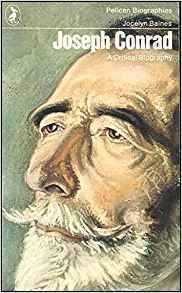
Joseph Conrad: A Critical Biography (1960) by JOCELYN BAINES
Unlike most literary biographers, Jocelyn Baines was not an academic as such. He was born in London in the same year that his one and only biographical subject died and worked for most of his professional life as an antiquarian bookseller, leaving that honourable profession for a brief stint as an editor at the English publishing firm of Longmans, Green. Although he read law at Oxford University and obtained an English degree, his study of Conrad's life –– the first major English biography of the novelist to appear in almost forty years –– is anything but donnish.
The book is divided into fourteen chapters, each of which is further subdivided into sections to facilitate the reading experience and ensure the presentation of facts never becomes so relentless that they can't be easily assimilated. While this may seem a trivial observation, it is not. Many literary biographies, particularly those which focus on towering figures like Conrad, can quickly become a drain on the reader's endurance, turning what should be a pleasurable and informative experience into a dull unedifying chore. Baines presents the facts of Conrad's life –– his birth in a section of Poland which had recently been annexed by Russia, the exile of his father for reasons of political expediency and the deaths of both his parents while he was still a young boy, his struggle to go to sea against the wishes of his autocratic uncle first in France and eventually in England, his gaining of his first (and only) maritime command and subsequent desertion of the sea for what became the even more uncertain career of professional writer –– in a clear straightforward manner, providing enough in the way of supplementary detail to convincingly recreate what, even by action-packed nineteenth and early twentieth century standards, was an extraordinarily rich and fascinating life.
Baines does this, in part, by including a generous selection of quotations drawn from the hundreds if not thousands of letters Conrad wrote throughout his life, including those composed in French to people like Marguerite Poradowska, the Polish-born Belgian novelist who was his maternal cousin by marriage and the woman, nine years his senior, whom he may have unsuccessfully proposed to before marrying Jessie George, eldest daughter of his London landlady, in March 1896. (Unfortunately, the letters written in French are untranslated, an oversight which should have been corrected in the reprinted edition of the book published in 1993.) By allowing Conrad to tell key parts of his own story in his own words, Baines provides the reader with unusually lucid insights into his subject's character, state of mind and literary preoccupations. He also has a gift for analysing Conrad's novels without becoming mired in esoteric academic language, of which his comments about Under Western Eyes should serve as a typically concise example:
There is a very successful attempt to present what Razumov [the novel's protagonist] thought … indeed, the characters in Under Western Eyes are more subtly and convincingly developed than those in any other of Conrad's novels. Razumov himself is the most considerable character that Conrad created; his thoughts, words, and actions reveal depths of personality which show that Conrad succeeded in identifying himself imaginatively with him.
While Joseph Conrad: A Critical Biography is not the most erudite book ever published about this great and still much studied novelist, it remains one of the more accessible in terms of style and length. It's also something practically never encountered in today's cut-throat and rapidly shrinking book market –– a reliable, uncondescending biography written for the non-specialist by a fellow (passionate and well-read) non-specialist that I would unhesitatingly recommend to anybody seeking to broaden their knowledge of Conrad's life as a means of acquiring a deeper understanding of his fiction.
Joseph Conrad: A Critical Biography is no longer in print.
 |
| Ecco Press, 1989 |
Joseph Conrad: A Personal Remembrance (1924) by FORD MADOX FORD
'He was small rather than large in height,' Ford Madox Ford states in the opening paragraph of the monograph he published about his friend and collaborator shortly after Conrad's death on 3 August 1924, '…very broad in the shoulder and long in the arm; dark in complexion with black hair and a clipped black beard. He had the gestures of a Frenchman who shrugs his shoulders frequently. When you had really secured his attention he would insert a monocle into his right eye and scrutinise your face from very near as a watchmaker looks into the works of a watch. He entered a room with his head held high, rather stiffly and with a haughty manner, moving his head once semicircularly. In this one movement he had expressed to himself the room and its contents; his haughtiness was due to his determination to master that room, not to dominate its occupants, his chief passion being the realisation of aspects of himself.' This is an astonishingly vivid description of Conrad the human being as opposed to Conrad the literary icon, entirely characteristic of Ford and what he set out to achieve in this short, affectionate, elegantly composed memoir.
Ford was the perfect person to write such a book, having collaborated with Conrad on three novels –– The Inheritors (1901), Romance (1903) and The Nature of a Crime (written in 1906 but published, like this memoir, in 1924) –– after being introduced to him in 1898 by Conrad's friend and literary advisor Edward Garnett. Theirs quickly became a mutually instructive friendship which naturally lent itself to collaboration and the perfecting of a literary technique that Conrad had dubbed 'progression d'effet' or, in English, progression of effect. 'In writing a novel,' Ford explains, 'we agreed that every word set on paper –– every word set on paper –– must carry the story forward and, that as the story progressed, the story must be carried forward faster and faster and with more and more intensity.' This method of writing, which became a core principle of what would come to be known as literary impressionism (and the modern spy and detective novel), is now considered to be one of Conrad's most essential contributions to Western literature –– a contribution it may have been impossible for him to make had he not met and worked so closely with the man he originally knew as Ford Madox Hueffer. (Ford changed his surname after World War One in an effort to re-invent himself following his military service in the trenches of France and the entirely understandable nervous breakdown he suffered as a result of that altogether horrific experience.)
Although their friendship was no longer as close by 1909 –– it became strained after they quarrelled about Conrad's contributions to The English Review, a new periodical Ford was at that time editing, and was further compromised by the affair the still-married Ford had recently begun with journalist Violet Hunt –– Ford's genuine affection for Conrad and his memories of the many hours they spent discussing the art and practise of writing at Pent Farm in rural Kent shines through on every page. It closes with a moving addendum, composed in (again untranslated) French, of Ford's thoughts written immediately after learning of Conrad's death that originally appeared in the Journal Littéraire on 26 August 1924.
As generous and laudatory as it is, Ford's memoir was vehemently disliked by the widow of his friend and former collaborator. Jessie Conrad –– who would go on to write several newspaper articles and two interesting if unreliable memoirs of her own about the husband whose genius she claimed not to have understood –– never warmed to Ford, whom she considered too bohemian in his outlook in addition to being a shameless exploiter of Conrad's overly generous nature. She publicly criticized Ford after his memoir appeared, going so far as to describe his reminiscences as 'detestable' to one Fleet Street journalist.
Personally, I think Mrs Conrad got it wrong. For all his faults, of which he possessed as many as the next person, Ford could not count insincerity or the failure to pay his friends due homage among them. A Personal Remembrance stands as an eloquent heartfelt tribute to a man he genuinely respected and admired and what they accomplished as novelists both individually and collectively.
Joseph Conrad: A Personal Remembrance may still be obtainable from your local library, bookstore or preferred online provider.
Joseph Conrad As I Knew Him (1927) and Joseph Conrad and His Circle (1935), both written by JESSIE CONRAD, are long out of print, as is Joseph Conrad: Times Remembered the better memoir by the writer's youngest son JOHN CONRAD published by the Cambridge University Press in 1981.
 |
| Farrar Straus Giroux first US edition, 1979 |
Joseph Conrad: The Three Lives (1979) by FREDERICK R KARL
It is hard to believe that this was only the third Conrad biography published since the writer's death, following the previously mentioned work by Jocelyn Baines and Gérard Jean-Aubry's Joseph Conrad: Life and Letters (1927) and Vie de Conrad (1947, translated ten years later as The Sea-Dreamer: A Definitive Biography of Joseph Conrad). What Baines lacked in detail and Jean-Aubry lacked in verisimilitude –– although he knew Conrad and translated much of his work into French, the Frenchman had a worrying tendency to extrapolate Conrad's fiction into his life and vice versa, making many of his claims and assumptions unreliable –– Frederick R Karl more than made up for in this massive tome, a book which remains one of the truly great literary biographies and a landmark of modern literary scholarship.
A critic of no small repute and a published novelist in his own right, Karl combines extensive research with a keen appreciation of Conrad's literary achievements and scrupulous analysis of his subject's novels, short stories, memoirs and even the three plays he wrote in his always urgent quest to obtain a steady source of income for his family. He depicts Conrad's life as a voyage of discovery divided into three distinct but overlapping phases ––
the young self-exiled Pole struggling to find a purpose and make his way in the world, the apprentice seaman who taught himself to speak and read English and rose through the ranks of the British merchant service to become master of the Otago in
1885 only to be denied the captaincy he undoubtedly deserved, and finally the writer who faced a different kind of
struggle to earn enough by his pen to support his ailing wife and sons.
Building upon what was unearthed by Conrad's previous biographers, Karl refutes many of their unsubstantiated claims (particularly those of Jean-Aubry) while confirming and elaborating on others, doing it all in a style that never patronizes the reader or becomes so academic as to become off-putting or tedious to read. He is refreshingly honest about the uneven quality of much of Conrad's later output, unafraid to state which, in his view, are his important works and which, like his last published novel The Rover (1923), would probably not have seen the light of day had their author not been so chronically strapped for cash throughout so much of his career.
The Three Lives was recognised as the masterpiece it is by many leading reviewers of the day, including Anthony Burgess who described it as '…a model of American scholarship in which not even the most recherché reference has gone unresearched. It tells the story of a very sad man, a hopeless warrior, and of the heroinism of a wife who… suffered not only in herself but for him.' There have, of course, been many other Conrad biographies published since 1979 but none, I dare to venture, that compare with Professor Karl's work in terms of erudition and sheer attention to detail.
Joseph Conrad: The Three Lives is no longer in print.
FREDERICK R KARL was the co-editor, with his colleague LAURENCE DAVIES, of The Collected Letters of Joseph Conrad which were published in nine volumes by the Cambridge University Press between 1983 and 2007.
 |
| Oxford University Press, 2000 |
Oxford Reader's Companion to Conrad (2000) by OWEN KNOWLES and GENE MOORE [editors]
This slim but densely packed book, first published in hardback by the Oxford University Press in 2000, is aptly named. Edited by two of the world's leading Conrad scholars, with contributions from four of their colleagues including Zdzislaw Najder who was Conrad's first Polish biographer, it delivers exactly what its title promises –– an easy to use, cross-referenced guide to its subject's life and career which provides effective short analyses of all his published works (no story, tale, novel, play or significant piece of journalism or non-fiction is omitted), including summaries of their plots, overviews of past and current critical responses along with many helpful suggestions for further reading.
This is the book I find myself automatically reaching for when I need further information regarding a particular point of Conrad's life or work. (This post would have been difficult to write without it.) It is informative, concise and helpfully separated into categories like 'Private Life and Attitudes,' 'Reputation' and 'Critical Approaches' which make it an indispensable research tool for the scholar and non-specialist alike. It also contains a well-structured chronology, a family tree and four maps of, respectively, Conrad's divided Poland, Conrad's Malay Archipelago (the setting for Lord Jim and much of his finest short fiction), the River Congo (the setting for The Heart of Darkness and a river he personally navigated in 1890 as first mate of the paddle steamer Roi des Belges) and his various Homes in southeast England. What more could any Conrad enthusiast reasonably expect from a reference book? This truly is a work designed for the so-called 'ordinary reader' (if there is such a thing), dating from a time before the internet became the preferred source of information not just about literature but about everything else on our factoid obsessed planet.
The Oxford Reader's Companion to Joseph Conrad may still be obtainable from your local library, bookstore or preferred online provider.
THE JOSEPH CONRAD SOCIETY is a UK-based organisation (with an allied branch in North America) devoted to 'the study of all
aspects of the writings and life of Joseph Conrad' that also aims to
'provide a forum and resource for Conrad scholars throughout the
world and those with a strong interest in things Conradian.'
You might also enjoy:
The Secret Agent: A Simple Tale (1907) by JOSEPH CONRAD
The Write Advice 118: JOSEPH CONRAD
A Call: The Tale of Two Passions (1910) by FORD MADOX FORD
Last updated 30 September 2021